Historical Background of AS 8s Movements
The story of A. Schild S.A. (commonly abbreviated as AS) is fundamentally intertwined with the golden age of Swiss horology. Founded in 1896 by Adolph Schild in the watchmaking hub of Grenchen, Switzerland, AS quickly grew into one of the largest and most influential ébauche manufacturers in the world. Long before the consolidation into Ebauches SA and later the Swatch Group, A. Schild produced millions of high-quality raw movements for hundreds of prestigious watch brands. Among their most notable early 20th-century outputs were their small-format pocket watch calibers, specifically those categorized around the 8-size (8s) American trade sizing or equivalent 13 to 15-ligne Swiss dimensions.
During the late Victorian and Edwardian eras, 8s movements were predominantly utilized in high-grade pendant watches, chatelaines, and compact men's dress pocket watches. These movements bridged the gap between the massive 18s and 16s railroad-grade pocket watch engines and the ultra-petite ladies' ring or cocktail watch calibers. With the outbreak of World War I, modern warfare demanded quick, hands-free time tracking, causing a sudden shift toward wrist-worn timepieces. The 8s platform became a natural candidate for early military wrist conversions and bespoke trench timepieces because its physical footprint provided an ideal balance between mainspring power reserve, movement durability, and wrist ergonomics.
Today, horologists and restoration specialists frequently turn to vintage AS 8s calibers as prime candidates for historical preservation projects. Understanding how to antique pocket watch conversions breathing new life into these historic ébauches requires a deep appreciation for AS architectural standards. These movements represent an era when bridge finishing, polished steel detents, and hand-trued balance wheels were standard even in mid-grade industrial production, making them exceptionally rewarding to restore and wear on the wrist.
Technical Specifications and Movement Architecture
Architecturally, the AS 8s movement is a classic example of turn-of-the-century Swiss movement layout. Most standard AS 8s calibers measure approximately 30mm to 33mm in movement plate diameter, featuring a height that generally ranges between 4.2mm and 5.0mm. They were typically manufactured in both Swiss bar bridge configurations—where individual bridges support the center wheel, third wheel, fourth wheel, and escape wheel—and traditional finger-bridge or three-quarter plate variations. The plates were constructed from high-grade brass, finished with frosted nickel plating or traditional damaskeening patterns, and held together by fire-blued or polished steel screws.
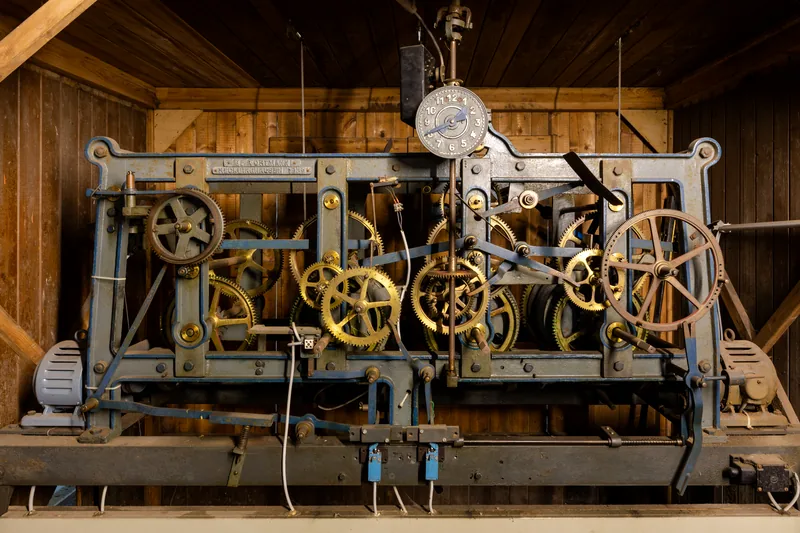
The escapement configuration inside an AS 8s caliber utilizes a straight-line Swiss lever system with cut, bimetallic balance wheels equipped with gold or brass timing screws. These balance assemblies operate at a traditional frequency of 18,000 vibrations per hour (2.5 Hz), suspended beneath a balance cock fitted with a steel index regulator. Higher-grade AS 8s variants feature 15 to 17 jewels, with rubies set into screwed chatterons or friction-set directly into the upper bridges and mainplate. The hairspring is typically a flat carbon steel spring, though elevated variants boast a Breguet overcoil for improved isochronism across various physical positions.
In terms of power delivery, the mainspring barrel in an AS 8s movement is engineered with a standard safety pinion or fixed arbor designed to protect the gear train in the event of a mainspring break. Depending on whether the movement was engineered as a Lépine (open-face) or Savonnette (hunter-case) design, the crown wheel and ratchet wheel interact directly with a winding click mounted on the barrel bridge. The center wheel wheel pinions, third wheel, fourth wheel, and steel escape wheel drive the motion work, providing a smooth torque transfer across a 36-to-38-hour power reserve when fully wound.
Challenges of Converting AS 8s to Wristwatch
When clients ask "can you convert as 8s pocket watch movements into a wrist watch," the initial answer is always yes—provided the watchmaker is prepared to overcome significant mechanical hurdles. The primary challenge lies in the fundamental difference between pocket watch setting mechanisms and modern wristwatch crown systems. Many vintage AS 8s movements utilize a "negative set" or sleeve-set mechanism, where the detent mechanism (which holds the stem in winding or setting position) resides inside the pocket watch case neck rather than within the movement itself. When removed from its original case, the movement loses its setting friction and will default strictly to winding mode or fail to lock into place.
Another major structural obstacle is dial and sub-seconds orientation. In a Lépine (open-face) 8s movement, the winding stem is located at the 12 o'clock position while the sub-seconds dial rests at 6 o'clock. If you simply rotate this movement inside a modern wristwatch case so the crown resides at 3 o'clock, your sub-seconds subdial shifts awkwardly to the 9 o'clock position. Conversely, a Savonnette (hunter) movement naturally positions the winding stem at 3 o'clock and the sub-seconds at 6 o'clock, making hunter movements much easier to convert into traditional wristwatch dial layouts without compromising visual geometry.
Finally, shock protection presents an ongoing operational hazard for converted AS 8s watches. Manufactured decades before the invention of Incabloc or Novodiac shock-absorbing systems, the balance pivots on an AS 8s movement measure a mere fraction of a millimeter in diameter and are resting directly against solid jewel caps. A sudden impact, drop, or severe modern vibration can instantly snap or bend an unshocked balance staff pivot. Converting these timepieces requires meticulous care during daily wear or the inclusion of modern custom casing rings designed to dampen kinetic shocks.
Lug Welding and Case Selection
Selecting or manufacturing the ideal as 8s pocket watch to wrist conversion case is the critical defining step in any successful build. Because an AS 8s movement features an approximate 32mm movement diameter, putting it into a custom case results in a finished watch measuring between 38mm and 40mm in overall exterior diameter. This dimensional profile sits squarely in the sweet spot for modern wrist proportions, avoiding the oversized "puck-like" appearance of 16s or 18s conversions while preserving the dramatic vintage pocket watch wrist presence.
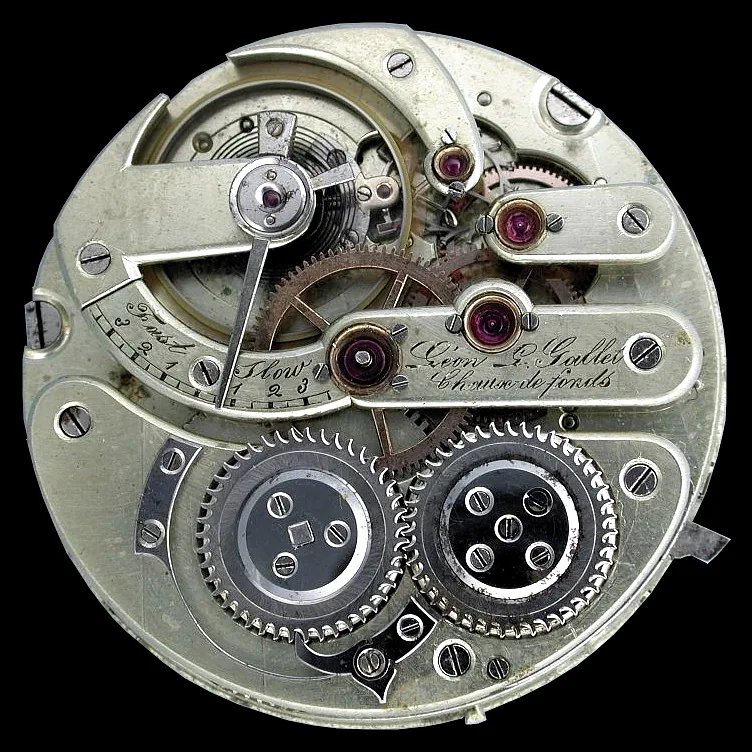
Watchmakers generally choose between two distinct casing methodologies: sourcing a purpose-built modern stainless steel conversion case or modifying an original vintage pocket watch case. When utilizing a purpose-built modern 316L stainless steel conversion case, a custom movement adapter ring (casing spacer) must be turned on a watchmaker's lathe. This ring bridges the exact tolerance gap between the AS 8s mainplate circumference and the interior case wall, featuring precise cutouts for movement clamps (casing dogs) and internal stem clearance.
For those aiming for historical accuracy resembling authentic WW1 trench watches, modifying an original sterling silver, nickel, or gold-filled pocket watch case is preferred. This traditional technique involves removing the original pocket watch bow and silver-soldering or micro-TIG welding custom wire lugs directly onto the case middle (band) at 12 o'clock and 6 o'clock. The heat applied during lug welding must be strictly controlled to avoid warping the case geometry or melting delicate bezel threads. Once welded, the case band is polished, re-threaded, and fitted with fixed wire bars or custom drilled spring bar holes.
Crown and Stem Solutions
Resolving the winding stem and crown mechanics is where master-level watchmaking skills are truly put to the test during an AS 8s conversion. Because original pocket watch stems were tailored to specific case neck dimensions, a conversion almost always requires manufacturing a brand-new custom winding stem or extending and re-threading the original stem arbor. The stem square—the squared portion of the steel stem that slides inside the clutch wheel—must be precision-ground to fit the AS 8s winding pinion tolerances perfectly without binding or excessive radial play.
If the target AS 8s movement is a pin-set (nail-set) movement, setting the time requires depressing a small push-pin located adjacent to the crown stem hole on the case perimeter while turning the crown. In these instances, the conversion case must be precisely drilled and fitted with a spring-loaded pusher pin that aligns perfectly with the pin-set rocker arm on the mainplate. If the caliber is a lever-set movement, an internal slot must be cut into the case wall or bezel ring to allow the setting lever to extend fully outward for time setting.
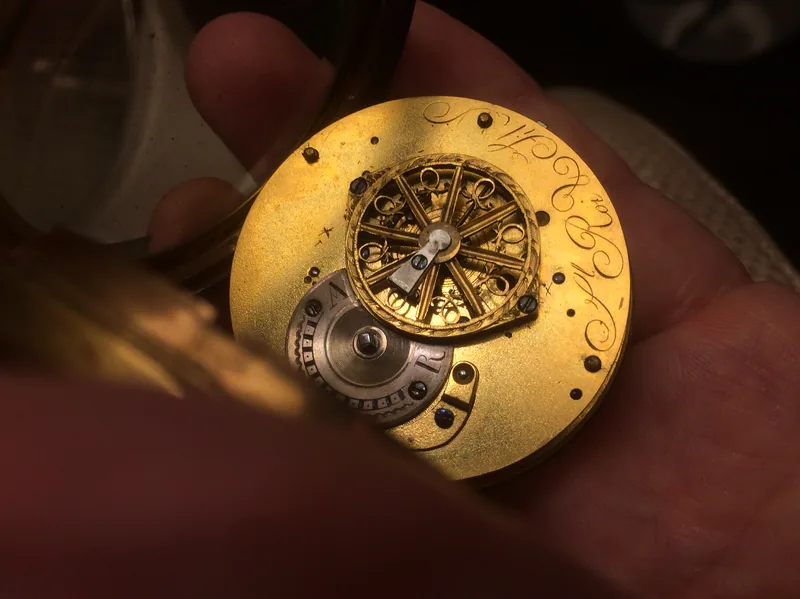
When selecting a crown to finish the build, horologists generally opt for oversized onion, pumpkin, or cabochon style crowns that mirror early 20th-century aesthetic codes. Beyond aesthetics, the interior of the crown stem tube must be fitted with custom rubber gaskets or silicone grease wells to provide splash and dust protection. Because antique pocket watch movements possess no inherent dust seals around the winding arbor, establishing a tight seal between the crown body and the conversion case tube is essential to prevent moisture ingress from ruining the freshly serviced movement.
Dial and Hand Considerations
The dial of an AS 8s movement is often a work of artistic mastery, typically constructed from vitreous double-sunk enamel (fired porcelain) or silvered brass with hand-painted numerals. Vitreous enamel dials are virtually immune to fading or UV discoloration, but they are exceptionally brittle. During the process to convert as 8s pocket watch into wristwatch configurations, extreme care must be taken when removing and reinstalling the dial. Chipping an enamel dial near the dial feet or center hole can create spider web stress cracks that permanently ruin the historic aesthetic.
Connecting the original dial to the new casing orientation frequently requires relocating the copper dial feet on the reverse side of the dial base plate. Because soldering heat would immediately fracture a vitreous enamel top layer, traditional heat soldering cannot be used. Instead, watchmakers utilize specialized cold-welding conductive epoxies or precision dial-foot milling techniques, or they engineer custom brass clamping rings that hold the outer perimeter of the dial firmly against the case rehaut without modifying the original dial structure.
Hand fitting presents its own unique set of dimensional challenges. The center wheel arbor, cannon pinion, hour wheel pipe, and fourth wheel sub-seconds pivot diameters on vintage AS 8s movements vary widely depending on the production run year. Original blued steel hands—such as Spade, Cathedral, Poire, or Breguet-style hands—should be restored, cleaned, and re-blued using traditional heat-pan methods. If original hands are missing or damaged, modern hands must be carefully broached or closed on a staking tool to achieve the exact fraction-of-a-millimeter hole fit required for the vintage arbors.
Why 8s is More Common for Conversion
In the vast landscape of horological conversions, the 8s pocket watch platform stands out as by far the most practical, elegant, and mechanically viable candidate for wrist wear. Larger American pocket watch sizes, such as 16-size (approx. 43mm movement) or 18-size (approx. 45mm movement), result in completed conversion watches measuring an astounding 48mm to 52mm across the wrist. While these large builds have a niche steampunk appeal, they are fundamentally uncomfortable, top-heavy, and highly prone to snagging or heavy impacts during daily activities.
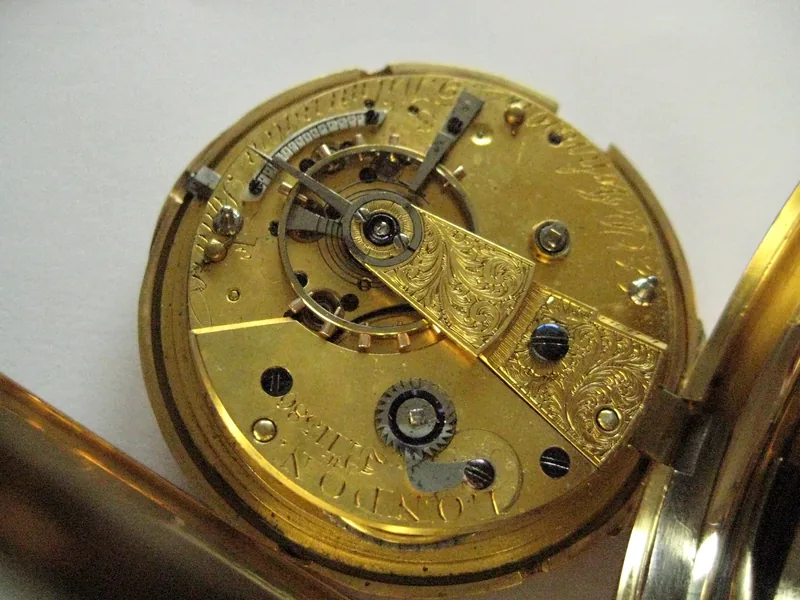
The 8-size movement, by contrast, sits in the technical sweet spot. With a mainplate footprint measuring roughly 30mm to 33mm, the resulting converted watch wears virtually identically to modern luxury sports timepieces and vintage military watches. The proportions allow for a refined dial composition that remains highly legible while fitting comfortably under a dress shirt cuff. Furthermore, the higher mass of an 8s movement compared to modern tiny wristwatch calibers provides enhanced mechanical stability, thicker gear teeth, and stronger mainspring torque, translating to robust timekeeping performance when properly adjusted.
Another major reason 8s calibers—especially those manufactured by A. Schild—are so heavily favored is their relative historical abundance and component interchangeability. Because AS produced these movement ebauches in enormous quantities for global export, finding donor parts, balance shafts, winding pinions, and mainsprings is significantly easier than sourcing components for rare or high-complication boutique pocket watches. Collectors frequently draw parallels between these meticulously converted AS timepieces and classic vintage Rolex wristwatches of the 1920s and 30s, which frequently employed similar high-grade Swiss ebauches inside early officer and cushion cases.
Final Thoughts on AS 8s Conversions
Converting a historical AS 8s pocket watch movement into a fully functional, wearable wristwatch is a masterclass in modern horological restoration. It is a delicate marriage between honoring historic Swiss mechanical engineering and applying contemporary machining, case fitting, and sealing techniques. When executed correctly, a converted AS 8s timepiece is not merely a custom watch; it is a living piece of early 20th-century history revived for a second lifetime of wrist-worn service.
For watchmakers and collectors alike, the journey to convert as 8s pocket watch into wristwatch builds demands patience, technical expertise, and absolute respect for the original artifact. From custom-fabricating stem arbors and engineering casing spacers to preserving delicate hand-fired enamel dials, every step in the process requires meticulous attention to detail. The end result is an extraordinary timepiece—a unique bridge between past and present that showcases the timeless durability of A. Schild's legendary Swiss movements.