1. Historical Background of Elgin 10s Movements
The Elgin National Watch Company, established in 1864 in Elgin, Illinois, stood as one of the titanic pillars of American industrial horology. Over its century of operation, Elgin manufactured over 60 million timepieces, mastering the precision assembly line method that democratized accurate timekeeping across North America. While the 19th century was dominated by large, heavy pocket watches such as the 18-size and 16-size models designed for railroad conductors and industrial timekeeping, the dawn of the 20th century brought a shift toward slimness, elegance, and portability. By the 1910s and 1920s, the 10-size (10s) movement emerged as a premier standard for refined dress pocket watches.
Elgin produced a vast array of 10s calibers across various grade numbers, including the renowned Grade 315, 303, 345, 454, and the higher-jeweled Lord Elgin series. These movements were engineered during an era when decorative watchmaking reached its aesthetic peak in America. Craftsmen applied intricate nickel damaskeening (radial, sunburst, or wave patterning), gold-flashed wheel trains, raised gold jewel settings (chatons), and blued steel screws. These movements were built to last generations, utilizing high-grade nickel-silver plates and hardened steel pinions that exhibit minimal wear even a century later.
Today, thousands of pristine Elgin 10s movements survive in antique markets, antique shops, and watchmakers' drawers, often stripped of their original solid gold or silver cases during historical metal scrap drives. This historical surplus provides modern horologists with a remarkable opportunity: to rescue orphaned American movement masterpieces and house them inside modern wristwear. When you convert elgin 10s pocket watch into wristwatch configurations, you are not merely re-casing a mechanism; you are re-imagining a piece of early 20th-century American mechanical art for the modern wrist.
2. Technical Specifications and Movement Architecture
To successfully convert elgin 10s pocket watch into wristwatch designs, a watchmaker must thoroughly understand the dimensional standard and architecture of the 10-size movement. Under the traditional American Lancashire watch gauge system, sizing is derived from a base diameter of 1 and 5/30 inches (size 0s), with each incremental size adding 1/30 of an inch. A standard Elgin 10s movement features a pillar plate diameter of precisely 1.500 inches, or 38.10 mm. This dimensional footprint is critical because it places the movement squarely in the ideal sizing sweet-spot for contemporary wristwear.
Architecturally, Elgin 10s movements are classically laid out with a spring barrel powering a four-wheel train (great wheel, center wheel, third wheel, and fourth wheel) driving an escape wheel and lever escapement. Most 10s movements operate at a traditional beat frequency of 18,000 vibrations per hour (vph) or 2.5 Hz, yielding a smooth, measured tick. Higher-tier Elgin 10s grades incorporate expansion balances with bimetallic steel-and-brass rims, cut balance wheels with heavy gold timing screws, and temperature-compensating Breguet hairsprings with terminal curves designed for optimal isochronism.
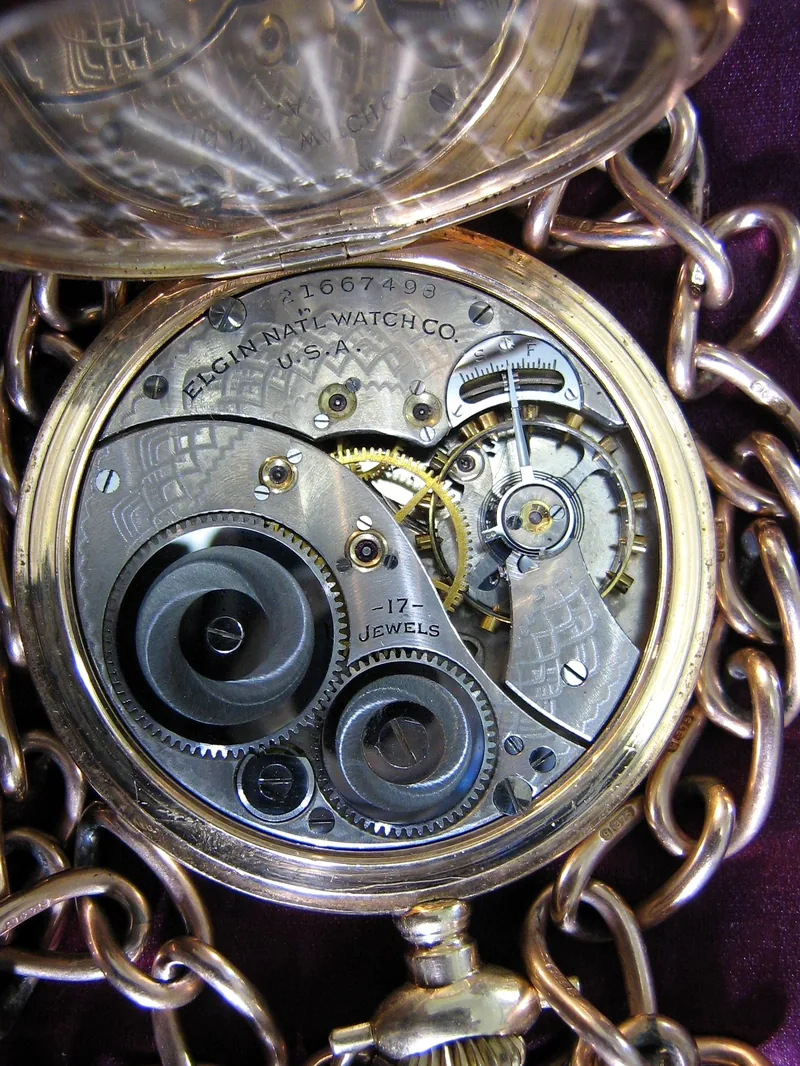
Jewel counts in Elgin 10s movements generally range from 7 jewels in base utility grades up to 17, 19, or 21 jewels in high-grade dress movements. Higher jewel counts feature ruby or sapphire jewels set in threaded or friction-set brass/gold chatons protecting the balance staff, lever pivots, escape arbors, and wheel train pivots. Understanding whether your movement is a "hunting movement" (stem at 3 o'clock relative to sub-seconds at 6 o'clock) or an "open-face movement" (stem at 12 o'clock relative to sub-seconds at 6 o'clock) dictates the architecture of the conversion and the resulting dial layout.
3. Challenges of Converting Elgin 10s to Wristwatch
Prospective customizers frequently ask: can you convert elgin 10s pocket watch movements without sacrificing horological integrity or functional reliability? The answer is yes, but the endeavor presents distinct engineering hurdles that require specialized watchmaking techniques. The primary challenge stems from dial alignment and stem orientation. Most Elgin 10s pocket watches were produced in open-face configurations, placing the crown at 12 o'clock and the running sub-seconds hand at 6 o'clock. When re-casing an open-face movement into a modern wristwatch case with a 3 o'clock stem, the dial rotates 90 degrees, shifting the sub-seconds subdial to the 9 o'clock position. While this creates a handsome pilot-style layout, it requires either a re-printed custom dial or acceptance of the off-axis original dial layout.
Another major technical challenge revolves around shock protection. Antique Elgin 10s balance staffs are suspended between fixed ruby jewel bearings without modern spring-loaded shock absorbers like Incabloc or KIF systems. The balance staff pivots on an Elgin 10s movement are microscopic—often measuring between 0.07mm and 0.10mm in diameter. Because wristwatches endure far higher dynamic forces, impacts, and wrist motions than pocket watches kept safe in a vest pocket, an unsheathed vintage balance staff is vulnerable to snapping if dropped or knocked against a hard surface. Watchmakers must ensure perfect endshake and sideshake adjustments, pristine pivot burnishing, and advise owners on proper wear habits.
Finally, environmental sealing presents an obstacle. Original pocket watch cases relied on snap-fit or screw-down bezels and open stem tubes designed for pocket transport. Modern wristwatches, conversely, require dust, sweat, and moisture protection. Finding or fabricating an elgin 10s pocket watch to wrist conversion case that incorporates modern rubber O-ring gaskets, a sealed crown tube, and adequate axial clearance for the elevated center wheel height demands precise calculations and custom movement ring fitment.
4. Lug Welding and Case Selection
Selecting or fabricating the proper case is the cornerstone of any pocket watch conversion project. Historically, early conversions—such as World War I trench watches—were made by taking existing pocket watch cases and silver-soldering wire lugs directly to the exterior frame at the 12 o'clock and 6 o'clock positions. While this vintage technique preserves the movement's original housing, modern horologists usually prefer purpose-built modern conversion cases machined from solid 316L stainless steel, titanium, or brass.
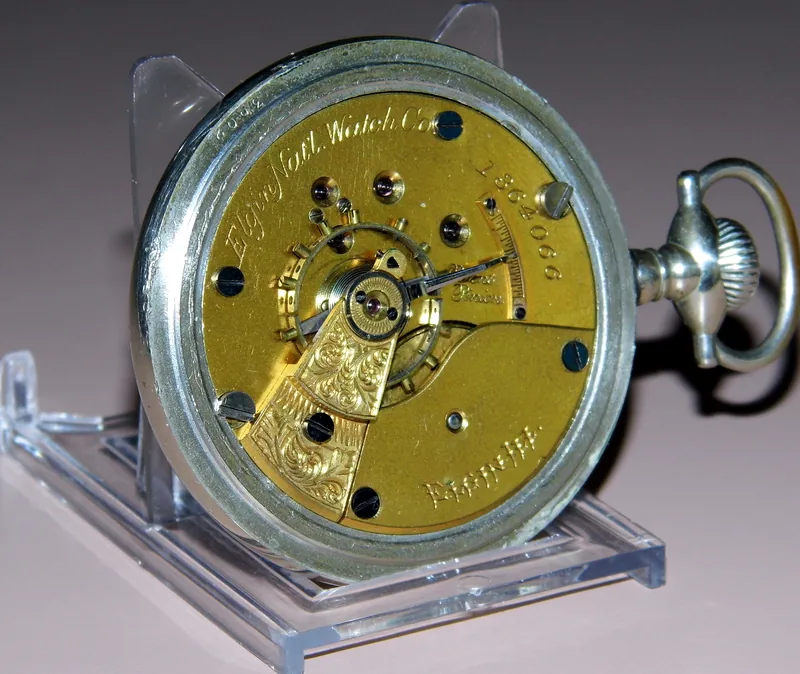
When searching for a dedicated elgin 10s pocket watch to wrist conversion case, key internal dimensions must be verified. The primary casing chamber must accommodate the 38.10 mm movement diameter, plus allowance for a custom movement adapter ring. Adapter rings are usually turned on a micro-lathe from brass or aluminum, engineered to fit the exact lip contour of the Elgin pillar plate. Securing tabs or casing screws are then utilized to clamp the movement securely into the ring, eliminating any lateral or rotational movement inside the case housing.
Lug design on conversion cases significantly impacts wearability. Because a 10s movement measures 38.10 mm on its own, the external case diameter usually ranges from 41 mm to 44 mm. To keep a watch of this diameter comfortable on an average wrist, cases with short, downward-curved (drilled) lugs or wire-style swing lugs are highly recommended. Furthermore, choosing a case equipped with a sapphire front crystal and an exhibition display back allows the owner to admire the elaborate nickel damaskeening and ticking balance assembly of the historic Elgin caliber inside.
5. Crown and Stem Solutions
One of the most intricate technical aspects when you convert elgin 10s pocket watch into wristwatch format involves resolving stem geometry and setting mechanisms. Most vintage Elgin pocket watches utilize what horologists call a "negative setting" or "pendant setting" system. In a negative setting mechanism, the catch spring and setting mechanism are actually located inside the neck of the pocket watch case rather than inside the movement itself. The winding stem is square-profiled or slotted at its terminus, requiring a spring sleeve in the case to hold the stem in either the winding or hand-setting position.
Modern wristwatch conversion cases, however, are built for "positive setting" movements, where the pull-out setting mechanism (yoke, setting lever, and clutch wheel) is fully integrated into the keyless works on the dial side of the movement. To bridge this divide, a master watchmaker must analyze the specific Elgin 10s grade being converted. Certain late-era Elgin 10s movements feature built-in positive setting keyless works, making them direct candidates for a standard threaded winding stem. For negative setting calibers, the watchmaker must either install a specialized converted stem featuring a built-in sleeve spring or retrofit a custom stem tube assembly into the new wristwatch case neck.
Thread matching requires equal attention to detail. Vintage American stems do not use modern metric stem tap threads (such as Tap 9 / 0.90mm or Tap 10 / 1.00mm). Vintage Elgin stems typically feature proprietary imperial thread sizes. To fit a modern vintage-style crown—such as a large onion, pumpkin, or diamond pocket-watch style crown—to an Elgin stem, the watchmaker often turns a stem adapter on the lathe or carefully re-threads the stem arbor to match the crown tap. Proper stem length is imperative: if cut too long, the crown will not sit flush against the case gasket; if cut too short, the keyless works will fail to engage the setting clutch properly.
6. Dial and Hand Considerations
The dial and hands are the visual focal point of any wrist conversion, bridging antique artistry with modern functionality. Original Elgin 10s dials were produced in two primary materials: single-sunk or double-sunk fire-enameled white porcelain, or silvered metal dials with painted or raised gold numerals. Fire-enameled porcelain dials are breathtakingly beautiful and resistant to fading, but they are exceptionally brittle. Removing dial foot screws or modifying a century-old porcelain dial carries a high risk of spiderweb fracturing or chipping around the center hole and sub-seconds hole.
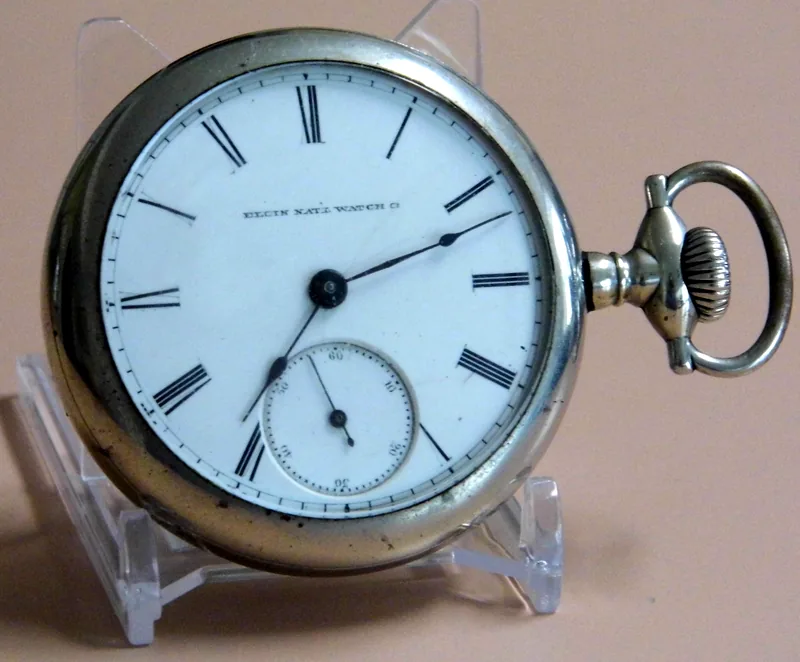
If utilizing an original dial, the watchmaker must account for dial foot placement. Dial feet on vintage Elgin movements were positioned to lock into set-screws located along the edge of the pillar plate. If mounting the movement into a new conversion case forces a 90-degree shift in stem orientation, the dial feet must be meticulously unsoldered using low-temperature micro-soldering tools, re-indexed, and re-soldered without scorch-marking the front enamel. Alternatively, custom brass replacement dials can be custom-milled, engine-turned, or hand-engraved to create a bespoke aesthetic that highlights the vintage movement inside.
Hand clearance and sizing present the final mechanical hurdle in this area. Hand posts on vintage pocket watches are significantly larger than modern ETA or Seiko hand standards. The hour wheel arbor, cannon pinion, and fourth wheel sub-seconds pivot diameters on an Elgin 10s require hand hole dimensions that match historical American specifications:
* **Hour Hand Hole:** Typically ~1.75 mm to 1.85 mm * **Minute Hand Hole:** Typically ~1.00 mm to 1.15 mm * **Sub-Seconds Hand Hole:** Typically ~0.22 mm to 0.28 mmWatchmakers must either re-boss and broach original blued-steel spade, cathedral, or Breguet hands to clear the internal crystal height of the modern conversion case, or custom-turn new modern hands on a lathe to fit the Elgin arbor diameters precisely.
7. Why 10s is More Common for Conversion
While watchmakers convert various sizes of pocket movements—ranging from massive 18-size railroad grade giants down to tiny 0-size pendant watches—the 10-size Elgin movement has earned a reputation as the "Goldilocks" platform for modern conversions. To understand why, one must look closely at wrist ergonomics and movement dimensions across standard American watch sizes:
* **18-Size (44.86 mm movement):** Requires a case outer diameter of 48 mm to 52 mm. On the average wrist, this creates an uncomfortably massive "wall-clock" profile that easily catches on sleeves and impacts door frames. * **16-Size (43.18 mm movement):** Yields a finished watch of 46 mm to 48 mm. While wearable for those with larger wrists, it remains heavy and top-heavy for everyday wear. * **12-Size (39.79 mm movement):** Yields a finished watch of 43 mm to 45 mm. Very popular, but can still present thickness and mass challenges depending on plate construction. * **10-Size (38.10 mm movement):** Yields a finished watch of 41 mm to 43 mm. This matches modern luxury sports and tool watch dimensions perfectly, distributing weight evenly across the wrist while maintaining high legibility.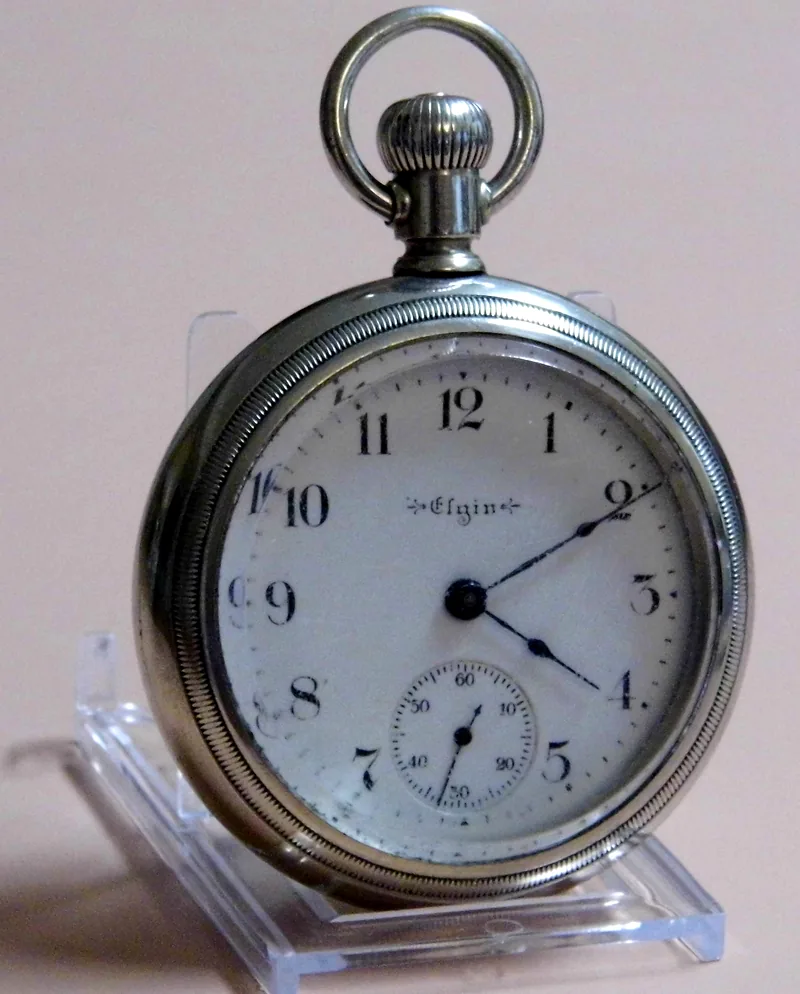
In addition to ideal proportions, the sheer availability of high-quality Elgin 10s movements makes them an attractive candidate. Millions were manufactured between 1900 and 1940, meaning high-jewel, beautifully finished movements can still be sourced at reasonable prices. Furthermore, spare balance staffs, mainsprings, setting parts, and jewel settings for Elgin 10s calibers remain widely available through horological supply houses and donor movements, ensuring that a converted watch can be maintained and serviced by a skilled watchmaker for decades to come.
8. Final Thoughts on Elgin 10s Conversions
The technical art required to convert elgin 10s pocket watch into wristwatch builds represents a harmonious intersection between historical preservation and practical horology. Rather than letting magnificent, hand-finished American mechanical artifacts sit forgotten in drawers or suffer the melting pot for their precious metal content, conversion horology gives these historical movements a second life. A properly executed Elgin 10s conversion transforms a displaced piece of 20th-century industrial history into a daily-wearable conversation piece.
However, owning and wearing a converted Elgin 10s requires an appreciation for vintage mechanical care. Because these movements lack modern synthetic shockproofing systems and rubber case seals of early waterproof watches, they must be treated with respectful care. Owners should avoid exposing converted timepieces to heavy sports, water immersion, or high-impact activities. Regular cleaning, oiling, and adjusting (COA) every 3 to 5 years using modern synthetic horological lubricants will ensure the wheel train runs smoothly and pivot wear is minimized.
Ultimately, when you look down at your wrist and see the balance wheel of a 100-year-old Elgin 10s movement oscillating at a steady 18,000 beats per hour beneath a sapphire crystal, you are connected to the gold standard of American industrial manufacturing. By combining careful case selection, precise stem customizer work, and thoughtful dial styling, the modern horologist ensures that the legacy of Elgin's master craftsmen continues to tick reliably into the 21st century and beyond.