1. Historical Background of Elgin 12L Movements
The Elgin National Watch Company, established in 1864 in Elgin, Illinois, stood as a titan of American industrial watchmaking for over a century. By the early 20th century, Elgin produced millions of precision timepieces, pioneering mechanized, interchangeable mass manufacturing while maintaining exceptional horological standards. While larger 18-size and 16-size pocket watches dominated the late 19th-century railroad and industrial markets, the introduction of the 12-size (12s or 12L) caliber in the 1910s marked a dramatic shift toward sleeker, more refined gent's timepieces. These movements powered elegant dress pocket watches worn in vest pockets throughout the roaring twenties and the Great Depression.
As wristwatches began gaining traction during World War I—prompted by officers fashioning temporary wrist mounts for utility—the demand for smaller timepieces accelerated. If you examine authentic WW1 trench watches, you will see the earliest evolutionary bridge between pocket movements and dedicated wristlet calibers. However, standard civilian 12-size pocket watches remained purely pocket-bound throughout their original production run. Today, as traditional pocket watch wear has diminished, these high-grade Elgin 12L calibers—such as the famous Grade 303, 315, 345, and late-era Lord Elgin variants—have become premier candidates for custom conversions, breathing new life into classic American engineering.
To successfully convert elgin 12L pocket watch into wristwatch configurations, a watchmaker must understand the historical design intent behind these movements. They were built during the pinnacle of American damaskeening, featuring high-grade nickel plates, gold jewel chatons, temperature-compensated balance wheels, and micro-metric regulator assemblies. Transforming an antique movement that was engineered to rest vertically in a vest pocket into a piece capable of surviving modern daily wear on a wrist requires deep technical respect for its historical architecture.
2. Technical Specifications and Movement Architecture
The technical architecture of the Elgin 12-size movement adheres to the standard American watch sizing scale. In American measurement, a 0-size movement has a baseline plate diameter of 1 5/6 inches (35.56 mm), with each increment in size adding 1/30th of an inch. A standard Elgin 12-size pillar plate measures approximately 1.500 inches (38.10 mm) in diameter, though minor variations exist across different manufacturing runs and plate cuts. These movements were produced in both open-face (stem at 12 o'clock) and hunting-case (stem at 3 o'clock) orientations, featuring either 3/4 plate, split-bridge, or streamlined bridge layouts.
Mechanically, high-grade Elgin 12L movements incorporate lever escapements, train wheels made of hard-drawn brass or beryllium copper, and balance assemblies suspended on polished steel balance staffs. Jewel counts range from entry-level 7-jewel configurations up to fully adjusted 17, 19, or 21-jewel movements equipped with ruby and sapphire jewels set in screw-down chatons. The balance springs are typically blued steel Breguet overcoils, engineered to maintain isochronism across varied temperatures and positions. The gear train operates at a traditional frequency of 18,000 vibrations per hour (2.5 Hz), giving these movements their iconic, deliberate ticking cadence.
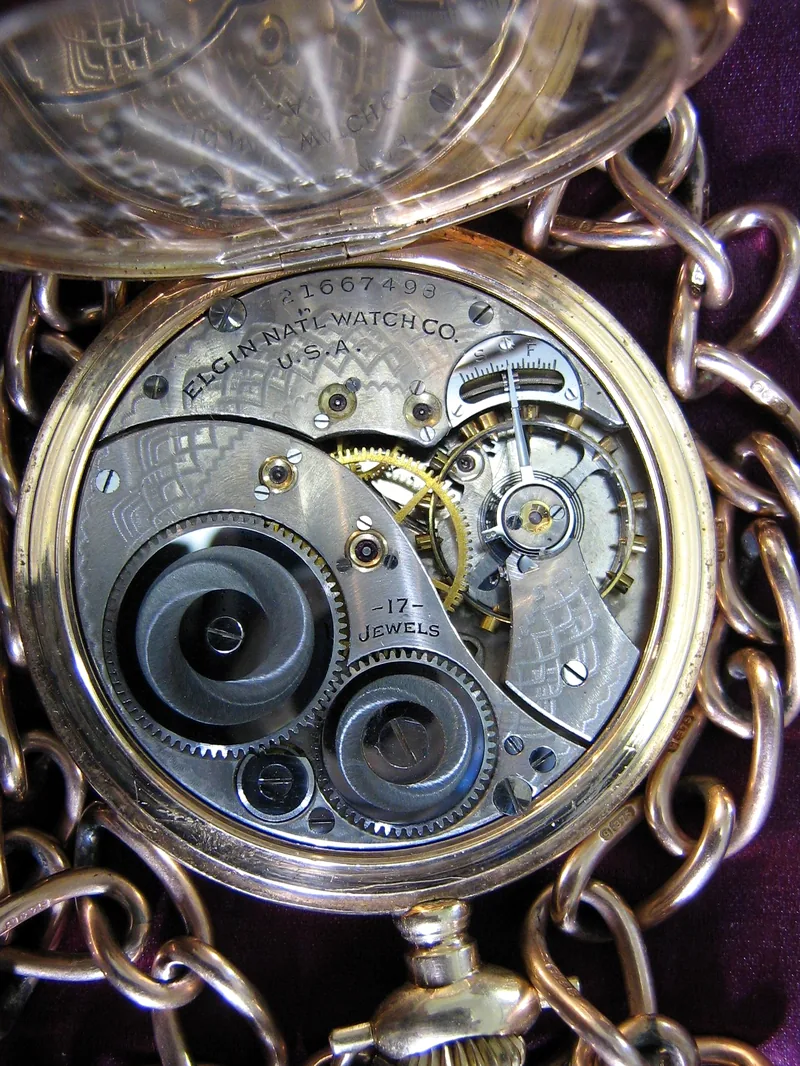
When assessing a caliber for an elgin 12L pocket watch to wrist conversion, the watchmaker must evaluate the keyless works architecture. Elgin 12s movements primarily utilize a negative setting system—a hallmark of traditional American pocket watches—where the setting mechanism (the clutch and setting spring) resides within the pocket watch case neck rather than on the movement plate itself. Understanding this mechanical distinction is critical before attempting any recasing procedure, as modern wrist cases are designed exclusively for positive-setting movement stems.
3. Challenges of Converting Elgin 12L to Wristwatch
The primary engineering hurdle when you decide to convert elgin 12L pocket watch movements into wearable wristwatches lies in shock protection. Antique pocket watch balance staffs feature extremely thin pivots—often measuring just 0.08mm to 0.12mm in diameter—unsupported by modern shock-absorbing jewel settings like Incabloc or Novodiac. When worn on the wrist, a movement is subject to rapid angular acceleration, accidental impacts, and vibrations that never occurred inside a soft vest pocket. Without careful handling and custom shock management, a sudden knock can easily shear off a balance pivot, necessitating custom lathe work to turn a new balance staff.
The second major challenge concerns layout orientation. Most accessible Elgin 12L movements are open-face configurations (pendant at 12 o'clock, sub-seconds dial at 6 o'clock). If an open-face movement is installed into a standard wristwatch case with the winding stem placed at 3 o'clock, the entire dial rotates 90 degrees clockwise. This shifts the 12 o'clock mark to the 3 o'clock position and moves the small seconds sub-dial to the 9 o'clock position. To achieve a traditional wristwatch layout with 12 at the top and sub-seconds at 6 o'clock, the horologist must either source a rare hunter-case caliber (stem at 3, sub-seconds at 6) or design a custom-printed dial layout that reorients the hour markers relative to the movement's fixed feet locations.
Finally, environmental sealing presents a constant threat. Original pocket watch cases relied on snap-on or screw-off bezels with minimal dust seals, entirely devoid of rubber gaskets. Antique nickel movement bridges and untreated steel train pinions will corrode rapidly if exposed to modern wrist humidity, sweat, or rain. The watchmaker must engineer modern sealing barriers into the custom wristwatch case, including stem O-rings, sapphire crystal gaskets, and screw-down case backs, to shield the exposed 100-year-old steel and brass components from ambient moisture.
4. Lug Welding and Case Selection
Selecting or fabricating the correct housing is arguably the most decisive phase of the project. Watchmakers generally choose between two distinct routes: fabricating wire lugs onto an original, modified pocket watch case, or installing the movement into a modern CNC-machined stainless steel conversion case. The best case size for elgin 12L conversion projects generally ranges between 42mm and 44mm in outer diameter. Given that the bare 12-size Elgin movement measures 38.10mm, a 42mm to 44mm case provides the ideal internal wall clearance to accommodate a custom brass movement ring while keeping wrist proportions balanced and wearable.
If opting for modern conversion cases, a custom movement retention ring (casing ring) must be machined on a precision lathe. The outer dimension of the ring matches the internal step of the case, while the inner diameter is turned to fit the exact lip profile of the Elgin 12L pillar plate. The ring is typically turned from free-cutting brass or 316L stainless steel and features threaded relief cuts for movement tab clamps. This ring serves a dual purpose: securing the movement laterally and radially, and acting as a kinetic dampener to absorb wrist impacts before they reach the delicate balance pivots.
For purists desiring an authentic vintage aesthetic, silver or stainless steel wire lugs can be micro-welded or silver-soldered directly onto a period-correct 12-size pocket watch case. This method preserves the original case metal, engravings, and pocket watch character. However, TIG (Tungsten Inert Gas) or laser welding is strictly required to prevent heat transfer from warping the thin case walls or annealing crystal retention lips. Once welded, the lugs are hand-filed, blended, and polished to match the surrounding contour before fixed or spring-bar strap attachments are installed.
5. Crown and Stem Solutions
As highlighted previously, the native Elgin 12-size keyless works operate on a negative-setting mechanism. In a standard pocket watch setup, a sleeve inside the case pendant holds the winding arbor in the setting position by default. Pressing the crown down forces the stem inward against a sleeve spring, engaging the winding pinion. Conversely, modern wristwatch cases utilize positive setting: the winding stem is fixed directly into the movement's setting works, pulled outward by the wearer to engage the setting wheel, and pushed inward to engage the winding mechanism.
To overcome this incompatibility, the watchmaker has two options. The first is sourcing or machining a specialized positive-to-negative stem conversion adapter. This involves turning a steel stem extension on a watchmaker's lathe (such as a Levin or Bergeon lathe) that incorporates an internal spring-loaded plunger. This custom stem bridges the gap between the modern crown stem thread (typically Tap 9 or Tap 10) and the square winding arbor profile of the Elgin 12L pillar plate.
The second technique involves modifying the movement's internal setting works to convert the system to positive engagement. This requires custom filing of the setting lever detent and fitting a modified clutch wheel. Browse through our specialized collection of antique pocket watch conversions to observe how various mechanical adaptations preserve winding friction and setting feedback. Regardless of the chosen path, the finished stem must align perfectly with the case pendant's central axis. Even a 0.05mm angular misalignment will create lateral pressure on the winding arbor, causing uneven winding resistance, rapid wear on the brass pillar plate stem bore, and potential stem shearing over time.
6. Dial and Hand Considerations
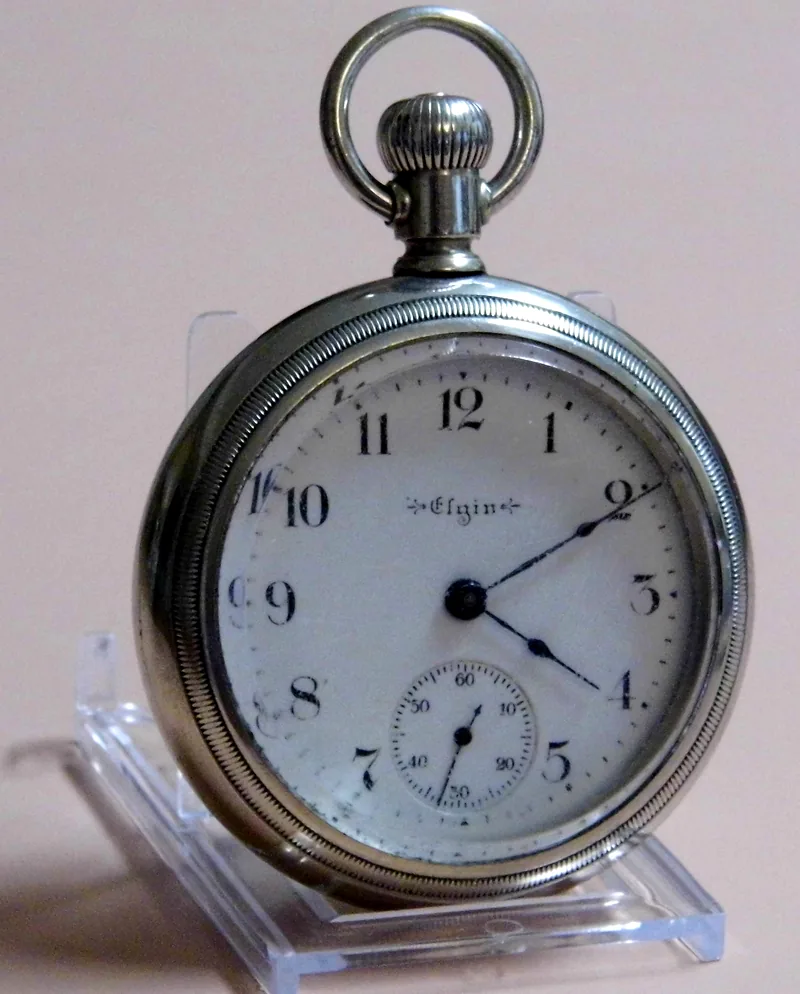
The aesthetic center of any wristwatch conversion is its dial and hand assembly. Original Elgin 12s pocket watches predominantly featured either grand feu enamel dials or silvered/gilded metal dials with painted enamel numerals. Grand feu enamel dials are prized for their resistance to fading, but they are exceptionally brittle. Attempting to drill new dial foot holes or bend existing feet on an antique enamel dial will instantly shatter the glass layer, causing spiderweb cracking across the surface.
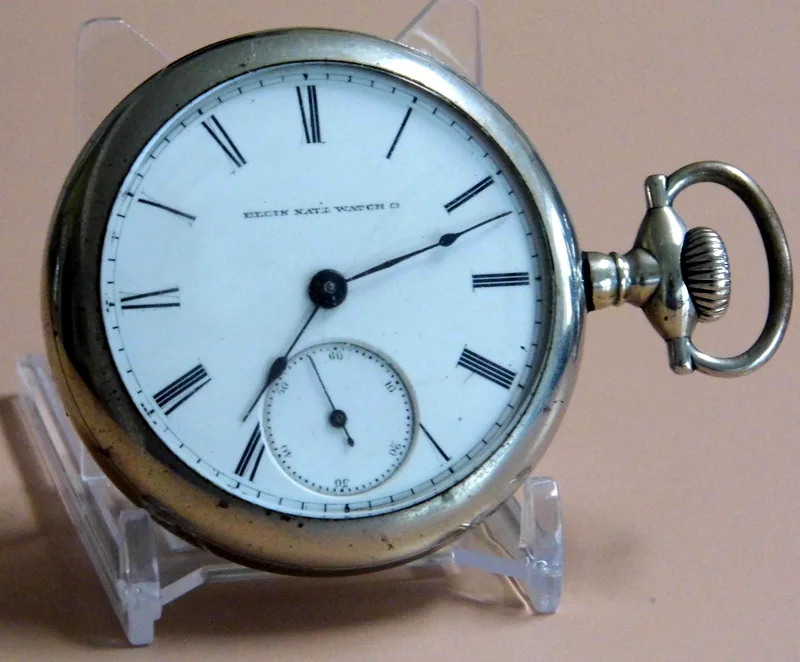
If the original dial is preserved in an open-face configuration and housed in a traditional conversion case (stem at 3 o'clock), the watchmaker must decide how to handle the shifted sub-seconds ring at 9 o'clock. If a central 12 o'clock orientation is mandatory, a custom replacement dial must be designed. Custom dials are typically laser-cut from 0.4mm gauge watchmaker's brass, fitted with silver-soldered copper dial feet located at Elgin's precise plate positioning holes, and finished with period-correct typography. The dial feet are fixed using a low-temperature micro-soldering rig or precision dial-foot soldering machine to avoid warping the dial blank.
Hand fitting requires delicate friction management. The original hand hole dimensions for Elgin 12L arbors differ significantly from modern Swiss wristwatch standards (such as ETA 6497 or 2824). The hour hand pipe, cannon pinion, and sub-second arbor diameters must be measured precisely with a digital micrometer or dial caliper. Original blued steel hands can be resized by lightly broaching the mounting holes with diamond-coated wire broaches until they achieve a precise press fit. If original hands are missing or damaged, custom hands must be turned on the lathe or carefully selected and re-bushed to fit the Elgin friction post dimensions.
7. Why 12L is more common for conversion
Among the vast spectrum of American pocket watch calibers, the 12-size Elgin movement stands out as the absolute standard for wristwatch conversions. To understand why, one must look at the physical limitations of human wrist ergonomics. Larger 16-size (43.18mm movement diameter) and 18-size (44.86mm movement diameter) pocket watches result in finished wristwatches that measure between 48mm and 52mm in case diameter—proportions that are excessively bulky and uncomfortable for the average wrist.
Conversely, smaller 10-size, 6-size, or 0-size movements offer smaller movement diameters but present significant repair challenges. Their delicate balance pivots are far harder to source, their mainspring availability is limited, and their smaller gear trains offer less mechanical torque to drive conversion hand assemblies smoothly. The 12-size movement strikes the perfect balance: its 38.10mm plate fits comfortably inside a contemporary 42mm case, delivering ideal wrist presence, robust torque, and superb legibility without feeling clumsy.
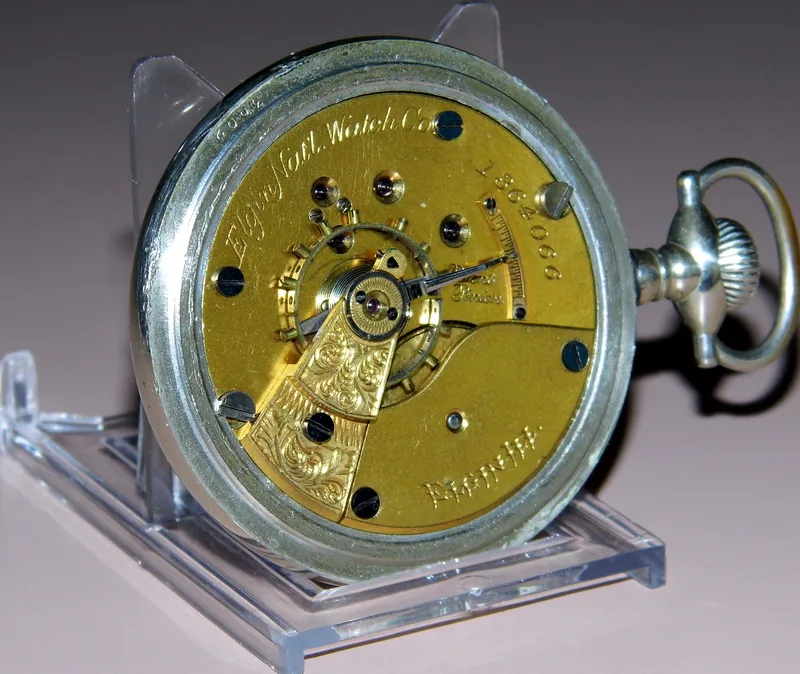
Furthermore, the shear availability and build quality of the Elgin 12L platform make it uniquely suited for horological modification. Elgin produced millions of 12s movements between 1910 and 1950. Parts such as balance staffs, mainsprings, click springs, and winding pinions remain widely available across material houses and secondary markets. Combined with the movement's striking visual appeal—featuring intricate damaskeened plates, polished steel screws, and gold-set ruby jewels—the 12L caliber offers unmatched aesthetic and mechanical value for custom watchmaking.
8. Final Thoughts on Elgin 12L Conversions
Converting an Elgin 12L pocket watch into a high-grade wristwatch is a masterclass in modern horological restoration. It marries 20th-century American industrial art with contemporary case engineering, creating a bridge between historical preservation and functional utility. When executed correctly—with precise casing rings, custom stem geometry, shock protection considerations, and period-appropriate aesthetic choices—the resulting timepiece is not merely a novelty, but a durable, heirloom-quality watch built to run for another century.
For watchmakers and enthusiasts alike, the key to a successful conversion lies in restraint and mechanical respect. Every modification made to the movement plate or keyless works should be carefully planned, executed with high-precision bench tools, and fully reversible whenever possible. By keeping these mechanical principles at the forefront of the build, you ensure that the brilliant legacy of the Elgin National Watch Company continues to tick proudly—not hidden away in a collector's drawer, but worn every day on the wrist.