Historical Background of Elgin 13L Movements
The Elgin National Watch Company, operating out of Elgin, Illinois, stood as one of the paramount titans of American horological manufacturing during the 19th and 20th centuries. Renowned for their precision engineering, standardized interchangeable parts, and industrial scale, Elgin produced millions of high-grade movements that served civilians, railroad conductors, and military personnel alike. Among their most celebrated architectural scales was the 13 Ligne platform—often identified in American sizing parlance as the 3/0 size or 0 size depending on the specific bridge design and manufacturing era. Developed during a transitional epoch when horology moved away from the vest pocket and toward the wrist, the 13L movement represents a critical evolutionary bridge in American watchmaking history.
During the early 20th century, particularly leading up to and through the First World War, the demand for personal timepieces shifted dramatically. Soldiers in the trenches required immediate, hands-free access to time for tactical coordination, giving rise to authentic WW1 trench watches. Horologists and casemakers began adapting small pocket watch movements into wrist-worn configurations by soldering wire lugs onto silver or nickel pocket cases. The Elgin 13L movement was at the forefront of this revolution. Its compact dimensions made it uniquely suited for wrist adaptation, offering robust American lever-escapement reliability in a size that did not overburden the soldier's arm.
Today, as horological enthusiasm shifts toward re-purposing vintage mechanical masterworks for daily modern wear, horologists frequently elect to convert elgin 13L pocket watch into wristwatch configurations. Understanding the historical context of the 13L movement allows the restorer to appreciate its dual identity: built with the uncompromising material standards of early 1900s American pocket watches, yet proportioned perfectly for modern ergonomic wristwear. Preserving these historic movements through sympathetic re-casing honors Elgin's legacy while granting a century-old caliber a second life on the wrist.
Technical Specifications and Movement Architecture
From an engineering standpoint, the Elgin 13L platform is a masterpiece of classical American movement architecture. Measuring approximately 29.26mm in plate diameter (13 Lignes in the French measurement system), the movement typically features an 18,000 vibrations per hour (vph) beat rate, translating to a standard 2.5 Hz frequency. Depending on the grade—such as the highly regarded Grades 462, 303, or 463—these movements were outfitted with anywhere from 7 to 17 jewels. The higher-grade variants featured raised gold jewel settings (chatons), friction-set ruby endstones, and micro-metric regulator assemblies like the Star or Reed spring regulator for ultra-precise rate adjustment.
The mechanical architecture relies on a traditional going train layout powered by a safety barrel or mainspring arbor designed to protect the wheel train in the event of a mainspring breakage. Escapement construction utilizes a cut expansion balance wheel—often bi-metallic with brass and steel arms—fitted with gold or brass timing screws paired with a Breguet overcoil hairspring. This combination provides exceptional isometric stability across varying temperatures and positions. Unlike contemporary Swiss mass-produced movements of the era, the Elgin 13L plates were crafted from thick nickel or gilding metal, decorated with intricate Damaskeening (Côtes d'Genève style patterning) that demonstrates extraordinary aesthetic detail hidden beneath the solid pocket watch case back.
Another crucial technical element when you attempt to convert elgin 13L pocket watch movements is the winding and setting mechanism. Standard American pocket watches of this size frequently utilized a negative setting system (where the setting sleeve resides in the case neck rather than on the movement plate) or a stem-wind, pendant-set system. Navigating this keyless works mechanism requires a deep technical understanding of how sleeve tension interacts with the winding pinion and clutch wheel, particularly when translating the movement out of its original pocket case and into a custom modern wrist enclosure.
Challenges of Converting Elgin 13L to Wristwatch
While the prospect of wearing an American mechanical artifact is enticing, an elgin 13L pocket watch to wrist conversion poses several severe technical hurdles that require the skills of a seasoned watchmaker. The primary engineering obstacle involves the orientation of the movement plates relative to the dial. Pocket watches were traditionally manufactured in two primary formats: Lépine (open-face), where the crown stem is located at 12 o'clock in direct alignment with the sub-seconds dial at 6 o'clock; and Savonnette (hunter case), where the crown stem is located at 3 o'clock with the sub-seconds display positioned at 9 o'clock. Casing a Lépine movement onto a wrist strap naturally places the crown at 12 o'clock unless a custom dial is fabricated or adapted, which alters the original visual geometry.
Another critical challenge is balance staff pivot protection. Elgin 13L movements were engineered decades before the invention of modern shock-absorption systems such as Incabloc or KIF spring mounts. The balance staff pivots on a vintage 13L are ground down to microscopic tolerances—often less than 0.08mm in diameter—and sit within rigid jewel holes. Subjecting a non-shock-protected balance assembly to the sudden kinetic impacts associated with modern wrist wear (such as dropping the arm, walking on hard surfaces, or tapping a desk) can easily shear the balance pivots. The watchmaker must ensure that the balance endshake and sideshake are perfectly adjusted and that the owner understands the structural limitations of vintage wrist wear.
Furthermore, managing dust, humidity, and atmospheric moisture ingress requires specialized modern sealing strategies. Antique pocket watch cases relied on snap-fit or screw-bezel brass and nickel enclosures with zero rubber gasket seals. When placing a vintage 13L movement into a contemporary wrist environment, modern custom cases must utilize synthetic O-ring seals around the case back, crystal, and crown tube. Failure to adequately seal the movement will result in rapid oxidation of the steel winding train, corrosion of the balance hairspring, and quick degradation of synthetic watch lubricants.
Lug Welding and Case Selection
Selecting or fabricating the correct housing is the foundational phase of any successful conversion project. When evaluating the best case size for elgin 13L conversion, the watchmaker must balance movement clearance with visual proportion. Because the bare movement measures approximately 29.3mm, the ideal finished exterior wrist case diameter generally ranges between 36mm and 38mm, though 39mm to 40mm cases can be used if a wider internal movement retention ring is employed. Choosing a case larger than 40mm creates an oversized, top-heavy visual aesthetic that swallows the classic dial proportions, whereas a case under 36mm leaves insufficient wall thickness for secure stem clearance and structural integrity.
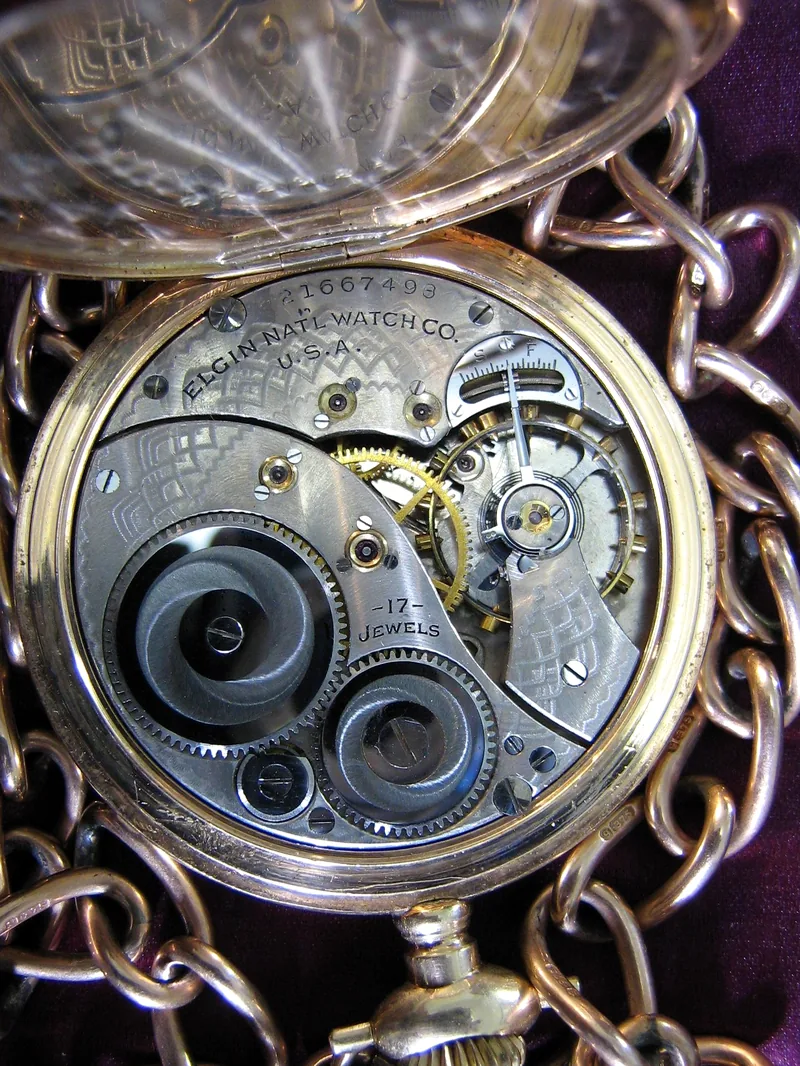
When creating a historic homage, watchmakers often opt for two distinct conversion casing paths: original pocket watch case modification via wire lug welding, or modern precision CNC-machined conversion cases. If the original nickel or sterling silver pocket watch case is preserved, wire lugs must be fashioned from matching sterling silver or stainless steel wire (typically 1.5mm to 2.0mm gauge). These wire loops are bent into traditional trench-style scroll configurations and silver-soldered or micro-TIG welded directly onto the outer perimeter of the case at 12 o'clock and 6 o'clock. Micro-welding requires extreme temperature control to prevent heat distortion of the case threads or annealing of the original hinge structures.
Alternatively, housing the 13L caliber in a modern 316L stainless steel conversion case provides superior structural protection, scratch resistance, and water resistance. In this scenario, a custom-machined movement ring (usually turned on a watchmaker's lathe from solid brass or 316L stock) is required to bridge the gap between the 29.3mm movement plate diameter and the internal perimeter of the new case. The movement is then locked down using traditional casing clamps and micro-screws that thread directly into the perimeter of the Elgin pillar plate, eliminating any radial or axial movement within the wrist case.
Crown and Stem Solutions
Mechanically integrating the winding and setting interface is arguably the most intricate task when you convert elgin 13L pocket watch into wristwatch hardware. Early Elgin pocket watches utilized negative-setting sleeve systems designed to function alongside the original case tube stem mechanism. In a standard negative-set setup, the spring sleeve inside the pocket case neck holds the stem in the setting position by default; pushing the crown down compresses the sleeve to engage the winding gears. Modern wrist cases, by contrast, rely almost exclusively on positive-setting systems, where the detent mechanism (yoke, setting lever, and setting lever spring) is fully contained within the movement itself.
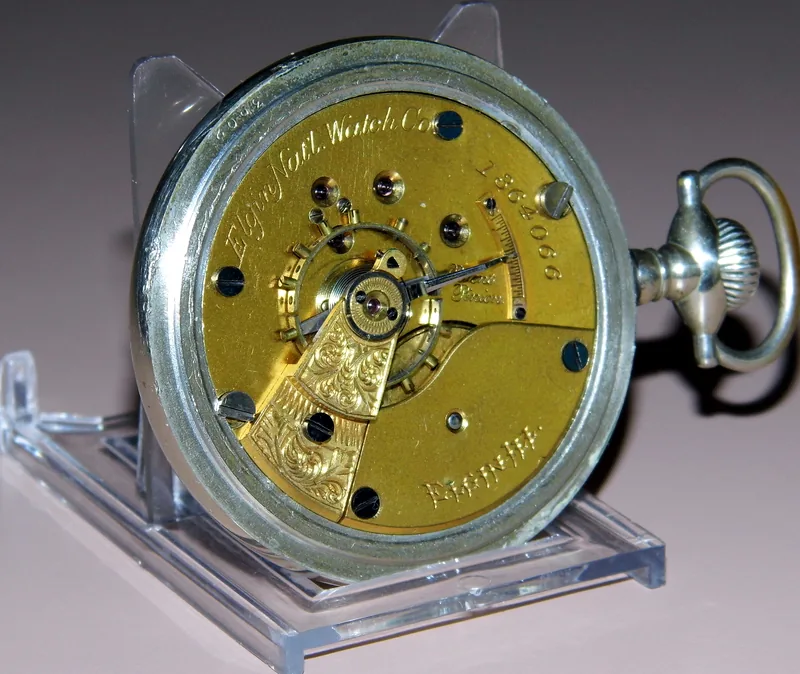
To overcome this disparity, the watchmaker must either adapt the vintage keyless works or engineer a custom conversion stem. Manufacturing a custom stem requires turning high-carbon steel rod stock on a micro-lathe to match the internal square profile of the Elgin winding pinion and clutch wheel while threading the external portion to standard modern crown tap sizes—most commonly Tap 10 (0.9mm) or Tap 9 (1.0mm). The stem length must be calculated to fractions of a millimeter: too long, and the crown sits proud of the case tube, allowing moisture ingress; too short, and the winding clutch will fail to engage the mainspring arbor gear teeth properly.
Aesthetically, crown selection should complement the era of the 13L caliber. Oversized onion crowns or ribbed pumpkin-style crowns are historically accurate choices that evoke early 20th-century aviation and military aesthetics. These crown styles afford excellent tactile grip, allowing the wearer to smoothly wind the manual mainspring daily without applying excessive lateral force to the stem tube. Synthetic micro-gaskets fitted inside the crown cap ensure that dirt and atmospheric moisture are blocked from creeping along the stem axis into the keyless works.
Dial and Hand Considerations
The dial and hands serve as the visual center of any horological project, and vintage Elgin 13L components present unique aesthetic and mechanical restoration challenges. Most original Elgin 13L pocket watches feature vitreous enamel dials fired over copper base plates. While these porcelain dials possess an immutable lustre that never fades or oxidizes, they are extremely brittle. Removing a century-old enamel dial requires immense delicate hand pressure using specialized dial-lifting levers to avoid creating hairline cracks or spiderweb fractures around the center wheel arbor and sub-seconds bit.
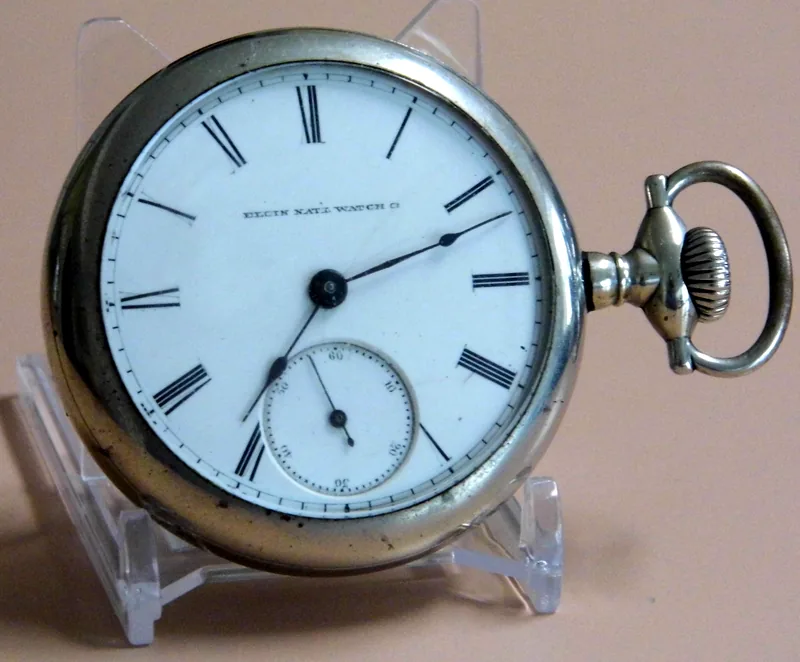
Fixing the dial securely to the movement inside a new case demands precise alignment of the dial feet. Elgin 13L movements feature specific dial foot retention screws positioned laterally on the pillar plate. If an aftermarket dial is selected—or if the original dial's copper feet have broken off over decades of wear—new dial feet must be attached using a capacitance spot welder or specialized low-temperature soldering techniques that will not heat-shock the fragile enamel face. Alignment must be absolute: a fraction of a millimeter off-center will cause the cannon pinion or hour wheel to bind against the central dial hole, causing erratic timekeeping or stopping the watch entirely.
Hand fitting presents its own set of technical specs. The friction-fit dimensions for vintage Elgin center arbors differ from modern Swiss ETA standard sizes. The watchmaker must measure the precise diameter of the cannon pinion (hour hand post) and hour wheel pipe using micro-calipers, often re-reaming or tightening the pipe collars of blued-steel spade or skeleton hands to match. Furthermore, hand clearance under the front sapphire or mineral crystal must be painstakingly verified. Because vintage pocket watch hands feature dramatic curved tips and high hand heights, the front crystal must offer sufficient internal dome height to prevent the hands from dragging against the inner glass surface.
Why 13L is more common for conversion
In the vast world of antique pocket watch conversions, the Elgin 13L caliber occupies a sweet spot that makes it significantly more popular among custom horologists than larger pocket watch platforms. Standard American pocket watches—such as the massive 16-Size (approx. 43.18mm movement diameter) or 18-Size (approx. 44.86mm movement diameter)—yield finished wristwatch conversions that measure between 45mm and 50mm in exterior case size. While impressive as oversized display pieces, such large watches are impractical, heavy, and uncomfortable for daily wrist wear for the vast majority of collectors.
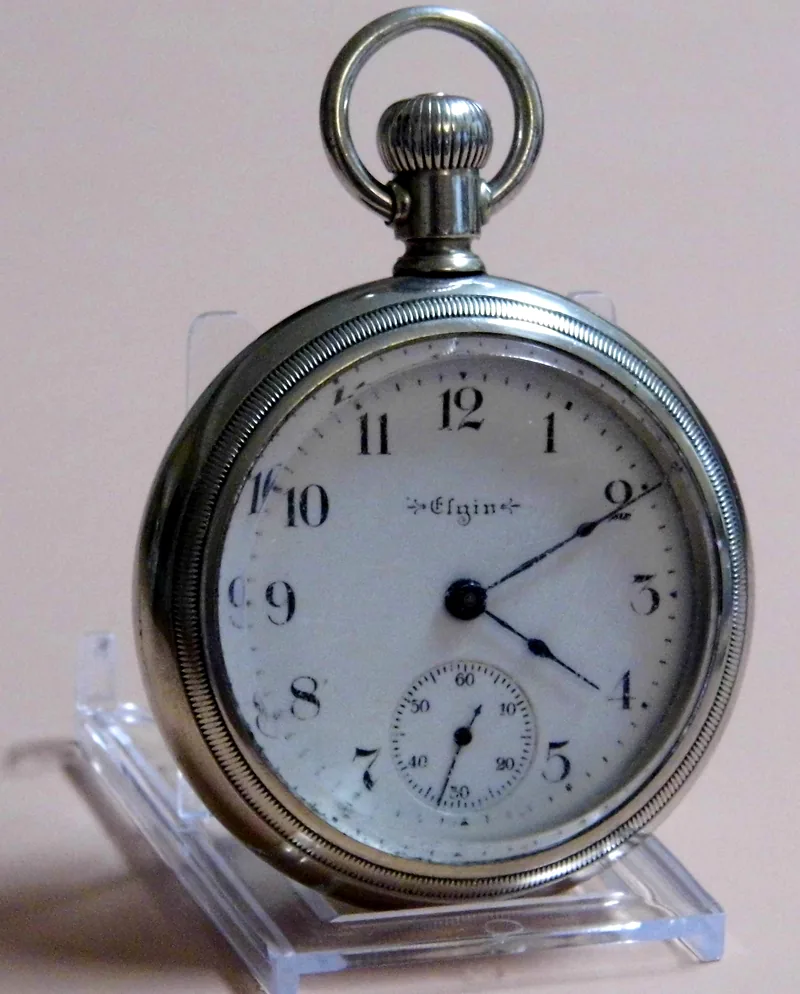
Conversely, ultra-small vintage pocket movements, such as 10/0 or 6/0 sizes, feature extremely tiny, delicate movement components that are notoriously difficult to service, source replacement parts for, or keep running reliably within modern timing tolerances. The 13L movement sits squarely in the "Goldilocks zone." With a 29.3mm movement diameter, it seamlessly translates into a 36mm to 38mm finished case size. This exact dimension corresponds with classic modern wristwatch sizing, matching the profile of iconic mid-century tool watches and modern dress pieces, including vintage mid-century references and classic vintage Rolex wristwatches.
Moreover, the sheer volume of 13L movements produced by Elgin during the early decades of the 20th century ensures an abundant supply of donor movements and spare components. Balance staffs, mainsprings, escape wheels, and pallet forks for the 13L can still be readily sourced from vintage material house new-old-stock (NOS) inventories. This structural longevity and component availability lower the operational risks of restoration, making an elgin 13L pocket watch to wrist conversion one of the most mechanically viable, practical, and visually rewarding conversion projects in technical horology.
Final Thoughts on Elgin 13L Conversions
Executing a high-grade conversion of an Elgin 13L movement is far more than a simple exercise in cased swapping—it is an act of historical preservation and specialized mechanical engineering. By taking a movement manufactured over a century ago in Illinois and expertly adapting its stem, case, and dial interfaces, the watchmaker bridges the gap between historical American industrial art and modern wearable functional style. When conducted with precision, the result is a unique timepiece that carries the soul of early American horology on the wrist.
Prior to finalizing any conversion, the movement must undergo a full horological overhaul. This includes complete disassembly down to the bare mainplate, ultrasonic cleaning of all train wheels and steel pivots, inspection and burnishing of pivot journals, replacement of the old fatigue-stressed carbon steel mainspring with a modern unbreakable alloy spring, and precise lubrication using modern synthetic oils such as Moebius 9010 and HP1300. Poising the balance wheel and adjusting the hairspring overcoil on a modern electronic timing machine ensures that the century-old caliber keeps time within respectable daily vintage tolerances.
Ultimately, choosing to convert elgin 13L pocket watch into wristwatch form gives horological enthusiasts a tactile connection to timekeeping history. With its perfectly proportioned 13-Ligne architecture, stunning nickel Damaskeening, and rugged American lever construction, a properly converted Elgin 13L stands as a testament to an era when American watchmaking set world standards for quality, elegance, and durability.