1. Historical Background of Elgin 14s Movements
The Elgin National Watch Company, established in 1864 in Elgin, Illinois, stands as one of the titans of American industrial horology. Over its century of operation, Elgin manufactured more than 60 million mechanical timepieces, perfecting the American System of Manufacturing. This approach relied on high-precision, standardized, interchangeable parts long before European manufactures adopted similar practices. Among the vast array of sizes produced by the factory, the 14-size (14s) movement holds a unique and historically compelling position. Introduced during the late 19th century and refined through the early 20th century, the 14s platform was designed as a versatile, medium-format caliber catered to gentlemen who sought a watch less cumbersome than the standard Railroad-approved 18-size or 16-size models, yet far more robust than the smaller dress movements.
In the context of late Victorian and early 20th-century American society, the 14s pocket watch occupied a sweet spot in the market. It was frequently selected for high-grade presentation pieces, corporate gifts, and personal heirlooms. Elgin fitted these movements with a wide spectrum of finishing styles and mechanical grades, ranging from utility 7-jewel workhorse movements to high-grade, 17- to 21-jewel precision chronometers featuring raised gold jewel settings, micrometer regulators, and adjusted temp/position balance assemblies. Calibers such as the Elgin Grade 288, 387, and various B.W. Raymond iterations demonstrated the brand's ability to combine mass-production efficiency with hand-finished, high-horology details like complex damaskeening patterns and blued steel screws.
As pocket watches fell out of popular fashion following World War I—when soldiers demonstrated the undeniable utility of wrist-worn timekeeping—millions of these exceptional American movements were left inside solid gold or sterling silver cases. During the economic downturns and gold rushes of the mid-to-late 20th century, countless original pocket watch cases were melted down for scrap bullion, leaving pristine, functional movements orphaned without housing. Today, when horological enthusiasts attempt to convert elgin 14s pocket watch into wristwatch configurations, they are directly saving these historical artifacts from oblivion, breathing new mechanical life into 100-year-old high-grade American craftsmanship.
2. Technical Specifications and Movement Architecture
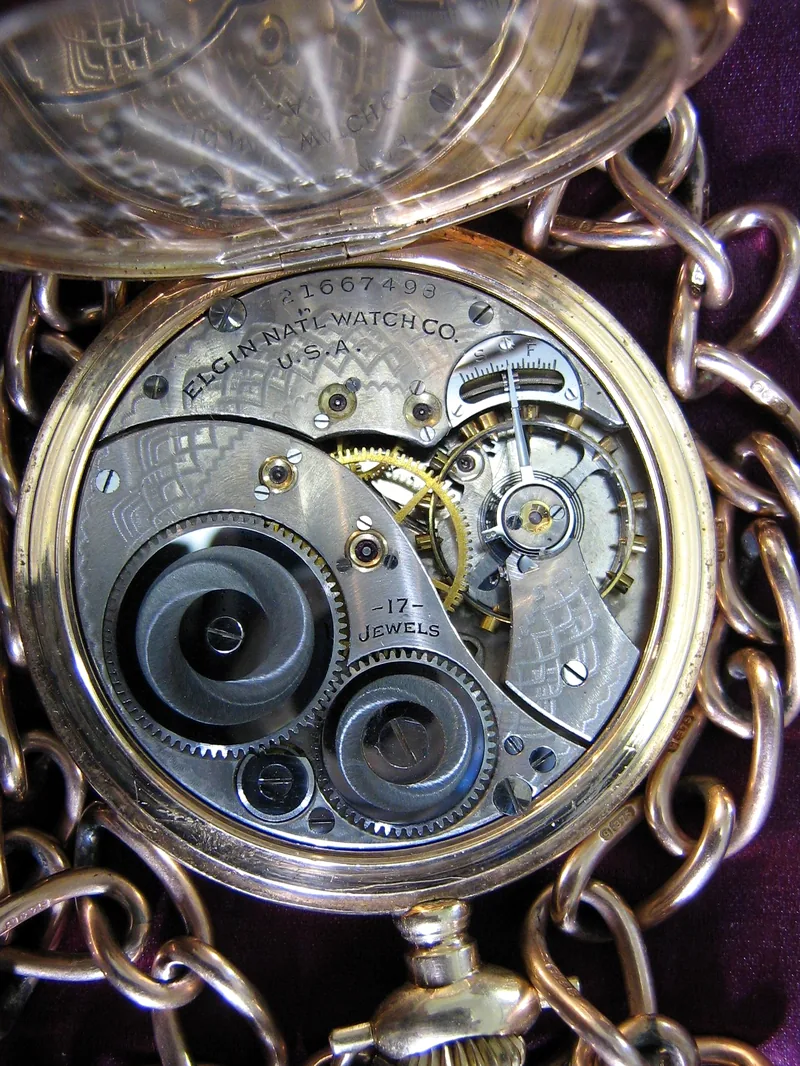
To successfully execute a conversion, a watchmaker must understand the exact dimensional standards and internal architecture of the Elgin 14-size movement. Under the American Lancashire gauge system, watch movement sizing is calculated using a standard formula: a size 0 movement measures 1.183 inches (30.05 mm) across the pillar plate, with each additional size increment adding 1/30th of an inch (0.846 mm). Consequently, a standard Elgin 14s movement features a bare pillar plate diameter of approximately 1.649 inches, or 41.88 mm. This fundamental dimension dictates every aspect of case selection and spatial planning required for the conversion process.
Architecture-wise, Elgin 14s movements were predominantly manufactured in three-quarter plate and split-bridge layouts. These configurations offer high structural rigidity, securing the train wheels—center wheel, third wheel, fourth wheel, and escape wheel—between heavy brass or nickel-silver (German silver) plates. The escapement relies on a traditional Swiss lever configuration with club-tooth escape wheels and synthetic rubies or sapphires serving as pallet stones and jewel bearings. Most 14s calibers run at a traditional beat rate of 18,000 vibrations per hour (2.5 Hz), giving the balance wheel its graceful, deliberate sweep. The hairspring is typically a high-grade Breguet overcoil, crafted from blued carbon steel, which enhances isochronism across varying states of mainspring tension.
Another defining feature of the Elgin 14s architecture is the keyless work, or winding and setting mechanism. Unlike European wristwatches that utilize a positive setting mechanism (where the setting assembly resides permanently within the movement plates), most American pocket watches, including Elgin 14s calibers, utilize a "negative setting" system (also known as a sleeve-setting mechanism). In a negative setting design, the detent and setting mechanism are located inside the stem/pendant tube of the pocket watch case itself, rather than inside the movement. The stem inside the movement is biased into the setting position by an internal spring and requires an external pull-sleeve located within the case neck to shift it into the winding position. Understanding this distinction is paramount when selecting hardware or machining modern adapters.
3. Challenges of Converting Elgin 14s to Wristwatch
When clients ask, "can you convert elgin 14s pocket watch mechanisms into functional daily wear wristwatches?", the technical answer is yes, but the practical execution requires navigating several major mechanical hurdles. The primary obstacle involves modern shock resistance—or the complete lack thereof. Pocket watch balance staffs feature hardened, tempered steel pivots that taper to a mere 0.08 mm to 0.12 mm in diameter. These ultra-fine pivots rest directly inside rigid jewel holes supported by flat cap jewels. Because pocket watches were intended to reside vertically in a vest pocket, they were never engineered to withstand the multi-axis kinetic shocks, vibrations, and accidental wrist impacts encountered in modern life. Without drop-in shock protection systems like Incabloc or KIF, a simple drop on a hard floor or a harsh tap against a doorframe can instantly snap a balance pivot, necessitating an intricate lathe turning job to make a replacement staff.
A second significant challenge centers around movement orientation and dial layout, specifically distinguishing between Hunter (Savonnette) and Open-Face (Lépine) configurations. In an Open-Face 14s movement, the winding stem is located at the 12:00 position, directly aligned with the sub-seconds dial at 6:00. If this movement is installed into a standard wristwatch case with the crown positioned at 3:00, the sub-seconds register moves to an unconventional 9:00 position. Conversely, a Hunter movement features the winding stem at 3:00 relative to a 6:00 sub-seconds layout, making Hunter calibers far more naturally suited for traditional wristwatch dial geometry. However, Hunter movements are less common than Open-Face models, forcing watchmakers to make critical aesthetic decisions regarding dial orientation.
Finally, environmental protection poses a continuous risk. Antique Elgin pocket watch movements were never intended to be water-resistant, dust-sealed, or antimagnetic. Modern wristwatches operate in high-humidity environments, exposed to wrist sweat, magnetic fields from smartphones and laptops, and atmospheric moisture. Protecting a raw carbon-steel hairspring and unplated balance wheel from rust and magnetization requires precision casing with modern O-ring gaskets, high-grade crystal seals, and carefully engineered clearance margins between moving bridges and the inner case wall.
4. Lug Welding and Case Selection
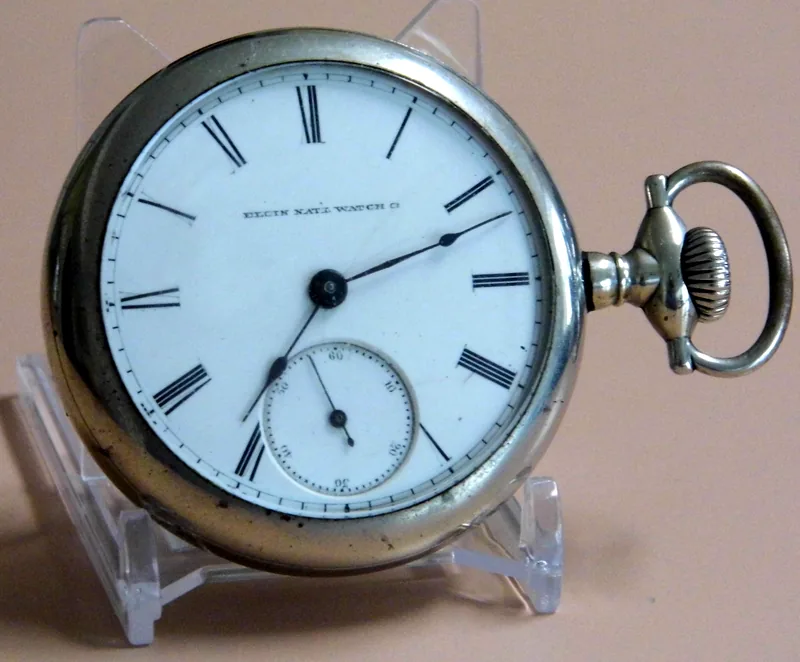
When undertaking a conversion, the watchmaker must choose between two distinct aesthetic and structural methodologies: converting an original vintage pocket watch case through lug welding, or re-housing the bare movement into a modern, custom-engineered elgin 14s pocket watch to wrist conversion case. Each approach presents unique technical trade-offs regarding structural integrity, historical authenticity, and daily wearability.
``` +-------------------------------------------------------------------------------+ | CASE SELECTION MATRIX FOR CONVERSIONS | +-------------------+-----------------------------------+-----------------------+ | Feature | Welded Vintage Case | Modern CNC Case | +-------------------+-----------------------------------+-----------------------+ | Material | Sterling Silver / Gold-Filled | 316L Stainless Steel | | Water Resistance | Dust-proof only (No seals) | 3 ATM - 5 ATM (Gasket)| | Crystal Type | Acrylic / Mineral Glass | Sapphire (AR-coated) | | Setting Compatibility| Native Negative Setting Sleeve | Requires Sleeve Adapter| | Wearability | Delicate, historical collector | Robust, daily wear | +-------------------+-----------------------------------+-----------------------+ ```If the decision is made to modify an original vintage pocket watch case, the technician must weld wire or contoured lugs directly onto the perimeter of the coin-silver, sterling, or gold-filled case. This requires specialized micro-TIG (Tungsten Inert Gas) welding or silver brazing equipment. High-temperature soldering risks stripping gold cladding, blistering pocket watch polish, or deforming the thin hinged bezels and casebacks. To prevent heat transfer from annealing delicate case springs, the movement must be entirely stripped from the case. The lugs must be custom-formed from matching metallurgy, mounted in a specialized alignment jig to ensure squareness with the 12-6 axis of the dial, and fused using silver solder with a melting point tuned precisely below the melting threshold of the primary case metal.
Alternatively, the modern horological approach utilizes a purpose-built elgin 14s pocket watch to wrist conversion case machined via multi-axis CNC from 316L surgical stainless steel or solid bronze. These conversion cases are engineered specifically to accommodate the ~41.9 mm pillar plate of the 14s movement. They usually feature modern exhibition screw-down casebacks with mineral or sapphire glass, modern rubber gaskets for water resistance (typically rated to 3 ATM or 5 ATM), and built-in, contoured wire or solid lugs measuring 22mm or 24mm between the horns. Because a 41.9 mm movement is inherently large, modern conversion cases generally have an overall exterior diameter of 44 mm to 45 mm. To hold the Elgin movement securely inside this larger perimeter, the watchmaker must turn a custom aluminum, brass, or stainless steel casing ring on a watchmaker's lathe, cut with micro-recesses that match the Elgin plate tabs and case-screw positions.
5. Crown and Stem Solutions
Resolving the keyless work and stem geometry is arguably the most technically demanding phase when you convert elgin 14s pocket watch into wristwatch hardware. Because standard 14s Elgin calibers utilize a negative setting mechanism, putting the movement into a modern case designed for positive setting wristwatches creates a mechanical mismatch. In a standard pocket watch case, a split steel sleeve screwed into the case neck grips the winding stem. Pulling the crown outward compresses this sleeve, which pulls the square arbor of the stem up, shifting the movement’s internal rocker arm (or clutch lever) into the setting position. Pushing the crown back down compresses the internal movement spring, locking it back into winding mode.
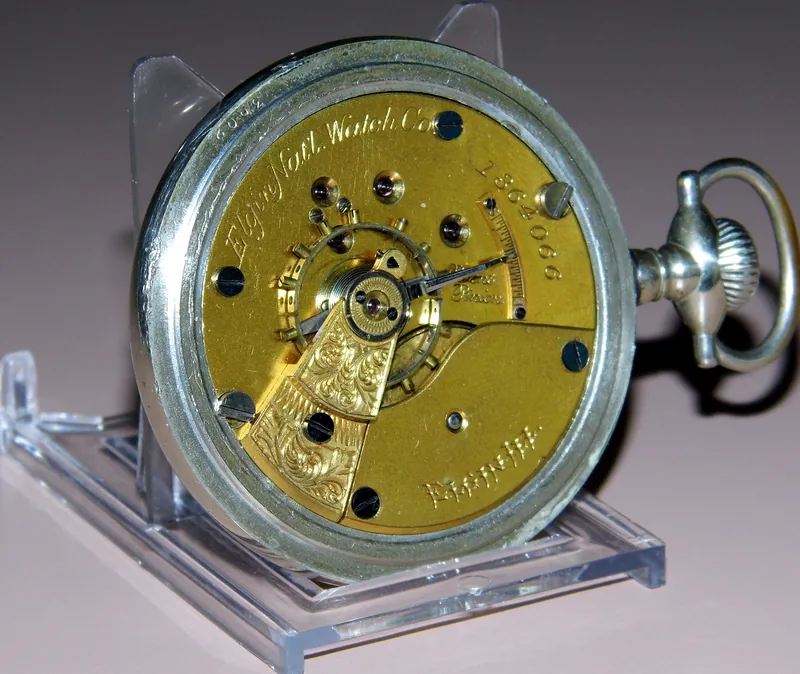
To overcome this issue when utilizing a modern conversion case, the watchmaker has two distinct technical solutions:
- Sleeve Conversion: Install a high-precision thread-in negative setting sleeve into the pendant neck of the modern conversion case. This allows the watchmaker to use a standard two-piece split stem or an original Elgin pocket watch stem modified on a micro-lathe.
- Positive Keyless Work Conversion: Modify the internal winding rocker arm and clutch spring of the Elgin 14s movement itself. By replacing or re-profiling the winding bridge spring, the movement can be converted to operate natively in positive setting mode, where the stem position is governed by a spring detent inside the movement rather than the case neck.
Furthermore, thread pitch and stem arbor dimensions vary wildly between vintage American pocket watch movements and modern wristwatch crowns. Standard modern watch crowns feature tap sizes such as Tap 10 (0.90 mm stem thread) or Tap 9 (1.00 mm stem thread), whereas vintage Elgin 14s stems often feature non-metric threads or square winding arbors. The master watchmaker must turn an adapter stem on a Levin or Lorch watchmaker's lathe—turning high-carbon drill rod down to match the square profile of the Elgin center winding pinion, cutting the detent groove for the setting lever, and threading the distal end to match the desired oversized onion or diamond crown thread tap.
6. Dial and Hand Considerations
The dial and hand assembly of an Elgin 14s movement represents both stunning antique craftsmanship and a high risk of catastrophic damage during casing. Vintage Elgin 14s dials are predominantly made of vitreous enamel (porcelain) fused over a copper baseplate, or stamped brass painted and silvered with raised gold/enamel numerals. Grand feu enamel dials are exceptionally brittle. Over decades, micro-fractures known as hairline cracks develop. Any uneven pressure from case clamps, ill-fitting crystal bezels, or improper hand-setting tools can shatter the enamel, ruining a piece of history that cannot be replicated.
Dial foot alignment is another critical detail. Elgin 14s movements feature three or four copper dial feet extending from the back of the dial plate, which drop into corresponding receiving holes on the pillar plate and are secured with side-locking screws. If the watchmaker chooses to rotate an Open-Face movement so that the stem sits at 3:00 (putting the sub-seconds register at 9:00), the original dial graphics will sit sideways unless a custom aftermarket conversion dial is fitted, or a custom-painted replacement dial is crafted. If a custom dial is built, the dial feet must be soft-soldered or copper-brazed to match the exact hole locations on the vintage 14s main plate with sub-millimeter accuracy to prevent binding the hour wheel pipe or central balance arbor.
Hand fitting presents its own clear geometry rules. Antique pocket watch hands feature friction-fit hole sizes that do not match modern ETA or Seiko hand standards. For instance, an Elgin 14s hour wheel and cannon pinion require specific hole diameters (typically around 2.10 mm for the hour hand and 1.15 mm for the minute hand, though exact dimensions vary by grade and generation). Hands must be carefully re-reamed or staked down using a staking tool and punching set to achieve perfect friction without splitting the hand collet. Furthermore, hand clearance under the crystal is paramount: because pocket watch hands feature steep, sculpted counterweights and high-arched profiles, a deeply domed sapphire or box-shaped acrylic crystal is strictly required inside the conversion case to ensure the sweep minute hand or center post does not rub against the interior surface of the crystal.
7. Why 14s is More Common for Conversion
In the conversion community, horologists frequently weigh the merits of working with different American pocket watch movement sizes: 18s, 16s, 12s, 10s, and 14s. Among these options, the 14-size movement has emerged as the definitive ideal platform for creating a wearable, well-proportioned modern wristwatch, beating out its siblings for several structural and ergonomic reasons.
Standard 18-size movements (approx. 44.86 mm movement diameter) and 16-size movements (approx. 43.18 mm movement diameter) are iconic because of their rich railroad heritage. However, when an 18s or 16s movement is installed inside a modern protective case with adequate wall thickness and sealing gaskets, the final exterior case diameter swells to 48 mm to 52 mm. Unless the wearer has an exceptionally large wrist, a watch of this scale becomes uncomfortably top-heavy, prone to hitting objects, and aesthetically disproportionate. On the opposite end of the spectrum, smaller sizes like 10s, 0s, or 3/0s dress watch movements offer manageable diameters but feature extremely delicate gear trains, tiny fragile balance staffs, and severe scarcity when searching for original replacement parts.
``` +-----------------------------------------------------------------------------------+ | MOVEMENT SIZE COMPARISON CHART | +------------+-------------------+--------------------+-----------------------------+ | Size Standard| Bare Plate Dia. | Typical Case Outer | Wearability Assessment | +------------+-------------------+--------------------+-----------------------------+ | 18s | 44.86 mm | 48 mm - 52 mm | Overly bulky, "wall clock" | | 16s | 43.18 mm | 46 mm - 48 mm | Large pilot profile | | 14s | 41.88 mm | 43 mm - 45 mm | Optimal modern wrist size | | 12s | 40.18 mm | 42 mm - 43 mm | Good, but fewer donor parts | | 10s | 38.50 mm | 40 mm - 41 mm | Delicate balance staff | +------------+-------------------+--------------------+-----------------------------+ ```The 14s caliber hits the geometric sweet spot. With a movement plate measuring approximately 41.88 mm, it fits cleanly into a modern custom 43 mm to 45 mm conversion case. This range matches popular modern pilot, diver, and oversized sports watch case proportions worn comfortably around the globe. Beyond modern ergonomics, Elgin produced an enormous quantity of 14-size calibers over several decades. This vast production output means that donor parts, replacement balance staffs, mainsprings, jewel settings, and train wheels are readily available through horological supply houses and vintage inventories, making long-term maintenance and servicing fully viable for the master watchmaker.
8. Final Thoughts on Elgin 14s Conversions
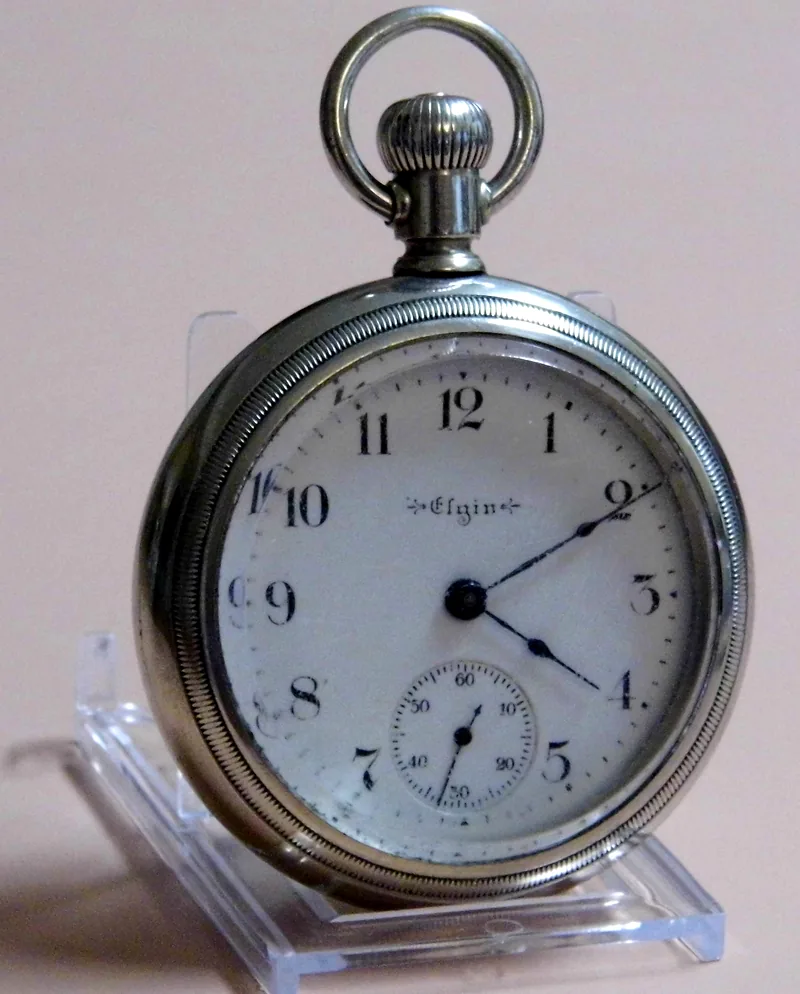
Attempting to convert elgin 14s pocket watch into wristwatch specifications is far more than a simple re-casing exercise; it is an act of horological preservation and mechanical art. By taking orphaned movements—many of which were stripped of their precious metal cases decades ago—and engineering precision modern housings for them, watchmakers rescue iconic artifacts of American industrial history. Wearing a 100-year-old Elgin movement on the wrist lets you appreciate mechanical design from an era when timepieces were built to last generations, decorated by hand with brilliant damaskeening, heat-blued screws, and ruby jewel settings.
However, owning and operating a converted Elgin 14s wristwatch demands a conscious shift in user expectations. Owners must remember that these vintage movements lack modern shock-absorbers, anti-magnetic alloys, and modern automatic winding convenience. They require deliberate daily hand-winding, protection from strong magnetic fields, avoidance of water exposure, and regular mechanical servicing every three to five years using high-grade modern synthetic lubricants such as Moebius 9010 and HP-1300. When built with precision lathe work, proper casing clearance, and correct keyless adaptation, a converted 14s Elgin transforms from an forgotten vest-pocket relic into an extraordinary, daily-wearable conversation piece that bridges two centuries of watchmaking legacy.