Historical Background of Elgin 16s Movements
The Elgin National Watch Company, operating out of Elgin, Illinois, stands as one of the most prolific titans in the history of American industrial horology. Founded in 1864, Elgin produced over 60 million timepieces across its century-long operation. Among its vast repertoire, the 16-size (16s) pocket watch movement emerged as the absolute backbone of American personal timekeeping during the golden age of rail travel and industrial expansion. Introduced as a mid-sized, highly versatile platform, the 16s superseded the bulkier 18-size movements that had dominated the mid-19th century, striking an ideal balance between physical durability and mechanical efficiency.
The development of the 16s caliber family coincided with strict standards set by railway chief inspectors, most notably Webb C. Ball. To be approved for railroad service, a movement had to meet rigorous criteria: open-face configuration, at least 17 to 21 jewels, adjustment to temperature and 5 or 6 positions, a micrometric regulator, and an accuracy rate within narrow margins. Elgin responded with legendary 16s movements such as the B.W. Raymond series, the Father Time, Grade 387, Grade 478, and later, the Grade 571. These calibers featured exquisite damaskeening, solid gold jewel chatons, and temperature-compensated balances that represented the pinnacle of mass-produced micro-engineering.
Today, as pocket watches have transitioned from functional everyday tools to inherited artifacts, watchmakers and enthusiasts frequently seek to convert elgin 16s pocket watch into wristwatch configurations. Doing so preserves these magnificent mechanical artifacts, allowing historical American industrial craftsmanship to be worn, observed, and appreciated on the wrist rather than languishing forgotten in a drawer.
Technical Specifications and Movement Architecture
Understanding the architectural blueprint of an Elgin 16s caliber is essential before attempting any physical conversion work. In the American horological sizing system, a 16-size movement possesses a base plate diameter of 1 and 22/30 inches, which translates precisely to 1.700 inches or 43.18 millimeters. This standardized movement plate diameter provides a robust foundation for spatial organization, housing a substantial mainspring barrel capable of delivering consistent torque across a standard 36-to-40-hour power reserve curve.
The internal movement architecture varies according to production era and grade, but generally falls into full-plate, three-quarter plate, or bridge-style configurations. High-grade Elgin 16s movements operate at a traditional frequency of 18,000 vibrations per hour (2.5 Hz), utilizing a escape wheel paired with a steel lever and synthetic or natural ruby pallet stones. The balance assembly on high-grade variants features a cut bimetallic compensation balance wheel with gold timing screws, paired with a blued-steel Breguet overcoil hairspring. Precision adjustment is facilitated by specialized whiplash or micrometric regulators, such as the Star Regulator or Reed's patent regulator, allowing micro-adjustments to beat rate without disturbing the hairspring stud.
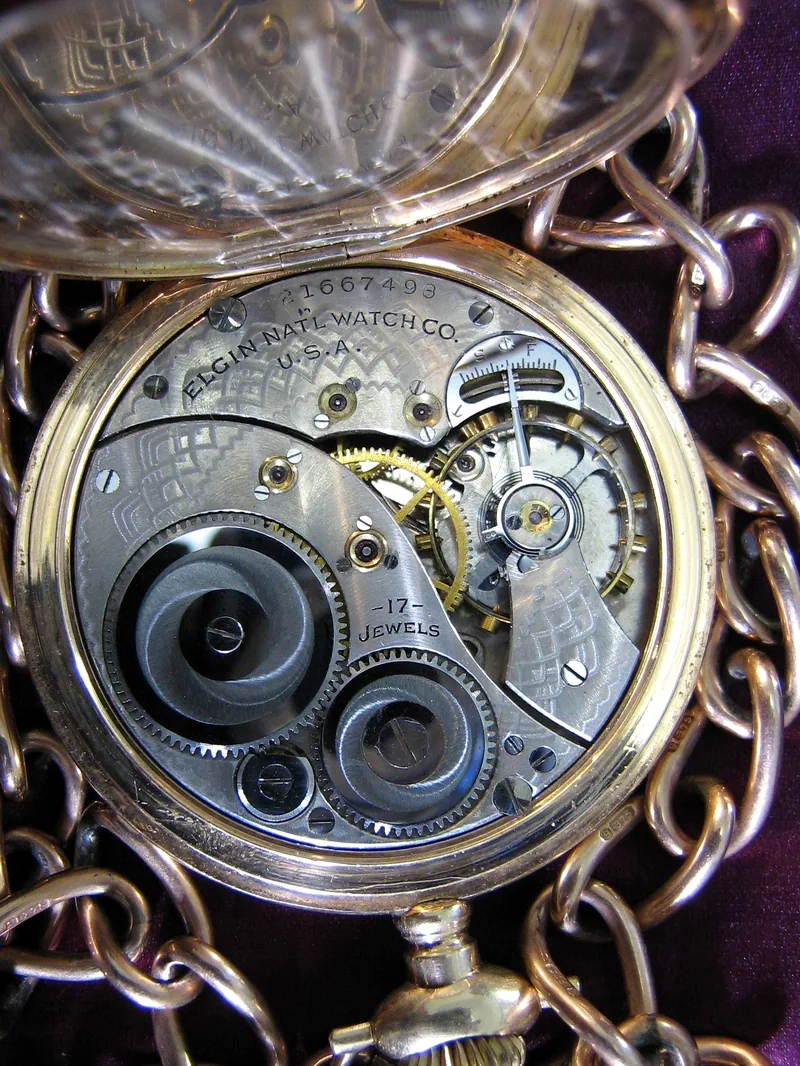
Power delivery in the Elgin 16s reliance on a center wheel driving a high-pinion train down to the fourth wheel, which directly carries the sub-second hand pivot. Because these movements were manufactured prior to modern CAD/CAM tolerances, jeweling methods evolved from friction-set jewels in early runs to screw-set gold chatons in premier models like the 21-jewel Grade 387. Understanding these architectural nuances—such as the exact placement of movement retaining screws and the interaction of the setting works—is critical when fitting the core mechanism into a custom wristwatch housing.
Challenges of Converting Elgin 16s to Wristwatch
When clients ask horologists, "can you convert elgin 16s pocket watch movements into modern wearable timepieces?", the answer is unequivocally yes, but it comes with substantial technical caveats. The primary obstacle revolves around shock protection. Pocket watch movements of the late 19th and early 20th centuries were designed to rest vertically in a vest pocket. They lack modern shock-absorption systems such as Incabloc or KIF spring-loaded jewel settings. The delicate balance staff pivots—often measuring a mere 0.08mm to 0.12mm in diameter—are held rigidly between solid jewel caps. Wearing a converted 16s wristwatch during high-impact activities, sports, or accidental wrist impacts can easily snap a balance pivot, requiring custom lathe work or hunting down rare original staff stock to repair.
The second major technical challenge concerns stem orientation and setting mechanism layout. Elgin produced 16s movements in two structural configurations: Lépine (open-face) and Savonnette (hunter case). In an open-face movement, the winding stem is located at the 12 o'clock position relative to the sub-seconds register at 6 o'clock. If mounted directly in a conventional wristwatch case with the stem at 3 o'clock, the sub-seconds register shifts awkwardly to the 9 o'clock position unless a specialized dial offset is utilized. Conversely, hunter movements naturally feature the winding stem at 3 o'clock and sub-seconds at 6 o'clock, making them architecturally ideal for wrist alignment, yet they are far less common than open-face variants.
Finally, environmental protection poses a continuous threat to converted pocket watch movements. Original Elgin pocket cases relied on threaded or snap-fit bezels without rubber O-ring seals, leaving the movement susceptible to dust, humidity, and ambient moisture. Translating these antique mechanical engines into modern wrist wear demands a housing environment that shields non-waterproof steel components from oxidation while preserving original dial tolerances.
Lug Welding and Case Selection
Historically, early wrist conversions—often referred to as "trench watches" or early "marriage watches"—were created by soldering wire lugs directly onto original pocket watch cases. While this preserves the vintage gold-filled, sterling silver, or nickel pocket case, silver-soldering or laser-welding steel or brass lugs onto nickel or gold-filled base metals requires high thermal control to avoid melting or delaminating thin metal cladding. Furthermore, original pocket cases lack modern ergonomics, resulting in an exceptionally thick, crown-heavy wrist profile that wears uncomfortably.
Modern horology has addressed this limitation through the development of specialized conversion cases. Selecting a purpose-built elgin 16s pocket watch to wrist conversion case provides a superior structural solution. These contemporary cases are precision CNC-machined from 316L stainless steel, specifically proportioned to accommodate a 43.18mm movement. They feature integrated, contoured lugs (typically designed for 22mm or 24mm strap widths) that curve downward to conform to the human wrist, counteracting the substantial diameter of the movement platform.

A quality conversion case utilizes an interior movement spacer ring or custom movement holder machined to tolerances within hundredths of a millimeter. This spacer centers the Elgin 16s mainplate within the case ring and provides securing points for original casing clamps or modern set-screws. Furthermore, modern conversion cases incorporate dual sapphire or mineral crystals—front and back—with internal rubber gaskets on the screw-down caseback, offering visual access to the beautifully damaskeened Elgin plates while providing vital dust and splash protection.
Crown and Stem Solutions
Solving the crown and winding stem geometry is one of the most mechanically demanding phases when you convert elgin 16s pocket watch into wristwatch hardware. Unlike modern modern wrist movements (such as the ETA/Unitas 6497/6498) where the setting mechanism relies on an internal yoke and setting lever entirely self-contained within the movement plates, antique Elgin 16s pocket watches often utilized a "sleeve-set" (or pendant-set) mechanism built into the neck of the original pocket watch case.
In a sleeve-set Elgin, a split steel sleeve housed inside the case pendant holds the stem in the winding position until pulled outward into the setting position. When removing the movement from its original pocket housing, the watchmaker loses this sleeve setting dynamic. To resolve this, the watchmaker must determine if the specific Elgin movement uses an internal movement-set mechanism (such as a pull-lever at the edge of the dial) or a sleeve-set design. For sleeve-set calibers fitted into a conversion case, a custom-turned adapter stem or a specially tensioned conversion crown assembly must be employed to maintain proper engage/disengage friction against the winding pinion and sliding clutch.
Stem thread pitches on vintage American watches do not adhere to modern metric stem tap standards (such as Tap 9 or Tap 10). Elgin 16s winding arbors feature historical imperial threading or unique proprietary pitches. Watchmakers must either turn a custom stem on a lathe, silver-solder an extension adapter, or use specialized thread adapters that step down antique stem threads to modern metric crowns. Crown selection itself favors oversized "onion" or "pumpkin" style crowns, which mirror the historical aesthetic of early 20th-century timepieces while providing adequate tactile grip to overcome the heavy mainspring tension characteristic of 16-size barrels.
Dial and Hand Considerations
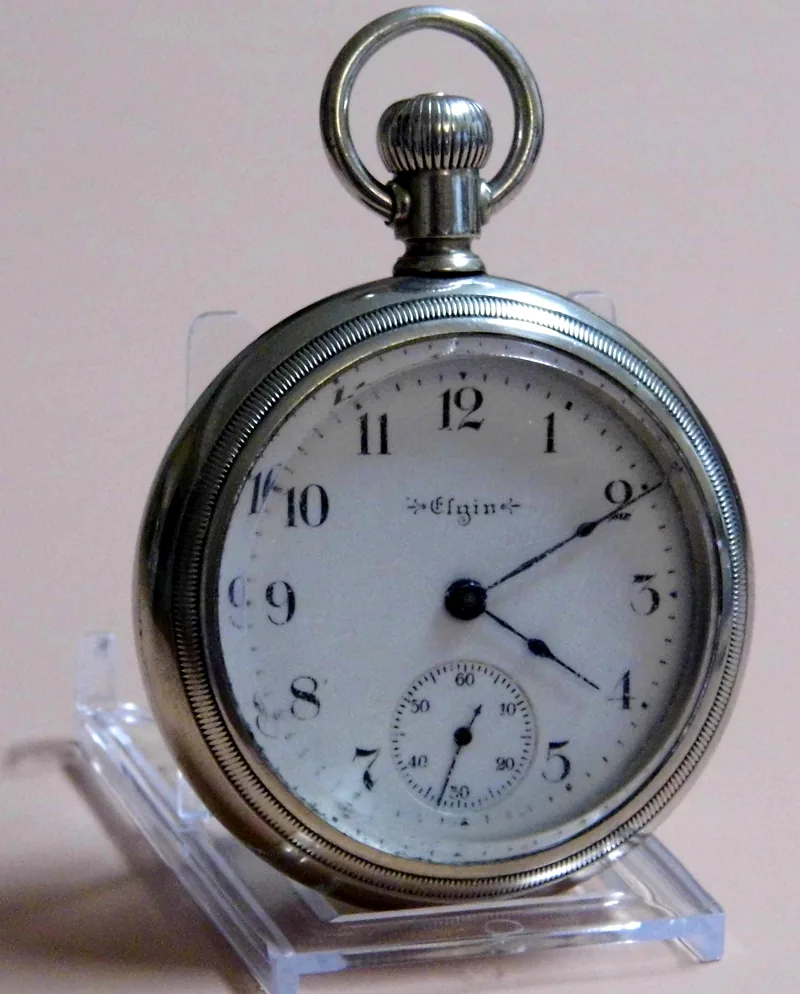
The visual soul of an Elgin conversion lies in its dial and hand assembly. Most 16s Elgin pocket watches featured multi-sunk vitreous enamel dials (porcelain cooked onto a copper substrate) or later metal dials with painted or raised numerals. Vitreous enamel dials are remarkably immune to UV fading or chemical oxidation, retaining their bright white appearance for over a century. However, enamel is extraordinarily brittle. Securing or modifying an original enamel dial during conversion requires extreme care; any uneven pressure applied by dial-foot screws can induce spiderweb cracks across the surface.
Dial feet placement on Elgin 16s movements is caliber-specific. When reorienting an open-face dial to position the crown at 3 o'clock, the dial feet will no longer line up with the receiving holes in the movement plate. Watchmakers must choose between three distinct pathways: sourcing an original rare hunter-case dial, carefully removing the original copper dial feet and soldering new feet in revised positions using low-temperature solder or specialized laser welding, or utilizing high-tack horological dial dots. Laser welding modern dial feet onto copper substrates is the professional standard, preventing thermal damage to the fragile face enamel while ensuring rigid mechanical lockup.
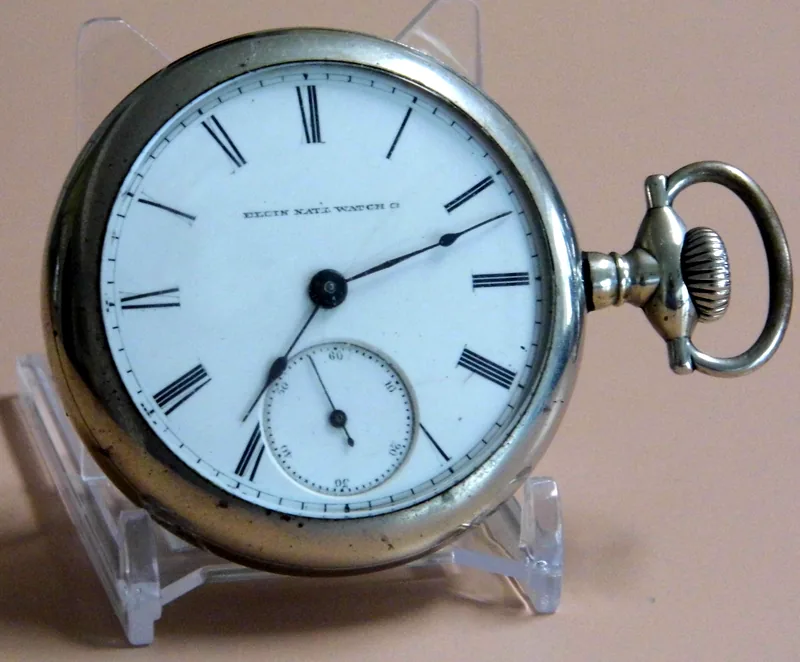
Hand fitting presents additional dimensional challenges. Vintage Elgin hand posts—comprising the hour pipe, cannon pinion, and fourth wheel sub-second pivot—were engineered for thick pocket watch crystal clearances. Modern streamlined wristwatch conversion cases have tighter tolerances between the crystal inner surface and the hand stack. Hands must be carefully selected, broached to precise friction-fit diameters, and bent or trimmed to ensure clearance above the sub-seconds register without touching the inner sapphire glass. Restoring original blued-steel hands through thermal re-bluing elevates the finished wristwatch, pairing authentic flame-tempered aesthetics with modern physical proportions.
Why 16s is More Common for Conversion
Within the vintage horological restoration community, the 16-size platform remains the absolute sweet spot for wristwatch adaptation, significantly outpacing conversions of 18-size, 12-size, or 10-size pocket watches. The reasons for this preference are both physical and mechanical. An 18-size movement possesses a plate diameter of 44.86mm; when housed inside a protective wristwatch case with adequate wall thickness and gasket channels, the resulting external diameter exceeds 50mm to 52mm. Unless worn over a flight jacket, an 18-size conversion is uncomfortably large for daily ergonomic wear on average human wrist sizes.
On the opposite end of the spectrum, smaller American pocket watch sizes like the 12s (39.37mm) or 10s (38.1mm) produce reasonable overall case diameters (41mm to 43mm), but they present significant mechanical trade-offs. Smaller movements were rarely manufactured to the absolute top-tier railroad grade specifications seen in the 16s lineup. Spare parts for 12s and 10s movements—such as original factory balance staffs, mainspring arbors, and replacement jewels—are noticeably harder to source than components for the ubiquitous 16-size workhorses. Elgin produced tens of millions of 16s calibers, establishing a deep reservoir of donor parts for modern watchmakers.
Furthermore, the physical geometry of the 16s movement aligns extraordinarily well with modern horological trends favoring prominent, instrument-style tool watches. Once installed in a custom **elgin 16s pocket watch to wrist conversion case**, the finished timepiece exhibits a case diameter typically measuring between 45mm and 47mm. This size directly mirrors classical aviation chronographs and military wristwatches, providing high legibility, mechanical presence, and historical authenticity that smaller dress movements cannot match.
Final Thoughts on Elgin 16s Conversions
Converting an Elgin 16s pocket watch into a functional wristwatch represents a harmonious marriage between historical preservation and practical horological utility. Rather than leaving an exquisite 100-year-old movement dormant in a display box, a proper conversion returns a masterpiece of American mechanical engineering to daily life. It allows modern observers to witness high-grade damaskeening, hand-finished steel balance bridges, and blued balance screws operating seamlessly through a clear display back.
However, successful execution demands an uncompromising approach to watchmaking technique. A master watchmaker must respect the inherent limitations of vintage mechanics. The absence of modern shock protection means a converted 16s wristwatch must be worn as a dress or casual piece rather than an sports watch. Routine maintenance—including ultrasonic cleaning of the wheel train, fresh synthetic lubrication with modern oils like Moebius 9010 and HP1300, and replacing fatigued mainsprings with modern alloy equivalents—is vital to prevent wear on century-old brass pivot holes and steel arbors.
Whether you choose to perform a conversion using a purpose-built 316L stainless steel case or seek out a custom watchmaker to undertake the project, the result is a truly unique, bespoke timepiece. An Elgin 16s wristwatch conversion is not merely a custom accessory; it is a wearable piece of American industrial history, carrying forward the legacy of the craftsmen who transformed Elgin, Illinois into a global capital of precision timekeeping.