1. Historical Background of Elgin 18s Movements
The Elgin National Watch Company, established in 1864 in Elgin, Illinois, stands as one of the monolithic pillars of American industrial horology. During the late 19th and early 20th centuries, Elgin manufactured tens of millions of mechanical movements, among which the 18-size (18s) was the quintessential standard for heavy-duty pocket timepieces. The 18s footprint was the standard for industrial workers, conductors, and railroad personnel who demanded absolute legibility, robust structural integrity, and uncompromising timekeeping precision under adverse environmental conditions. When horology enthusiasts ask, "can you convert elgin 18s pocket watch movements into wearable modern timepieces?" they are looking at bridging over a century of industrial engineering with contemporary personal aesthetics.
The evolution of the Elgin 18s spans several horological eras, transitioning from full-plate movements with key-wind and key-set mechanisms (such as the early Grade 69 and Grade 73) to advanced three-quarter plate and bridge-model configurations utilizing stem-winding and lever-setting systems. Iconic lines like the B.W. Raymond and Father Time grades set early benchmarks for precision before the stricter 16-size railroad standards dominated the market in the 1910s and 1920s. These 18s movements featured massive mainspring barrels, heavy cut bimetallic compensation balance wheels, and hand-finished dampening systems that were built to run continuously for generations with proper routine maintenance.
Understanding the historical context of these movements is vital for any watchmaker attempting a conversion today. Because these movements were designed during an age when timepieces resided safely in a vest pocket rather than exposed on a swinging wrist, their structural architecture reflects a completely different set of engineering priorities. To convert elgin 18s pocket watch into wristwatch configurations requires deep respect for the original mechanical layout, recognizing that modifying these historical artifacts involves bridging two fundamentally different eras of mechanical watchmaking.
2. Technical Specifications and Movement Architecture
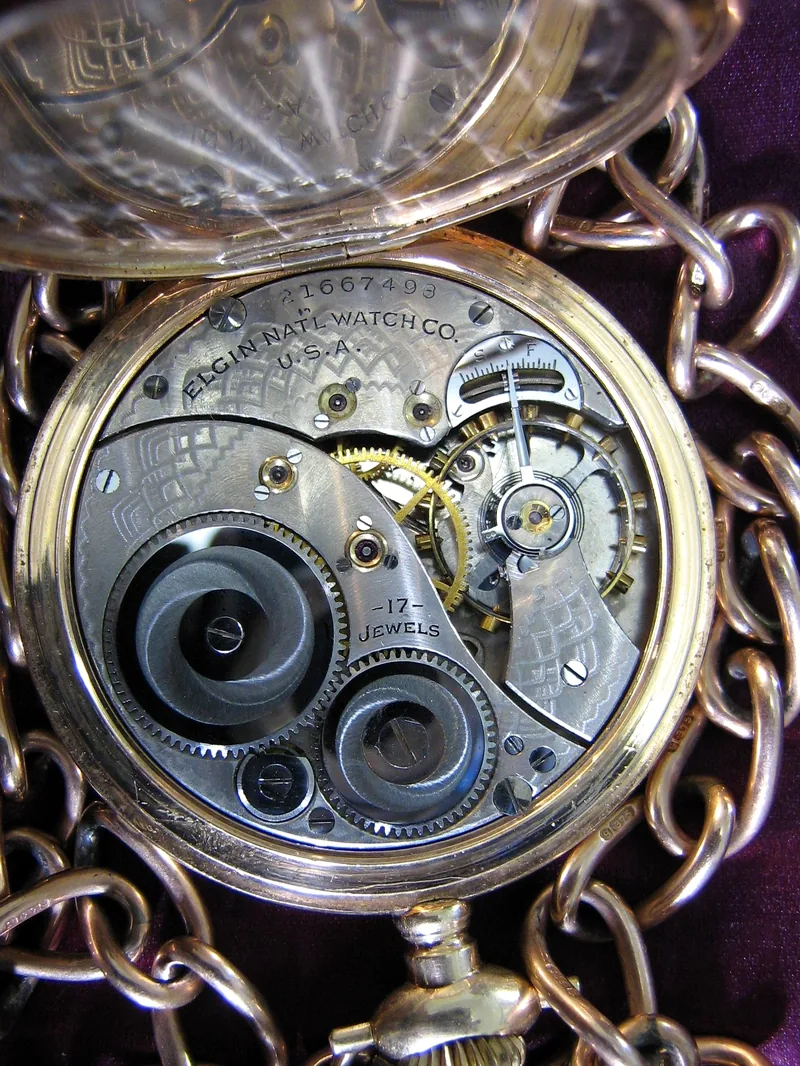
To execute a successful conversion, a watchmaker must understand the precise dimensional metrics defined by the historic American Lancashire gauge system. An 18-size movement features a dial plate diameter of 1 23/30 inches, which converts to approximately 44.86 millimeters in modern metric measurements. The total movement thickness, depending on whether it is a full-plate or three-quarter plate model, typically ranges between 7.5 millimeters and 9.5 millimeters. This substantial mechanical volume presents both unique engineering advantages—such as oversized components that are easy to inspect—and severe spatial constraints when fitting into a wearable wrist case.
Architecturally, Elgin 18s movements were built with exceptional component mass. The escapement operates at a traditional frequency of 18,000 vibrations per hour (2.5 Hz), characterized by a slow, resonant tick driven by a large balance wheel. High-grade models incorporate 17 to 21 ruby or sapphire jewels set in threaded gold settings (chatons), high-grade Breguet hairsprings with overcoils, micro-metric regulator assemblies (such as the Star regulator or Reed's patented regulator), and double-sunk enamel dials. The train gear teeth are precisely cut to minimize friction, transmitting power from a heavy-gauge mainspring housed within a wide mainspring barrel.
Another defining technical characteristic of American 18s movements is the winding and setting architecture. Unlike modern Swiss wristwatches that utilize a positive setting mechanism integrated directly within the movement, most Elgin 18s movements employ the American negative setting system. In this mechanism, the setting sleeve and detent reside inside the pocket watch case pendant rather than inside the movement itself. The movement features a square-ended center stem winding arbor that relies on external tension from the case spring to switch between the winding and setting positions. Master watchmakers must address this fundamental architectural quirk when planning any modern adaptation.
3. Challenges of Converting Elgin 18s to Wristwatch
The primary engineering hurdle when deciding to convert elgin 18s pocket watch into wristwatch formats revolves around sheer physical scale. Adding a protective stainless steel or bronze case around a 44.86mm movement yields a finished wristwatch with a total diameter ranging between 48mm and 52mm, excluding the crown assembly. The overall thickness often exceeds 15mm to 17mm when accounting for crystal clearance and caseback depth. For the vast majority of modern wrists, this creates severe ergonomics issues, turning the watch into a heavy, unbalanced piece susceptible to impacts against door frames, desks, and daily obstacles.
A second, critical technical vulnerability is the complete absence of shock absorption systems on the balance pivots. Antique Elgin 18s movements utilize solid steel balance staff pivots riding directly in rigid jewel bearings or metal bushings. Modern wristwatches use spring-loaded shock systems (such as Incabloc or KIF) designed to flex during violent wrist motions. Wrist impacts generate strong shear stresses that easily snap thin balance staff pivots on an unshocked 18s movement. A converted watch must be worn with extreme caution, treated as a delicate mechanical showcase rather than a tool for active daily wear.
Finally, movement orientation poses a significant visual and structural challenge. Elgin 18s pocket watches come in two standard dial layouts: Openface (Lépine) and Savonnette (Hunter). In an openface movement, the winding stem is located at the 12 o'clock position, placing the small seconds sub-dial directly opposite at 6 o'clock. Converting an openface movement into a standard wristwatch orientation (crown at 3 o'clock) rotates the entire dial, placing the small seconds at 9 o'clock—a layout familiar to pilot watches, but often visually unexpected. Conversely, hunter movements have the crown at 3 o'clock with small seconds at 6 o'clock, making them dial-wise ideal for wrist conversions, though hunter movements are statistically less common in high-grade 18s Elgin production.

4. Lug Welding and Case Selection
Acquiring or fabricating a dedicated elgin 18s pocket watch to wrist conversion case is the single most important step in establishing structural integrity and wearing comfort. Modern conversion cases are typically machined via multi-axis CNC from 316L stainless steel, titanium, or marine-grade bronze. These custom cases feature a wide inner aperture, precise internal retaining ledges, and heavy-duty screw-down display casebacks equipped with synthetic sapphire crystals to show off the decorated American movement. Utilizing a proper conversion case ensures the movement is supported uniformly without stressing the fragile pillar plates or dial feet.
Historically, early 20th-century watchmakers adapted pocket watches using a process known as lug welding directly onto original pocket watch cases (often referred to as trench watch modifications). In this procedure, solid wire lugs or curved silver arms were silver-soldered or TIG-welded onto the outer perimeter of a brass, silver, or gold-filled pocket watch case. While historically authentic, this approach presents challenges: vintage pocket watch cases lack structural rigidity, offer zero dust or moisture resistance, and often use soft metals that deteriorate under the constant leverage exerted by a modern leather strap.
When selecting or custom-machining an elgin 18s pocket watch to wrist conversion case, the watchmaker must calculate strap integration, lug drop angle, and overall lug-to-lug distance carefully. Given the massive 48mm+ outer diameter of the case, straight lugs will cause the watch to hover above the wrist, creating an uncomfortable gap and increasing the risk of catching on external objects. Downward-curved (drilled) lugs with a minimal lug-to-lug length (ideally kept under 56mm) are essential. Strap widths must be proportionally scaled to 22mm or 24mm to balance the visually heavy steel case and maintain proper weight distribution on the wearer's wrist.
5. Crown and Stem Solutions
Engineers and watchmakers face significant mechanical friction when adapting the stem and crown mechanism of an Elgin 18s movement to a modern conversion case. Because Elgin utilized the negative setting design (where the winding sleeve lives in the original case pendant), installing the movement into a modern case with a positive setting stem (or a modern custom-machined stem) requires delicate lathe work and custom engineering. The watchmaker must construct a specialized conversion sleeve or fit a custom winding stem featuring a square winding tip that engages the Elgin center winding arbor precisely while providing proper thread pitch for a modern crown.
Fabricating a custom stem requires turning high-carbon steel stock on a watchmaker's lathe (such as a Levin or Lorch lathe). The stem must feature a cylindrical pivot journal, a hardened square section to lock into the winding pinion, a recess groove for the case detent or locking screw, and a threaded section (typically Tap 9 or Tap 10) to accept the chosen crown. The tolerances here must be within fractions of a millimeter: if the square section is too long, the winding stem will bind against the mainplate; if it is too short, the movement will fail to switch reliably between winding and setting modes, risking stripped teeth on the clutch wheel.
Crown selection must carefully balance historical aesthetics with mechanical leverage. Winding a large, high-torque 18-size mainspring requires substantial manual effort compared to a tiny modern wristwatch movement. A small modern crown will hurt the user's fingers and fail to provide enough grip to turn the ratchet wheel. Watchmakers generally opt for oversized "Onion," "Pumpkin," or "Diamond" style crowns ranging from 8mm to 10mm in diameter. These crowns are fitted with internal nitrile rubber O-ring gaskets that seal against an extended case tube, providing basic dust and moisture resistance to preserve the unsealed antique movement components inside.
6. Dial and Hand Considerations
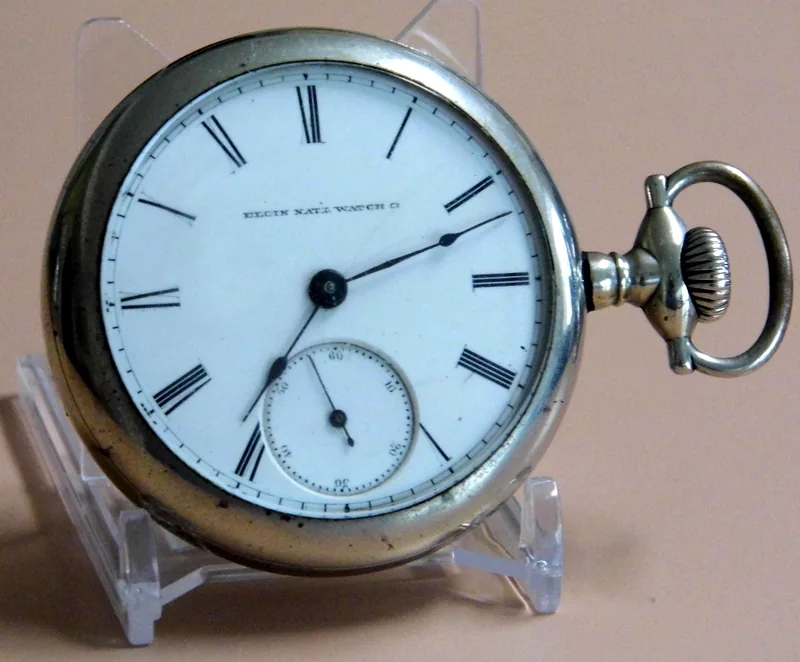
The vast majority of authentic Elgin 18s pocket watches feature brilliant white enamel (porcelain) dials fired over copper baseplates. These historic dials are absolute masterpieces of utilitarian art, featuring hand-painted double-sunk wells, sharp Roman or Arabic numerals, and red marginal minute tracks. However, enamel dials are exceptionally fragile; decades of exposure, thermal stress, and micro-flexing create hairline fractures. When re-casing an 18s movement, mounting pressure or improper handling can instantly cause an enamel dial to shatter or drop chips of glass into the balance wheel area.
Securing the dial and movement inside the modern conversion case requires precise alignment of the dial feet and spacer rings. Elgin 18s movements use dial feet locked into place by side-mounted copper screws or turn-latch cam mechanisms on the pillar plate. If a custom or aftermarket dial is required—for instance, to reposition the sub-seconds dial or reduce thickness—the new dial must be custom-cut with laser precision, painted, and fitted with copper dial feet silver-soldered at the exact angular coordinates matching the Elgin pillar plate holes. The dial casing ring must cushion the edge of the movement without placing direct downward force on the glass enamel surface.
Hand fitting presents another complex dimensional challenge. Original Elgin 18s hands—often made of heat-blued steel or spade-style plum steel—feature precise hole diameters tailored to large pocket watch arbors. The hour wheel pipe diameter, center minute arbor tip, and sub-seconds hand pivot are significantly thicker than those found on standard modern wristwatches. If original hands are damaged or missing during a restoration, finding suitable replacements requires searching for authentic vintage stock or custom-boring modern hands using fine broaches on a stake tool. Adequate vertical clearance between the hands, the dial surface, and the interior face of the top sapphire crystal must be meticulously measured using a depth micrometer.
7. Why 18s is Less Common for Conversion
While watchmakers frequently convert elgin 18s pocket watch movements for passionate collectors, the 18s size remains far less common in the custom horology market compared to the 16s (16-size) or 12s (12-size) platforms. The single primary factor driving this disparity is sheer wearability. A 16-size American movement (found in famous models like the Hamilton 992B or Elgin Grade 454) measures 43.18mm in diameter, fitting neatly into standard 44mm to 45mm conversion cases that mirror modern large sports watches. The 18-size movement, being almost 2 millimeters wider and noticeably thicker, pushes the outer case limits to proportions that are uncomfortable for standard daily wear.
From an aesthetic perspective, 18-size conversions often suffer from visual imbalance when paired with standard formal wear or modern clothing sleeves. The extreme height of the case, combined with the wide flat top crystal, makes the watch prone to severe angular impacts against everyday objects. Watchmakers recognize that an 18s wristwatch is effectively a "desk clock for the wrist." Unless the client possesses an exceptionally large wrist circumference, an 18s conversion watch looks overwhelmingly oversized, causing many custom builders to focus their production efforts on 16s American or 18-ligne European pocket watch movements (such as the ubiquitous Unitas/ETA 6497 and 6498 platforms).
Furthermore, horological preservation ethics play a central role in the rarity of these conversions. High-grade, complete, undamaged 18-size Elgin pocket watches—especially those housed in original, engine-turned gold-filled or sterling silver cases—are irreplaceable historical artifacts. Disassembling a fully functional, museum-grade 18s Railroad pocket watch simply to scrap its case and build an oversized wristwatch is increasingly frowned upon in the professional horological community. Master watchmakers strongly prefer to perform conversions using "orphan" movements—movements whose original precious metal cases were melted down during mid-century gold rushes, leaving high-grade mechanical engines without a home.
8. Final Thoughts on Elgin 18s Conversions
When executing a conversion with proper technical discipline, transforming an 18-size Elgin movement into a wristwatch creates a breathtaking physical monument to American industrial history. Seeing a massive, slow-beating 18,000 vph balance wheel oscillating through a clear sapphire display caseback offers a tactile, mechanical experience that modern mass-produced wristwatches simply cannot duplicate. Every hand-turned stem, custom spacer ring, and meticulously restored blued steel hand represents an artistic bridge connecting late-19th-century heavy manufacturing with contemporary artisanal craft.
For collectors and craftspeople considering this path, success requires selecting the right candidate movement, utilizing a high-precision elgin 18s pocket watch to wrist conversion case, and respecting the inherent limitations of unshocked balance staffs and delicate enamel dials. When preserved in a custom-built enclosure, an Elgin 18s movement stops being an obsolete pocket tool tucked away in a drawer and becomes a living, functional piece of kinetic engineering proudly displayed on the wrist.
Ultimately, deciding to convert elgin 18s pocket watch into wristwatch format is a labor of love that requires patience, specialized watchmaking tools, and custom machining skills. For those who undertake the challenge, the reward is an unrepeatable, conversation-starting masterpiece—a ticking testament to the brilliance of the Elgin National Watch Company that can be worn, admired, and passed down to future generations of horological enthusiasts.