Historical Background of Elgin 6s Movements
The Elgin National Watch Company, established in 1864 in Elgin, Illinois, stands as one of the monolithic titans of American industrial horology. Over its operational lifespan spanning more than a century, Elgin produced over 60 million mechanical movements, playing a pivotal role in democratizing precise timekeeping. During the late 19th and early 20th centuries, standard pocket watch sizes were governed by the Lancashire gauge system. While massive 18-size (18s) and 16-size (16s) movements dominated men’s railroad and field horology, smaller form factors were required for dress pocket watches, pendant watches, and early utility timepieces. Enter the Elgin 6-size (6s) movement family, which hit its production zenith between the 1890s and the 1920s.
The 6s size class was originally designed as a high-grade option primarily aimed at women’s chatelaine or pendant watches, as well as men's refined gentleman’s dress pocket watches. Movements such as the famous Elgin Grade 117, 159, 286, and 303 embodied exemplary American manufacturing techniques: damaskeened nickel or gilded brass plates, raised jewel settings, cut bimetallic compensation balances, and finely executed regulator assemblies. These movements were built to withstand generations of use, featuring heavy-gauge brass mainspring barrels and hardened steel pinions that rivaled European high-horology standards of the same era.
As wristwatches began to supplant pocket watches during and immediately following World War I, the 6s movement occupied a unique historical crossroad. While early "trench watches" utilized converted 0-size or 3/0-size movements, horologists and retrofitting watchmakers quickly recognized that the 6s architectural scale offered an optimal middle ground. Today, modern artisans who undertake the project to convert elgin 6s pocket watch into wristwatch setups are participating in a lineage of watchmaking adaptation that spans over a century, transforming pocket-bound relics into functional wrist-worn micro-engineering art.
Technical Specifications and Movement Architecture
To successfully execute a conversion, a watchmaker must possess a rigorous understanding of the 6s caliber's dimensional metrics and gear train architecture. In the Lancashire sizing system, a 0-size movement measures 1 and 5/30 inches in plate diameter, with each additional size adding 1/30 of an inch. Consequently, an Elgin 6s movement features a bare movement plate diameter of approximately 1.35 inches, or 34.29 mm. This standard physical footprint makes it markedly smaller than an 18s (approx. 44.86 mm) or a 16s (approx. 43.18 mm), allowing it to sit naturally within contemporary wrist-wearable parameters without looking cartoonishly oversized.
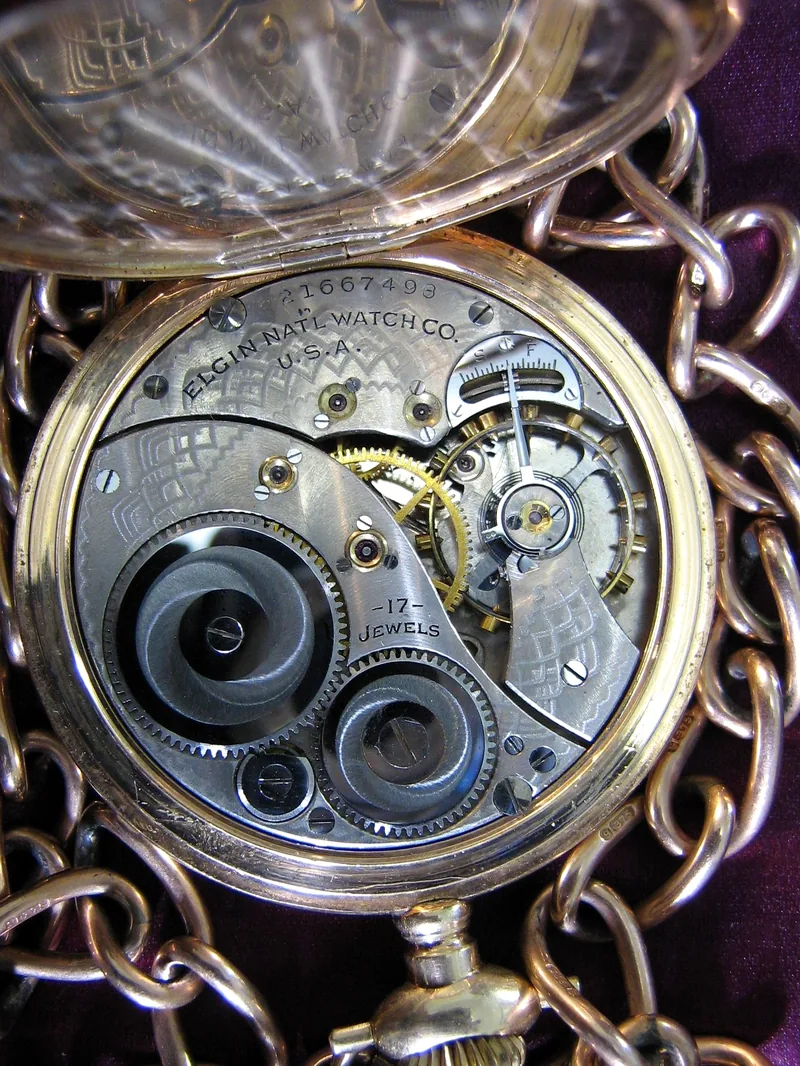
Architecturally, Elgin 6s movements were produced in both open-face (Lépine) and hunting-case (Savonnette) configurations. Open-face movements feature the winding stem arbor aligned directly at 12 o'clock in relation to the sub-seconds dial at 6 o'clock. Hunting-case movements, designed for cases with a protective spring-loaded cover, position the winding stem at 3 o'clock, with the small seconds hand positioned at 9 o'clock or 6 o'clock depending on the specific wheel train geometry. Most 6s movements utilize a standard going train layout with a side-lever or straight-line lever escapement beating at a traditional frequency of 18,000 vibrations per hour (vph) or 2.5 Hz. Jewel counts across 6s grades typically range from 7 jewels in base utility grades up to 15, 17, or even 19 jewels in high-tier models, featuring screw-set ruby or sapphire jewels in gold chatons.
The oscillator assembly usually consists of a bimetallic split-balance wheel with brass and steel rims designed to compensate for temperature variations, paired with a blued steel Breguet overcoil hairspring. Power delivery is managed via a manual-wind safety-barrel mechanism designed to protect the train wheels in the event of a mainspring breakage. Understanding these exact specifications—particularly the 34.29 mm plate diameter, the 4.5 mm to 5.5 mm movement height, and the balance wheel clearance—is vital prior to cutting metal or selecting conversion components.
Challenges of Converting Elgin 6s to Wristwatch
Clients and enthusiasts frequently ask master craftspeople: can you convert elgin 6s pocket watch components into a reliable, daily-wear wristwatch? The technical answer is a resounding yes, but it comes with severe engineering caveats that require advanced bench watchmaking skills to resolve. The foremost obstacle is the absolute lack of shock protection on vintage balance pivots. Pocket watch movements were designed to rest vertically in a vest pocket or horizontally on a nightstand. They lack modern shock-absorption systems such as Incabloc, KIF, or Novodiac. The delicate balance staff pivots—often measuring just 0.07 mm to 0.09 mm in diameter—are exceptionally vulnerable to snapping if the converted wristwatch suffers an impact.
A second fundamental challenge relates to dust and moisture resistance. Original 19th-century pocket watch cases relied on snap-fit or threaded bezels that lacked elastomeric O-ring gaskets. When transferring an Elgin 6s movement into a wristwatch environment, the movement is exposed to heightened levels of wrist perspiration, ambient humidity, and sudden thermal shifts. Without creating a hermetically sound environment inside the replacement case, environmental moisture will rapidly oxidize the unplated steel screws, balance spring, and winding pinion steel.
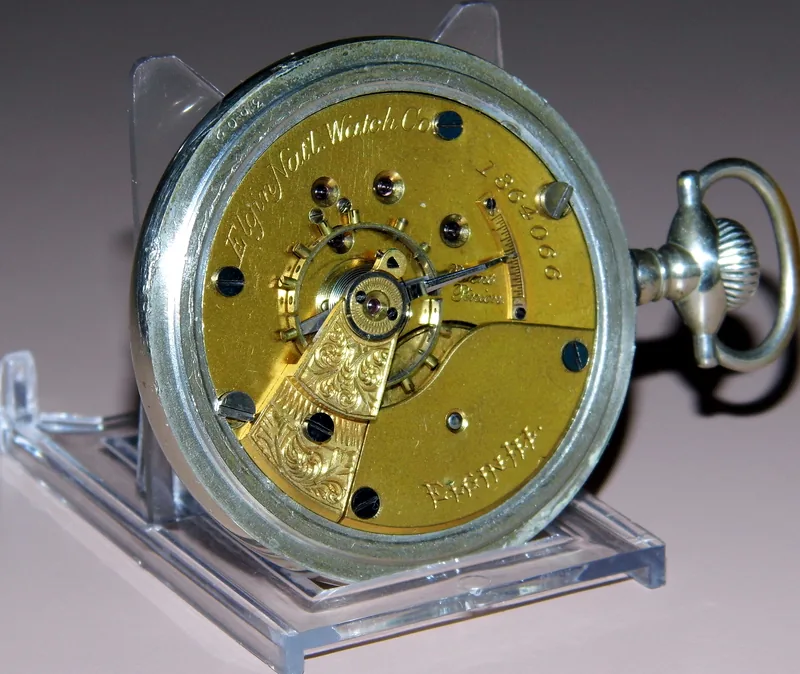
Finally, movement orientation presents a severe aesthetic and functional design dilemma. If you attempt to convert elgin 6s pocket watch movements from a hunting-case origin, the standard stem location places the crown at 3 o'clock, but the sub-seconds register lands at 9 o'clock unless a custom dial is fabricated. Conversely, converting an open-face 6s movement results in the crown sitting at 12 o'clock on the wrist—resembling a traditional bullhead chronograph—unless the dial is rotated, which subsequently shifts the sub-seconds subdial to the 3 o'clock position. Resolving these spatial orientation issues requires strategic movement selection and precise dial re-engineering.
Lug Welding and Case Selection
When executing a conversion, the watchmaker faces two primary path choices regarding housing: modifying an original vintage pocket watch case by adding wire lugs, or retrofitting the movement into a modern, purpose-built elgin 6s pocket watch to wrist conversion case. The traditional retro-fit approach involves taking the movement’s original sterling silver, gold-filled, or nickel pocket watch case, carefully removing the pocket watch bow and crown neck, and silver-brazing or TIG-welding custom wire lugs directly to the case band at 12 and 6 o'clock positions.
Lug welding demands extreme thermal control. The watchmaker must completely strip the case of all movement components, crystals, and gaskets. Using high-silver content hard solder and a micro-torch (or a precise jewelry laser welder), wire lugs fabricated from silver, gold, or surgical stainless steel are fused to the perimeter. Laser welding is heavily preferred over torch soldering today because it delivers localized heat, preventing annealing or warping of the host case band and avoiding heat-discoloration on precious metals. Lugs must be set perfectly parallel to the longitudinal axis of the case to ensure proper strap alignment and comfortable wrist ergonomics.
Alternatively, the modern custom case approach utilizes a modern 316L stainless steel wristwatch case designed specifically around the proportions of classic pocket watch calibers. Because a bare 6s movement measures ~34.3 mm, it can be fitted into a modern 38 mm to 41 mm wristwatch case using a custom-machined movement ring. This movement ring—typically turned on a lathe from brass, Delrin, or stainless steel—bridges the dimensional gap between the outer perimeter of the Elgin 6s mainplate and the interior mounting ledge of the modern case. The movement is secured to the spacer ring via custom-shaped casing clamps and screws, ensuring zero axial or radial movement during wear.
Crown and Stem Solutions
One of the most complex mechanical hurdles when you convert elgin 6s pocket watch movements to a modern wrist case is the winding and setting system architecture. The vast majority of American pocket watches from the Elgin factory utilized a "negative setting" mechanism (also known as a sleeve-set system). In a negative set design, the detent system (the mechanism that catches and holds the stem in either the winding or time-setting position) resides inside the neck of the pocket watch case, rather than inside the movement itself. The stem within the movement is spring-loaded naturally into the setting position, and the case sleeve forces it downward into the winding position.
When transferring a negative-set Elgin 6s movement into a modern wristwatch case, traditional positive-set wristwatch stems will not interface correctly without significant modification. The watchmaker must execute one of three solutions:
- Adapt the Original Case Sleeve: Unthread the original brass or steel setting sleeve from the original pocket watch case, machine external threads onto it using a micro-lathe, and thread it into the pendant tube of the modern conversion case.
- Fabricate a Custom Split-Stem Assembly: Create a two-piece male/female square-coupling stem. The male stem portion is installed permanently within the movement's winding pinion, while the female section—connected to the external wristwatch crown—slips over it, permitting easy movement insertion and removal while retaining proper setting pressure.
- Convert to Positive Set via Movement Modification: On select Elgin 6s grades that featured native positive-set mechanics (or by swapping setting levers from compatible donor grades), the setting mechanism can be set up so the stem naturally stays in the winding mode until pulled outward by an internal setting lever catch.
Furthermore, custom stem extension turning is frequently required. Modern wristwatch cases usually have longer pendant tubes fitted with internal rubber double-O-ring gaskets for water resistance. The watchmaker must turn an extension rod on a watchmaker's lathe, thread it to match the standard American thread pitch (typically TAP 8 or TAP 10), heat-treat the carbon steel to restore spring temper, and secure the crown with high-strength thread-locking compound.
Dial and Hand Considerations
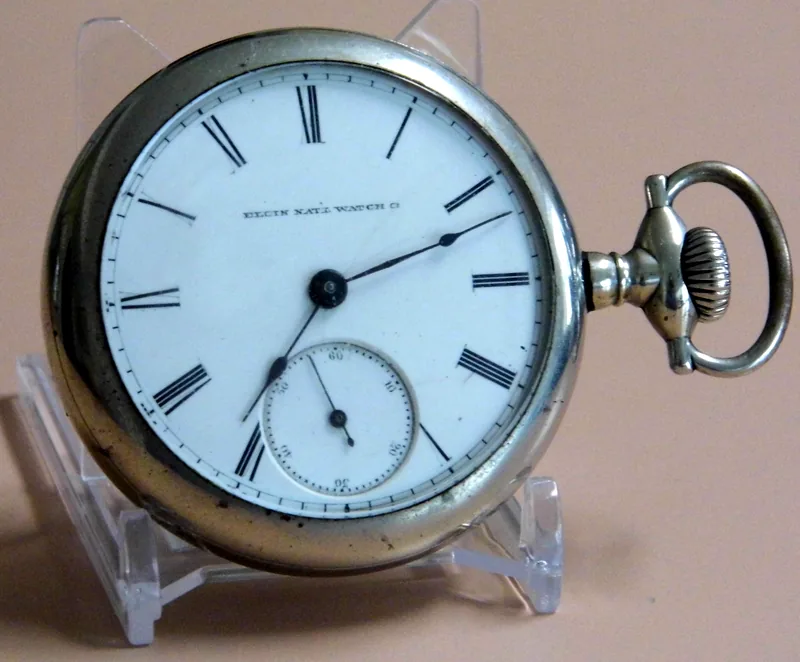
The aesthetic soul of an Elgin conversion lies in its dial and hand assembly. Vintage Elgin 6s pocket watches feature magnificent double-sunk or single-sunk vitreous enamel (porcelain) dials, or stamped silver/gold metal dials with engine-turned Guilloché patterns. Porcelain dials present extreme fragility risks. When removing a century-old enamel dial from its movement mainplate, copper dial feet can snap, or radial hairline fractures ("crazing") can rapidly propagate across the enamel surface if uneven pressure is applied with dial removers.
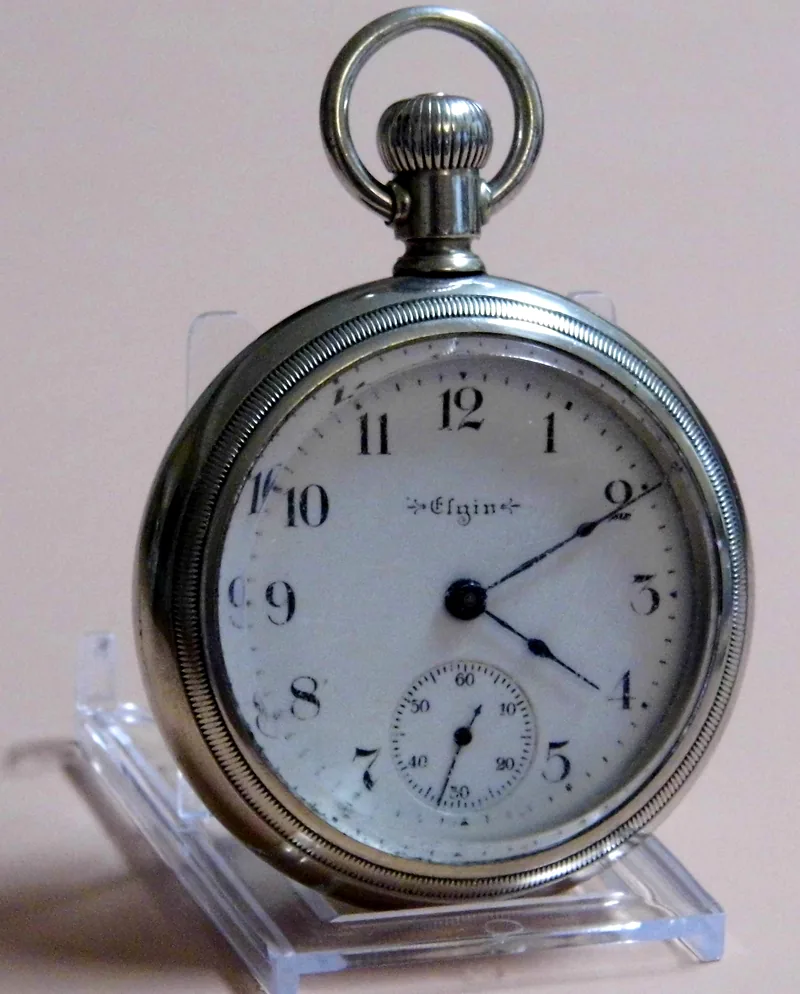
If the target case orientation requires rotating the dial by 90 or 180 degrees—for instance, repositioning an open-face dial so the winding stem rests at 3 o'clock on the wrist—the original dial feet will no longer line up with the locating holes on the Elgin 6s pillar plate. The watchmaker must carefully snip off the original copper feet flush with the back of the dial plate using micro-flush cutters. Modern adhesive dial dots are strictly avoided in high-grade restorations; instead, new copper dial feet are precision-soldered onto the dial back using a low-temperature capacitive-discharge spot welder, preserving the pristine porcelain face without thermal shock damage.
Hand fitting presents an equally demanding sizing challenge. Hand arbor hole diameters for classic American pocket watches do not conform to modern Swiss standards (such as the ubiquitous 1.50mm/0.90mm/0.21mm sizing used on Unitas 6497/6498 calibers). An Elgin 6s hour wheel pipe, cannon pinion, and second bit arbor require custom-broached or re-bushed hand hubs. High-grade blued steel spade, moon, or Louis XV hands must be meticulously selected. The watchmaker must ream the hand holes with fine diamond broaches until an exact friction fit is achieved on the hour wheel and cannon pinion arbors. Furthermore, modern wrist cases offer significantly lower vertical crystal clearance than deep pocket watch bezels. The hands must be carefully leveled using fine-nosed hand-truing pliers to ensure they clear each other and the underside of the sapphire crystal without rubbing or causing positional stopping.
Why 6s is More Common for Conversion
Within horological conversion circles, the Elgin 6s size movement is widely considered the absolute optimal size class for custom wrist projects. To understand why, one must analyze the physical scale of alternative pocket watch sizes. An 18-size movement has a plate diameter of nearly 45 mm; once housed inside a protective wristwatch case with standard wall thickness and water-resistant bezels, the finished watch measures a massive 48 mm to 52 mm in diameter. Unless worn over a flight jacket, an 18s conversion watch is ergonomically impractical, visually overwhelming, and prone to severe shock damage due to the sheer mass of its case and balance wheel.
| Elgin Movement Size | Plate Diameter (mm) | Average Finished Wristwatch Case Outer Diameter | Wearability & Ergonomic Practicality |
|---|---|---|---|
| 18s | 44.86 mm | 48.0 mm - 52.0 mm | Extremely bulky; impractical for standard daily wrist wear. |
| 16s | 43.18 mm | 45.0 mm - 48.0 mm | Large statement piece; heavy on wrist, prone to edge impacts. |
| 6s | 34.29 mm | 38.0 mm - 41.0 mm | Ideal modern wristwatch proportion; superior comfort and balance. |
| 0s / 3/0s | 29.63 mm / 27.94 mm | 33.0 mm - 36.0 mm | Historically accurate trench watch size; highly delicate staffs. |
Conversely, tiny 0-size, 3/0-size, or 10/0-size movements—while dimensionally closer to mid-century vintage wristwatches—feature exceptionally thin balance pivots and tiny mainsprings that generate low torque. These micro-scale vintage pocket watch calibers are notoriously difficult to service, feature poor power reserves, and are highly susceptible to dirt accumulation and positional variance. The 16-size calibers, while immensely popular due to railroad grade availability, still demand a finished case size of 45 mm or larger.
The 6s size hits the horological sweet spot. Its 34.29 mm movement core installs beautifully inside contemporary 38 mm to 41 mm cases—the exact golden ratio of modern watch design. It possesses enough rotational momentum in its balance wheel to maintain solid ISOHRONISM and stable timekeeping across 36 hours of run time, while staying small enough to preserve standard sleeve-cuff clearance. Additionally, because Elgin produced hundreds of thousands of 6s movements, donor parts—such as escape wheels, winding pinions, balance staffs, and mainspring barrels—are widely available across auction houses and material supply houses, making long-term servicing highly viable.
Final Thoughts on Elgin 6s Conversions
The process required to convert elgin 6s pocket watch components into an everyday wearable wristwatch is a serious technical undertaking. It demands an intersection of traditional horological restoration, precision micro-machining, and artistic sensibility. While purists may argue that pocket watches should remain in their original cases, many orphan movements—whose original precious metal cases were melted down for gold or silver scrap during economic downturns—are left completely useless without a home. Converting these abandoned 6s movements breathes vibrant new life into American manufacturing history.
Before committing to a conversion project, the watchmaker or collector must ensure the movement undergoes a complete overhaul: modern synthetic lubrication (such as Moebius 9010 for high-speed pivots and Moebius 9415 for escape pallet stones), dynamic poise checking of the balance wheel, hairspring centering, and rigorous multi-positional timing adjustment on a digital timegrapher. When executed with precision, an Elgin 6s wrist conversion is far more than a simple novelty—it becomes a living, ticking piece of mechanical heritage, transformed from an obsolete vest-pocket tool into a bespoke, functional piece of wrist art that can be enjoyed for another hundred years.