1. Historical Background of Elgin 8s Movements
The Elgin National Watch Company, established in 1864 in Elgin, Illinois, stands as one of the towering titans of American industrial horology. Over its century of operation, Elgin manufactured over 60 million mechanical timepieces, setting benchmark standards for precision mass production, interchangeable parts, and meticulously finished movements. Among the diverse array of sizing standards produced under the American Lancashire gauge system, the size 8 (commonly denoted as 8s) holds a uniquely compelling place in American watchmaking history. Manufactured predominantly from the late 19th century through the middle of the 20th century, 8s movements were originally designed as high-grade mid-sized pocket watches for gentlemen seeking a less bulky option, as well as premium pendant watches for ladies and utility timing instruments.
During the golden age of American pocket watch production, size standards were defined by the outer plate diameter of the movement, where 0-size measured 1 and 5/30 inches, with each numerical increase adding 1/30th of an inch. The 8s movement, measuring approximately 36.41 mm (1.433 inches) in plate diameter, represented an ideal middle ground in mechanical design. Unlike the giant 18s railroad timepieces or tiny cocktail watch mechanisms, the 8s movement gave Elgin’s master horologists enough surface area to implement sophisticated gear train layouts, robust escapements, expansion balances, and high-jewel counts, while keeping the overall footprint manageable. These movements were outfitted with gorgeous nickel or gilded brass plates featuring intricate damaskeening—a decorative surface pattern technique applied with precision machines that gives American movements their signature iridescent shimmer.
Today, as interest in vintage mechanical timepieces shifts toward custom, wearable horology, the decision to convert Elgin 8s pocket watch into wristwatch configurations has gained immense traction among master watchmakers and modern collectors alike. Because vintage pocket watches are often discarded when their precious metal cases are melted down for scrap, thousands of pristine, fully operational Elgin 8s movements remain orphaned without a home. Repurposing these mechanical marvels into custom wristwatches honors the incredible engineering heritage of Elgin while resurrecting historic American watchmaking into a modern, wearable form factor.
2. Technical Specifications and Movement Architecture
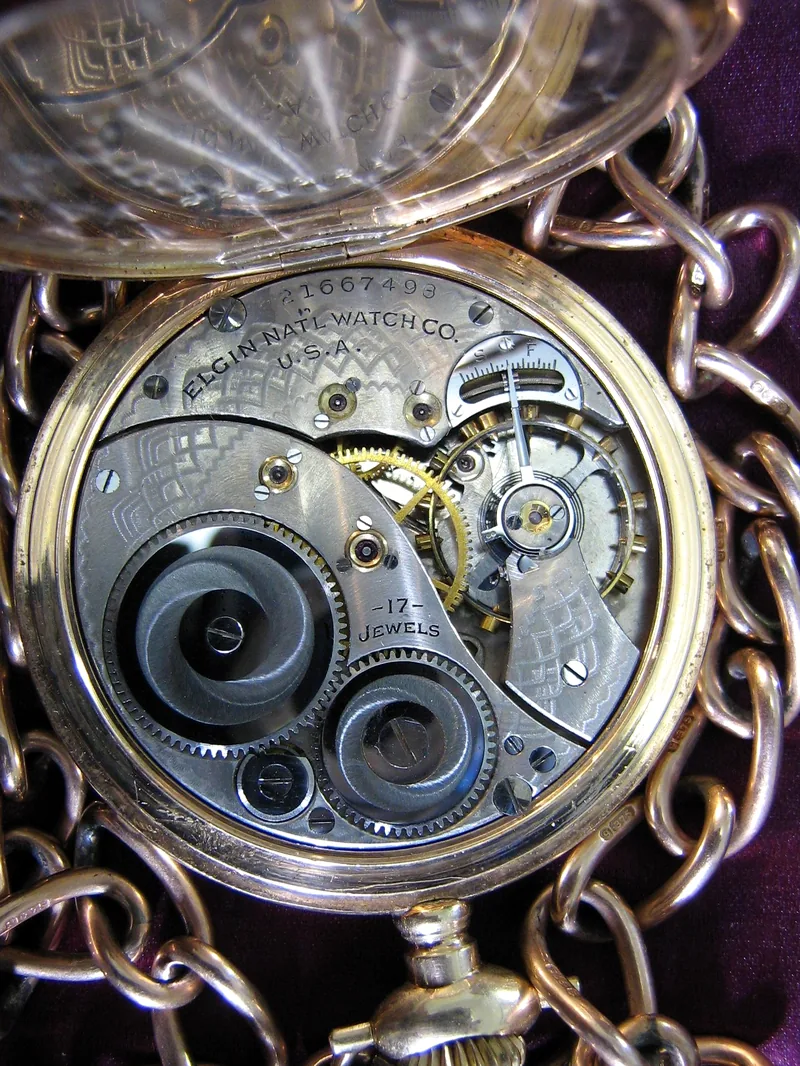
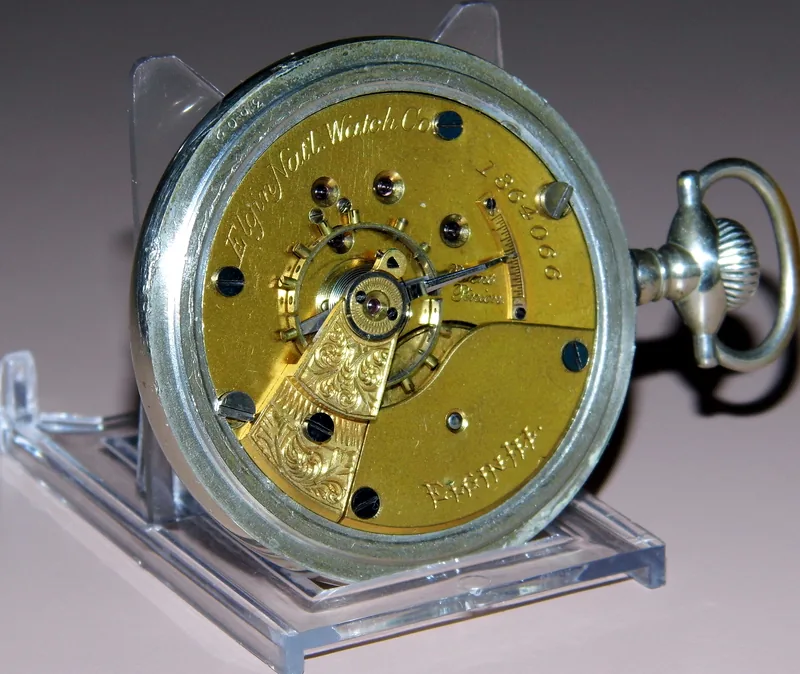
To successfully perform a conversion, a watchmaker must thoroughly understand the architecture and mechanical specifications of the Elgin 8s calibers. Across different production runs, Elgin manufactured 8-size movements in various configurations, including full-plate, three-quarter plate, and finger-bridge architectures. The movement diameter of 36.41 mm makes it exceptionally rigid compared to modern wrist calibers. Most high-grade 8s movements feature 7, 15, 17, or 19 jewels, with top-tier grades employing ruby or sapphire jewel bearings mounted in raised gold or brass screwed chatons. The escapement is typically a traditional Swiss-style lever escapement with a cutout bimetallic compensation balance wheel, fitted with gold timing screws and a Breguet overcoil hairspring designed to minimize positional error.
A crucial distinction in Elgin 8s architecture lies in the winding and setting mechanics, as well as the distinction between open-face (Lépine) and hunting-case (Savonnette) movement layouts. Open-face 8s movements feature the balance wheel, train wheel layout, and dial configuration arranged such that the winding stem resides at 12 o'clock, with the sub-seconds dial positioned directly opposite at 6 o'clock. Conversely, hunting-case 8s movements position the winding stem at 3 o'clock relative to a sub-seconds dial at 6 o'clock. This distinction is paramount when planning a conversion: a hunting-case layout natively matches the standard wristwatch architecture, whereas an open-face movement rotated to place the winding stem at 3 o'clock will shift the sub-seconds dial to the 9 o'clock position.
Furthermore, Elgin 8s movements incorporate a variety of micro-metric precision regulators, most notably the Star Regulator and the Reed's patent box regulator. These mechanisms allow fine adjustment of the active length of the hairspring via a precision screw thread, enabling micro-second daily adjustments. The mainspring barrel is housed within a sturdy arbor assembly, often utilizing a going barrel system that continues powering the gear train even while winding. Understanding these precise spatial dimensions, train wheel clearances, and jewel setting depths is essential before attempting any disassembly, cleaning, re-jeweling, or casing operation on these historic movements.
3. Challenges of Converting Elgin 8s to Wristwatch
When clients ask, "can you convert elgin 8s pocket watch timepieces into modern wristwatches safely?", the answer is unequivocally yes—but it presents substantial technical challenges that require advanced horological expertise. The primary vulnerability of any vintage pocket watch movement adapted for wrist wear is the total absence of shock protection systems on the balance staff pivots. Modern wristwatches utilize springs like Incabloc or KIF to absorb kinetic impacts, whereas a vintage Elgin 8s balance staff rests directly in rigid jewel cap settings. The balance staff pivots on an 8s caliber are micro-machined to tolerances under 0.10 mm in diameter; a sharp impact, drop, or sudden knock against a hard surface can easily shear these delicate pivots, stopping the watch instantly and requiring a custom replacement staff to be turned on a watchmaker's lathe.
A second major technical challenge involves dust, moisture, and magnetic field resistance. Vintage pocket watches were intended to live shielded inside thick gold or silver pocket cases tucked into soft vest pockets. Exposed to the harsh environment of a modern human wrist—sweat, ambient humidity, atmospheric pressure shifts, and daily modern magnetic fields from laptops and smartphones—an Elgin 8s movement will quickly degrade without adequate external shielding. The hairsprings in classic 8s calibers are crafted from un-treated high-carbon steel, making them exceptionally susceptible to magnetization, which causes adjacent coils to stick together and forces the movement to run ridiculously fast.
Finally, spatial constraints present unique mechanical hurdles during the conversion process. The canon pinion height, hour wheel clearance, and hand-setting depths on an 8s movement were calibrated for deep, domed pocket watch crystals and thick porcelain enamel dials. When translating these components into a sleek modern wrist case, tolerances become microscopically tight. If the interior height of the top crystal does not provide sufficient clearance, the center sweep or sub-seconds hand will rub against the inner glass face, causing amplitude drop, irregular timekeeping, or outright stoppages.
4. Lug Welding and Case Selection
The foundation of any successful conversion project lies in securing a high-grade, precision-engineered elgin 8s pocket watch to wrist conversion case. Historically, early watchmakers attempted to convert pocket watches by soldering crude wire lugs directly onto the perimeter of the original pocket watch case. While this yields a vintage, antique aesthetic, soft-soldered or TIG-welded lugs on thin, worn pocket watch cases frequently lack structural integrity, suffer from metal fatigue, and fail to provide water resistance. Modern master watchmakers instead utilize custom-machined, 316L stainless steel conversion cases engineered specifically to accept 36.4 mm movement plates.
These specialized conversion cases are crafted either with integrated solid lugs or reinforced spring bar holes designed to accommodate 20 mm or 22 mm leather straps. The primary technical objective when selecting or custom-milling an 8s conversion case is ensuring absolute axial and radial centering of the movement. Because an 8s movement lacks modern case-screw flanges found on contemporary wrist calibers, the watchmaker must machine a custom movement spacer ring (often made from solid brass or stainless steel) that fits snuggly between the perimeter of the Elgin pillar plate and the inner wall of the steel wristwatch case. This spacer ring features precision-tapped set screws that lock the movement immovably in place, preventing micro-shifts during daily wear.
Equally critical is the selection of front and rear crystals. Modern conversion cases almost universally integrate scratch-resistant sapphire crystals with anti-reflective coatings on both sides. The caseback should feature an optical-grade sapphire exhibition display port, allowing the wearer to admire Elgin's legendary engine-turned damaskeening, polished winding wheels, and glowing ruby chatons. The case seals must be fitted with custom synthetic fluorocarbon O-rings around the threaded caseback and crown tube to achieve a reliable dust-proof and splash-resistant enclosure.
5. Crown and Stem Solutions
Resolving the winding stem and crown geometry is widely considered the most mechanically complex aspect of learning how to convert elgin 8s pocket watch internals into modern cases. American pocket watches of the late 19th and early 20th centuries relied heavily on two distinct setting systems: positive setting mechanisms and negative setting mechanisms (often referred to as sleeve-setting mechanisms). In a negative setting system, the spring-loaded detent mechanism that alternates between the "winding" and "setting" positions is located inside the neck of the pocket watch case rather than inside the movement plate itself. The movement stem is simply a truncated square stem that slots into a hollow sleeve built into the case.
When transferring a negative-set Elgin 8s movement into a modern wristwatch case, the watchmaker faces an immediate problem: modern wristwatch conversion cases do not contain built-in spring sleeves. To solve this, the horologist must either adapt a conversion sleeve into the crown tube of the new case or re-engineer the setting train. Many custom convertors machine a specialized stem adapter that couples a precision-milled male square adapter (matching the square winding arbor hole of the Elgin 8s winding pinion) to a standard metric threaded stem rod (typically Tap 9 or Tap 10). This permits the fitment of a modern threaded wrist crown while maintaining the precise axial engagement required to turn the winding wheels cleanly without binding.
The aesthetic choice of the crown must also harmonize with the physical proportion of the larger case profile. Vintage Elgin pocket watches were originally hand-wound daily using broad, grippy onion crowns, pumpkin crowns, or crown-and-bow assemblies. When constructing a converted wristwatch, watchmakers generally favor oversized onion or diamond-shaped crowns. These larger profiles honor the visual design language of early 20th-century aviation timepieces while providing the user with ample mechanical leverage to hand-wind the stiff mainspring of an 8s caliber without placing excessive lateral torque on the winding stem and stem tube gasket.
6. Dial and Hand Considerations
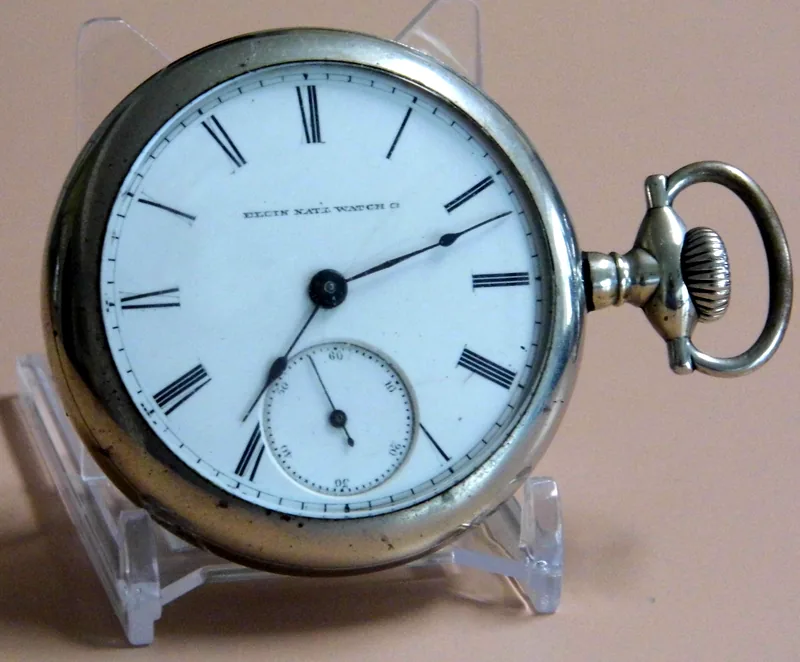
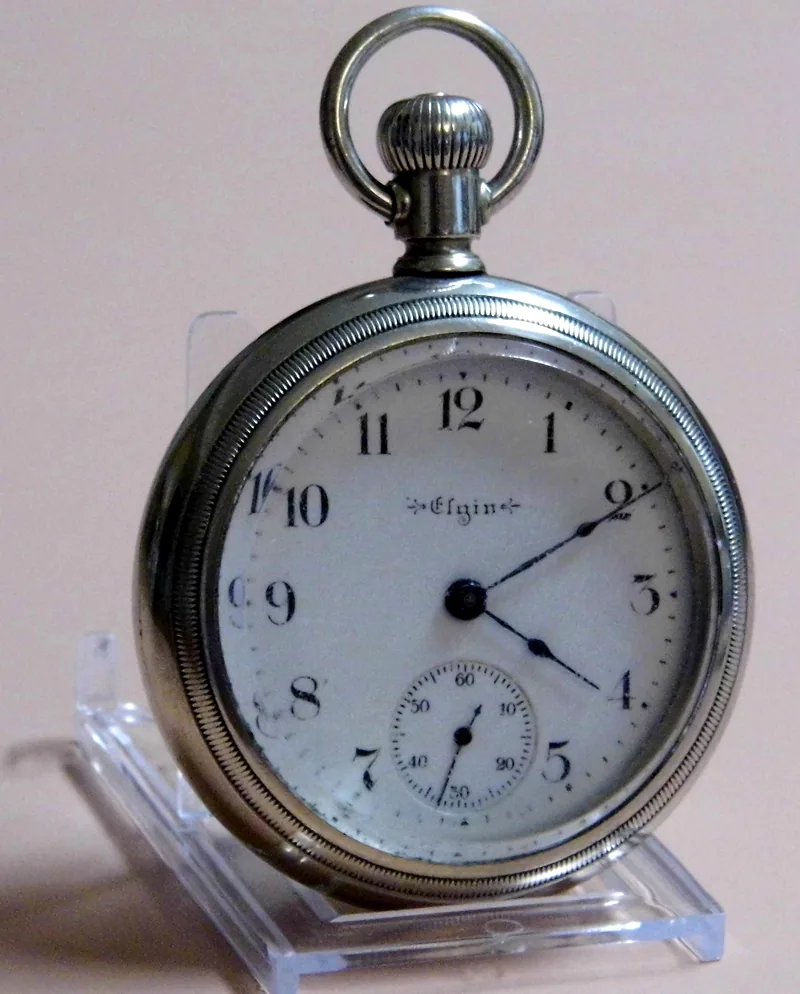
The dial and hand assembly is the visual heart of an Elgin 8s conversion, demanding surgical delicate precision during restoration and installation. Original Elgin 8s dials are typically double-sunk or single-sunk vitreous enamel fired onto copper baseplates, featuring crisp black enamel Roman or Arabic numerals and delicate outer track markers. Vitreous enamel dials are extraordinarily durable against light and aging, but they are extremely brittle. Over a century of temperature fluctuations, these dials often develop microscopic hairline fractures ("crazing"). Removing dial screws, lifting hand stacks, or applying pressure during case fitting can easily cause these hairline cracks to spider-web or chip off entirely.
If the watchmaker is using an open-face (Lépine) Elgin 8s movement, rotating the crown to the standard 3 o'clock wristwatch position moves the sub-seconds register from the 6 o'clock position over to the 9 o'clock position. If the original enamel dial is kept in its native orientation, the numerals will be turned 90 degrees out of alignment. To maintain a traditional upright numeral orientation with an open-face movement, watchmakers have two choices: accept a 9 o'clock sub-seconds layout and source or custom-refinish a dial designed for that layout, or relocate the dial copper feet. Modern custom dial makers often produce custom metal dials specifically designed to bridge open-face and hunting-case geometry for 8s movements, featuring customized dial foot positions that snap precisely into the pillar plate receiver holes.
Hand fitting presents an additional layer of horological precision. The hour wheel pipe and center canon pinion arbors on vintage Elgin 8s movements have non-standard imperial diameters that rarely match modern off-the-shelf wristwatch hands. The watchmaker must either retain, restore, and thermal-blue the original vintage steel hands (such as classic Spade, Cathedral, or Louis XV styles), or carefully broach and re-fit modern steel hands to exact fractional millimeter tolerances. The hands must be staked down onto their arbors with absolute level parallel alignment: if the minute hand dips by even a fraction of a degree, it will drag across the raised numerals or catch on the underside of the sapphire crystal, bringing the balance assembly to a sudden halt.
7. Why 8s is more common for conversion
Within the custom watchmaking community, a frequent debate centers around movement sizing selection: why convert elgin 8s pocket watch movements when massive supplies of 18s, 16s, and 12s movements are readily available? The answer comes down almost entirely to ergonomics, proportions, and modern wrist wearable comfort. An 18-size movement measures a massive 44.86 mm in plate diameter alone; once installed inside a protective steel conversion case with adequate wall thickness and gasket channels, the resulting wristwatch measures between 48 mm and 52 mm in outer diameter. For the vast majority of modern watch enthusiasts, wearing a 50 mm, 15 mm-thick steel block on the wrist is visually overwhelming and physically uncomfortable for daily wear.
Conversely, smaller sizes like 0s (29.63 mm) or 3/0s movements suffer from extreme scarcity of parts, delicate sub-miniature components that are prone to wear, and overly tiny dial profiles that lose the iconic open, legible aesthetic of classical pocket watches. The 12s (39.7 mm) and 16s (43.18 mm) calibers yield magnificent conversions, but they still result in finished wristwatch case sizes of 44 mm to 48 mm—pushing the absolute upper limits of modern wearable wrist dimensions.
The Elgin 8s movement hits the absolute golden ratio for pocket-watch-to-wristwatch conversions. With its native plate diameter of 36.41 mm, an 8s movement fits comfortably inside a sleek modern wristwatch case measuring 40 mm to 42 mm in outer diameter—the universal sweet spot for contemporary gents' sports and dress timepieces. Furthermore, because Elgin manufactured 8s movements in vast quantities across multiple decades, high-quality donor movements, replacement train wheels, balance staffs, mainsprings, and click springs remain widely available at reasonable prices. This availability makes the 8s platform far more economically viable and mechanically sustainable for custom builds and long-term servicing than almost any other vintage size caliber.
8. Final Thoughts on Elgin 8s Conversions
Converting a historic Elgin 8s pocket watch movement into a functional modern wristwatch represents a profound convergence of historical preservation, mechanical engineering, and artistic craftsmanship. Rather than leaving these exceptional American-made micro-machines languishing forgotten in drawers or seeing them scrapped for precious metals, a conversion breathes vibrant new life into a ticking piece of industrial history. When executed by a skilled watchmaker who understands proper movement geometry, custom casing, custom stem engineering, and dial alignment, an Elgin 8s wristwatch becomes a captivating heirloom timepiece that commands attention and respect on any wrist.
However, prospective owners and aspiring horologists must approach this art form with clear mechanical expectations. A converted vintage timepiece is not a modern quartz watch or a rugged dive watch; it demands respect, mindful handling, and careful protection against water exposure, severe physical vibration, and heavy magnetic sources. Regular mechanical servicing—including complete ultrasonic disassembly, fresh synthetic lubrication with Moebius oils, and precision electronic timing regulation—should be performed every three to five years to keep the movement running flawlessly.
Ultimately, if you are asking yourself, "can you convert elgin 8s pocket watch movements into wearable art?", the answer is a resounding yes. Finding a clean, high-grade Elgin 8s donor caliber, mating it to a meticulously machined elgin 8s pocket watch to wrist conversion case, and restoring its fire-blued hands yields a bridge between the heroic era of American industrial manufacturing and the modern horological world. It is a true wearable masterpiece—a 100-year-old ticking legacy transformed for the modern age.