1. Historical Background of Felsa 6s Movements
Felsa S.A., established in 1918 in Lengnau, Switzerland, stands as one of the quintessential cornerstones of the Swiss ebauche industry. Long before becoming an integral pillar of the Ebauches SA conglomerate, Felsa earned an international reputation for engineering exceptionally reliable, well-proportioned raw movement blanks (ebauches). During the early decades of the 20th century, the firm produced a wide range of pocket watch calibers, catering to both domestic Swiss brands and aggressive export markets, particularly across North America and Europe.
Among their early portfolio, the 6-Size (often abbreviated as 6s) movement represented a pivotal moment in portable horology. Based on the American sizing scale where a 0-Size movement measures 1.1 inches (27.94 mm) and each additional size increases by 1/30th of an inch, a 6s movement boasts a base plate diameter of approximately 1.25 inches or 31.75 mm. During the 1910s and 1920s, this dimensional profile occupied a unique space: it was small enough to fit into elegant, slim men’s dress pocket watches or large women's pendant watches, yet robust enough to maintain high chronometric performance.
As wristwatches began to replace pocket timepieces following their battlefield utility in World War I—a shift exemplified by authentic WW1 trench watches—the Felsa 6s movement found itself in a historical transition zone. Watchmakers recognized that these 6-size movements, with their reliable geometry and reasonable physical footprint, were naturally suited to wearable wrist instruments. Today, these vintage mechanical hearts represent ideal candidates for modern conversion, bridging the gap between classical early 20th-century Swiss micro-engineering and contemporary horological aesthetics.
2. Technical Specifications and Movement Architecture
To successfully evaluate and execute a conversion, a watchmaker must understand the precise mechanical architecture of the Felsa 6s caliber. The base movement typically measures between 30.80 mm and 31.75 mm in diameter, with a overall movement height (thickness) ranging between 4.0 mm and 4.6 mm depending on the specific bridge layout and winding mechanism configuration. Operating at a traditional beat rate of 18,000 vibrations per hour (2.5 Hz), the movement delivers a classic, steady ticking cadence with a power reserve averaging 36 to 40 hours when driven by a pristine mainspring.
Architecturally, the Felsa 6s is built upon a brass pillar plate plated in nickel or damaskeened brass. It was offered in configurations ranging from basic 7-jewel unadjusted grades up to fully cap-jeweled 15-jewel and 17-jewel variants featuring screwed chatons. The train layout usually employs a Swiss lever escapement with a cut, bimetallic compensation balance wheel equipped with timing screws, paired with a flat or overcoil Breguet hairspring. The winding and setting mechanism operates via a standard stem-wind, stem-set arrangement (or occasionally a nail-set pendant system on earlier iterations), utilizing a sliding pinion and winding crown gear setup mounted on the dial side of the main plate.
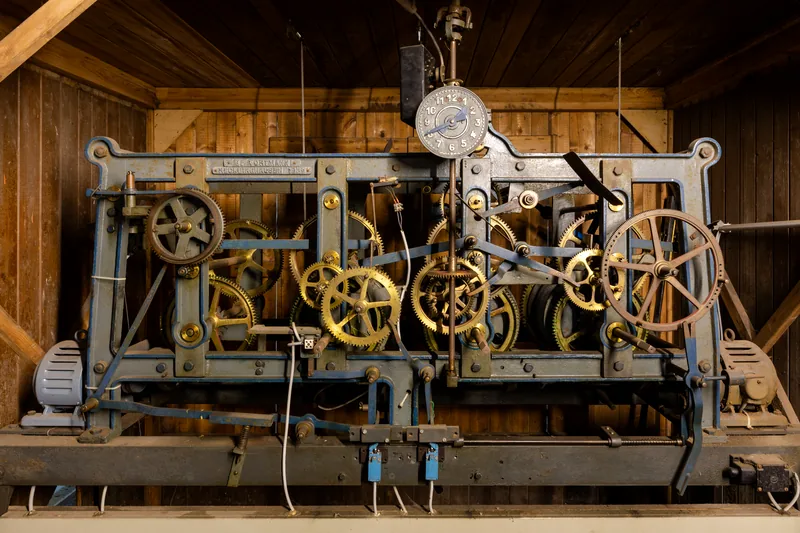
The bridge structure generally follows classic Swiss styling, utilizing either a three-finger bridge design for the train wheels or a streamlined three-quarter top plate that secures the barrel, center wheel, third wheel, fourth wheel, and escape wheel. The fourth wheel pivot is positioned directly opposite the crown in a open-face (Lépine) layout, or at a 90-degree angle relative to the stem in a hunting (Savonnette) layout. This architecture provides excellent rigidity, high repairability, and exceptional dimensional stability—qualities essential for any caliber intended to undergo a custom casing process.
3. Challenges of Converting Felsa 6s to Wristwatch
When clients ask, "can you convert felsa 6s pocket watch movements into functional modern wristwatches?", the technical answer is an emphatic yes—provided the watchmaker navigates several significant mechanical hurdles. The primary challenge stems from shock resistance, or the lack thereof. Original Felsa 6s movements were designed to rest cushioned in a vest pocket; they do not feature modern balance pivot shock protection systems such as Incabloc or KIF. The delicate balance pivots (often measuring a mere 0.08 mm to 0.11 mm in diameter) are highly susceptible to shearing or bending if the converted wristwatch experiences a drop or direct impact against a hard surface.
A second major obstacle lies in the orientation of the movement layout. Lépine (open-face) 6s calibers place the winding stem at 12 o'clock and the running small-seconds sub-dial at 6 o'clock. If this movement is housed in a standard wristwatch case with the stem at 3 o'clock, the sub-seconds register shifts to 9 o'clock unless a custom dial is manufactured or a Savonnette (hunter) movement is selected. Furthermore, dust and moisture sealing present a constant threat. Antique pocket watch cases lacked rubber O-rings, thread seals, and synthetic crystal gaskets; housing a delicate vintage 6s movement in an unsealed custom casing risks rapid oxidation of the steel balance spring, mainspring barrel, and train pivots due to ambient humidity.
Finally, positional timing poses a distinct tuning challenge. A pocket watch was primarily adjusted to function in two or three positions: stem-up, dial-up, and dial-down. On the wrist, however, a timepiece shifts constantly across five positions (including crown-down, crown-left, and crown-right). Achieving stable rate results across all five positions requires meticulous truing of the hairspring, precise dynamic poising of the balance wheel, and careful adjustment of the palette stone lock and drop—tasks that demand advanced bench skills and patience from the watchmaker.
4. Lug Welding and Case Selection
Executing a successful project requires securing a suitable **felsa 6s pocket watch to wrist conversion case** or modifying an period-appropriate original case. Historically, watchmakers converted pocket timepieces by hard-soldering or brazing silver or gold wire lugs directly onto the perimeter of the original pocket watch middle case. This approach retains maximum historical authenticity, creating a piece reminiscent of early trench timepieces. However, wire-lug silver soldering requires complete stripping of the case, precise chemical cleaning, the application of high-temperature flux, and silver solder (flowing around 650°C to 700°C), followed by extensive polishing and pickle-bath neutralization to prevent long-term metal degradation.
In modern horology, modern custom CNC-machined conversion cases have emerged as the superior choice for structural integrity and protection. Machined from high-grade 316L stainless steel or solid brass, these cases are specifically dimensioned to hold a 31.75 mm movement plate. They incorporate internal movement holder rings (casing clamps), exhibition sapphire or mineral crystal display backs, and standard spring-bar lugs (typically 20 mm or 22 mm lug width) welded or integrated directly into the case body during machining.
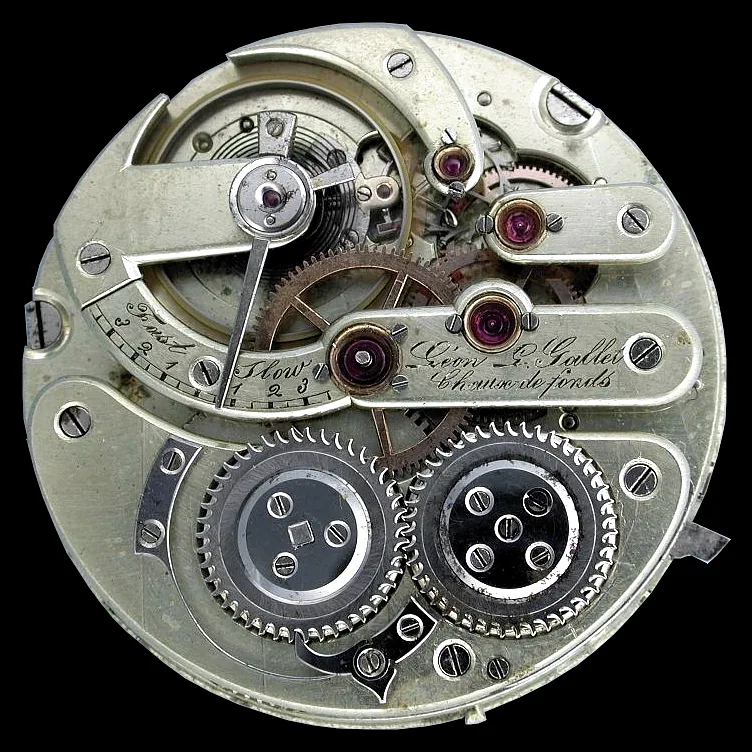
When selecting a modern conversion case, internal tolerances are paramount. The inner casing ledge must precisely match the Felsa 6s movement shoulder depth (typically around 0.8 mm to 1.2 mm deep) to prevent axial or radial displacement within the case. If the movement float is not strictly eliminated using custom brass movement tabs and case screws, the winding stem will bind against the pendant tube, leading to rapid stem wear or catastrophic shearing during winding.
5. Crown and Stem Solutions
The winding and setting infrastructure represents one of the most mechanically demanding phases when you **convert felsa 6s pocket watch into wristwatch** specifications. Antique pocket watch stems were tailored to specific case pendant lengths and keyway depths. When transitioning the Felsa 6s movement into a custom conversion case, the original stem is almost universally too short, too long, or threads into a crown with an incompatible pitch (often obscure historic Swiss thread sizes rather than modern Tap 10 or Tap 9 standards).
To overcome this, a custom winding stem must frequently be turned from scratch on a watchmaker's lathe (such as a 10 mm Schaublin or Lorch lathe). The process begins with high-carbon steel rod stock (such as silver steel/W-1 tool steel). The watchmaker turns down the pivot, square section, winding arbor shoulder, and threaded section to match the internal sliding gear and setting lever detent of the Felsa 6s movement. Once machined and test-fitted, the custom stem undergoes thermal heat treatment: it is heated to cherry red (approx. 800°C), quenched in oil to achieve maximum hardness, and then carefully tempered back to a peacock blue hue (approx. 290°C) to restore elasticity and eliminate brittle fracture risks.
For the external winding crown, ergonomics and sealing must be balanced. An onion or pumpkin-style crown pays homage to early vintage aesthetics while offering sufficient leverage to wind the heavy mainspring of a 6-size pocket movement. Crucially, the crown must incorporate an internal rubber O-ring or silicone gasket that fits snugly over the outer diameter of the case pendant tube. This creates an effective barrier against atmospheric dust and splash moisture, protecting the internal winding pinion and crown wheel from premature corrosion.
6. Dial and Hand Considerations
The visual soul of any conversion project resides in its dial and hand assembly. Original Felsa 6s pocket watches frequently featured double-sunk or single-sunk genuine vitreous enamel (porcelain) dials fired over copper baseplates. Enamel dials offer timeless, non-fading optical brilliance, but they are exceptionally fragile. Microscopic hairline cracks can propagate instantly if excessive pressure is applied during casing or dial foot adjustment.
If the original enamel dial is retained, the dial feet must match the securing set-screw locations on the Felsa 6s main plate. If the feet are broken or incorrectly positioned for a new case orientation, traditional soldering irons cannot be used directly on the back of an enamel dial, as the thermal shock will crack the porcelain surface. Instead, watchmakers utilize specialized low-temperature copper-loaded conductive epoxies or precision spot-welding dial-foot machines equipped with heat-sink blocks to secure replacement copper dial feet without damaging the face.
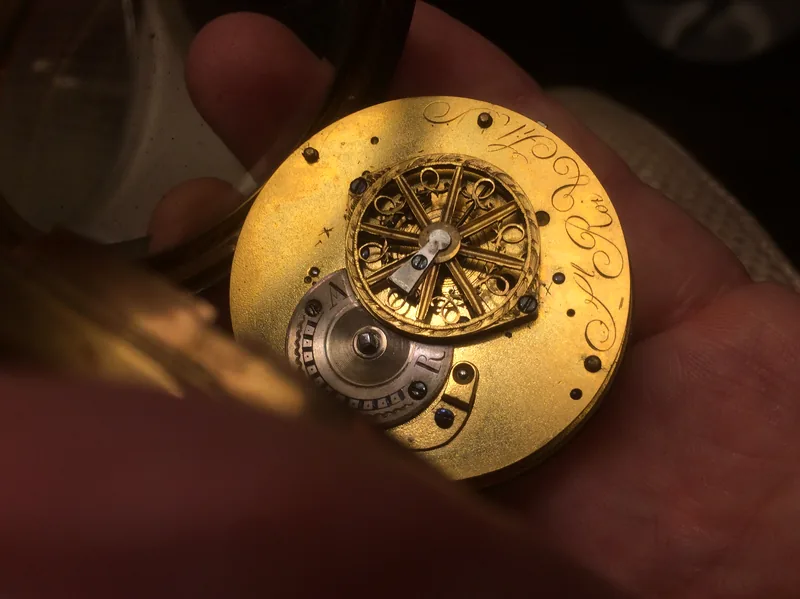
Hand fitting requires equal precision. The Felsa 6s movement features specific shaft diameters for its center canon pinion (hour wheel) and fourth wheel pivot. Typical hand hole sizes for this caliber range around 1.80 mm to 2.20 mm for the hour hand, 1.00 mm to 1.20 mm for the minute hand, and 0.20 mm to 0.30 mm for the sub-seconds pivot. Original pocket watch hands—often crafted from heat-blued steel or flame-gilded brass—must be carefully broached or closed using staking punches to achieve a friction fit. If modern hands are retrofitted, hand clearance must be verified under a bench microscope to ensure the underside of the minute hand does not drag across the hour hand or graze the inner surface of the crystal.
7. Why 6s is More Common for Conversion
In the broader landscape of antique pocket watch conversions, movement sizing dramatically affects final wearability. Larger pocket watch movements, such as the ubiquitous American 18-Size (approx. 44.8 mm movement diameter) or 16-Size (approx. 43.2 mm), yield conversion wristwatches measuring 48 mm to 52 mm in total case diameter. These massive dimensions result in "hockey-puck" wrist proportions that are heavy, uncomfortable, and prone to catching on cuffs and doorframes.
Conversely, ultra-small movements like 0-Size (approx. 27.9 mm) or 3/0-Size often lack the robust mechanical tooth profiles and thick balance staffs necessary to tolerate daily wrist motion, and can be difficult to source parts for. The 6-Size footprint—measuring around 31.75 mm across the plate—occupies the undisputed "Goldilocks zone" for modern horological conversions. When placed inside a tailored modern case, a Felsa 6s results in an overall finished case diameter of 38 mm to 41 mm with a total thickness under 12 mm.
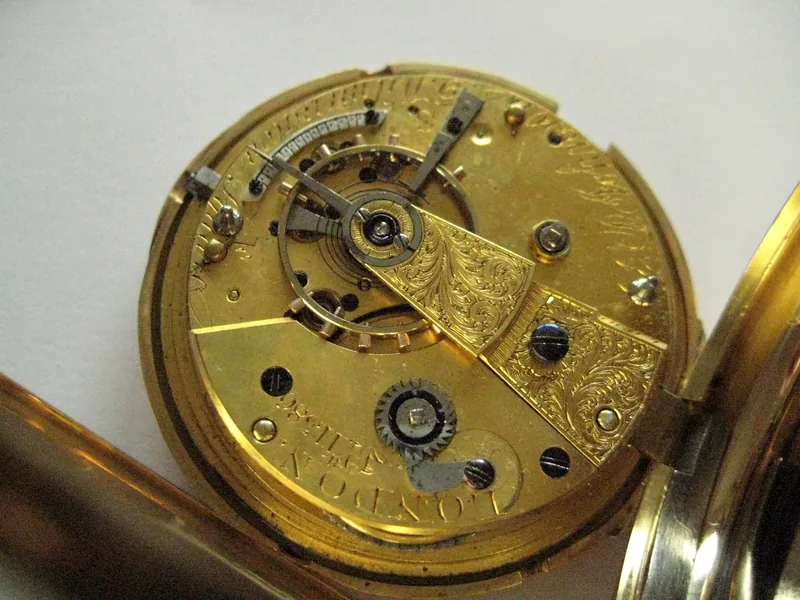
This dimensional envelope closely mirrors the classical case proportions of mid-century Swiss wristwear and historic military models, including early vintage Rolex wristwatches which frequently utilized small pocket movement blanks (such as the 13-ligne Rebberg movements) for their early trench and cushion cases. A converted Felsa 6s delivers substantial wrist presence, superior legibility, and remarkable wearing comfort while maintaining genuine vintage scale on the wrist.
8. Final Thoughts on Felsa 6s Conversions
Converting a Felsa 6s pocket movement into a custom wristwatch is far more than a simple re-casing exercise; it is an act of high horological preservation. By breathing new functional life into an early 20th-century movement that might otherwise sit forgotten in a drawer, watchmakers honor the original artisans of Lengnau while creating a bespoke, highly wearable mechanical instrument.
To ensure long-term reliability, every conversion project must begin with a complete tear-down overhaul. The Felsa 6s movement should be fully disassembled, cleaned in ultrasonic solvent baths, inspected for pivot wear, re-pivoted or jeweled where necessary, and lubricated with modern synthetic oils (such as Moebius 9010 for high-speed pivots and HP-1300 for train wheels and barrel arbors). When executed with uncompromising attention to movement securing, stem geometry, dynamic poising, and atmospheric sealing, a **felsa 6s pocket watch to wrist conversion case** project transforms historical heritage into a reliable daily-wear masterwork capable of ticking accurately for another century.