1. Historical Background of Hamilton 10s Movements
The Hamilton Watch Company, established in Lancaster, Pennsylvania, in 1892, earned its moniker as "The Watch of Railroad Accuracy" by manufacturing exceptionally reliable pocket watch movements. While the brand built its reputation on large 18-size and 16-size railroad-grade calibers engineered for extreme precision under demanding conditions, the roaring 1920s and 1930s heralded a shift toward svelte, elegant timepieces. As men's fashion evolved toward tailored suits and lighter attire, the demand for slim dress pocket watches surged. To capture this burgeoning market, Hamilton introduced smaller, highly refined movement platforms, culminating in the celebrated 10-size (10s) series.
The 10-size series—most notably represented by the legendary Grade 917, Grade 921, and the ultra-exclusive Grade 923—represented the pinnacle of American industrial micro-engineering. Introduced during the Art Deco era, these movements were designed from the ground up to offer the accuracy of larger railroad movements while dramatically reducing thickness and diameter. Unlike utility-focused pocket watches of the 19th century, Hamilton 10s movements were decorated with exquisite striping patterns, solid gold jewel settings, polished steel components, and high-jewel counts, reflecting an era where the inner workings of a watch were treated as fine art.
As pocket watches gradually fell out of favor over the mid-to-late 20th century, thousands of these beautifully crafted 10s movements remained tucked away in storage or lost their original precious-metal cases to bullion scrappers during economic downturns. Today, horologists, custom watchmakers, and vintage enthusiasts routinely seek out these orphaned movements. The drive to convert hamilton 10s pocket watch into wristwatch projects has breathed vibrant new life into these American industrial artifacts, allowing a new generation to wear a masterpiece of early 20th-century American watchmaking directly on the wrist.
2. Technical Specifications and Movement Architecture
Understanding the exact architecture of the Hamilton 10s caliber family is essential before attempting any conversion project. On the Lancashire gauge system traditionally used by American manufacturers, a 10-size movement features a pillar plate diameter measuring approximately 1.5 inches, or 38.35 mm. This physical dimension places the 10s platform squarely in the ideal sizing sweet spot for a bold, contemporary wristwatch without requiring an excessively bulky case. The height of the movement typically ranges between 4.2 mm and 4.8 mm depending on the grade, allowing for a relatively sleek profile when cased.
The movement architecture across the Hamilton 10s family reflects high-end traditional horology. The entry-level Grade 917 features 17 jewels, temperature compensation, and adjustment to three positions, making it an exceptionally accurate base movement. The Grade 921 upgrades this specification to 21 jewels, adding solid gold train wheel construction, gold friction-set or screw-set cap jewels, and adjustment to five positions alongside temperature and isochronism. At the absolute top tier sits the Grade 923, boasting 23 jewels and elaborate, mirror-polished beveling on every bridge edge. All three grades utilize a classical three-quarter bridge layout, a cut bimetallic or monometallic balance wheel with timing screws, and a high-grade Breguet overcoil hairspring paired with a whiplash (swan-neck) micrometer regulator assembly.
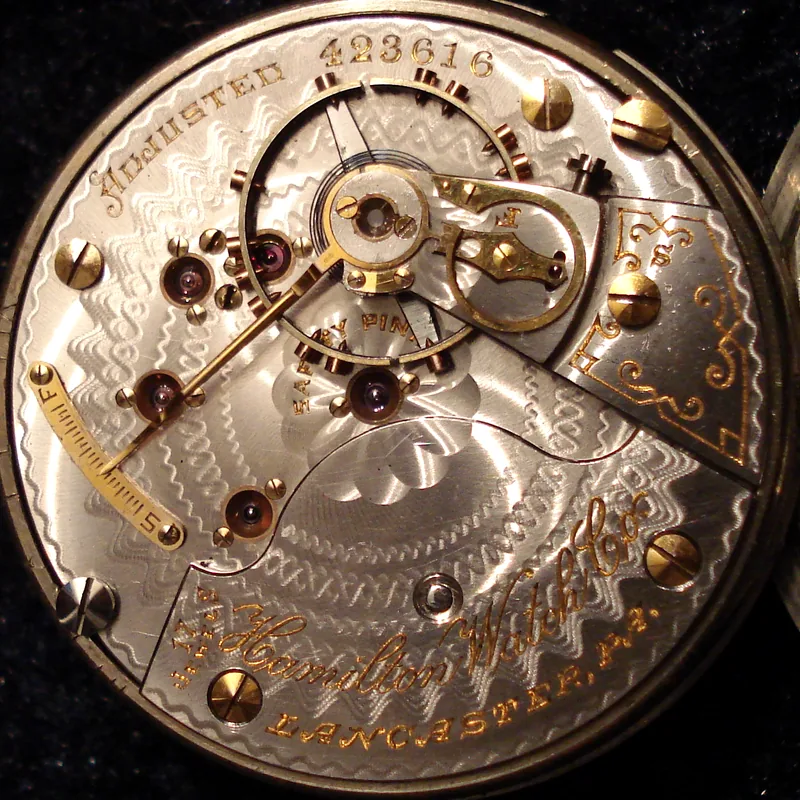
Unlike lower-tier mass-market pocket watches of the era, the layout of the gear train in the Hamilton 10s is remarkably stable and precise. The center wheel drives a high-efficiency lever escapement operating at a classic frequency of 18,000 vibrations per hour (2.5 Hz). This slow beat rate yields the iconic, deliberate mechanical tick characteristic of vintage American timekeeping. The mainspring barrel is nickel-plated with damaskeened circular graining, designed to provide a smooth power reserve of approximately 38 to 42 hours. Below is a closer look at the movement bridge architecture and finishing techniques typical of this caliber platform.
3. Challenges of Converting Hamilton 10s to Wristwatch
When prospective builders evaluate vintage movements, the immediate question arises: can you convert hamilton 10s pocket watch mechanisms into reliable wristwatches without compromising their integrity? The short answer is yes, but the process presents severe mechanical challenges that demand genuine bench skills. The primary technical hurdle is shock resistance. Pocket watch movements from the 1920s through 1940s were never designed to withstand the rapid accelerations, accidental impacts, and vibrations experienced by a human wrist. Original balance staffs in Hamilton 10s calibers lack modern shock-absorbing systems like Incabloc or KIF; the delicate, polished pivots rest directly inside fixed ruby jewels. A single drop onto a hard surface will snap a balance pivot instantly, requiring a full balance staff repivoting or custom lathe turning to repair.
Another profound challenge lies in the orientation of the winding stem and dial layout. Pocket watches manufactured during this era were produced in two main configurations: open-face (Lépine) and hunting case (Savonnette). Open-face pocket watches position the winding stem at 12 o'clock and the sub-seconds dial at 6 o'clock. When you reorient an open-face movement into a standard wristwatch configuration where the winding stem resides at 3 o'clock, the sub-seconds register shifts abruptly to the 9 o'clock position. If you desire a classic 6 o'clock sub-seconds layout on a wristwatch, you must either source rare hunter-style movement configurations or utilize specialized transfer gearing, which introduces additional friction and mechanical complexity into the train.
Environmental sealing poses a final, crucial obstacle. Antique pocket watch movements were never intended to encounter moisture, atmospheric humidity, or fine airborne dust in the way wristwatches do daily. Because traditional pocket watch plates lack internal rubber gaskets or modern water-tight seals, placing a 10s movement into an unsealed or poorly fitted case will lead to rapid oxidation of the steel balance spring, rusting of the steel setting components, and premature degradation of horological oils. Overcoming these hurdles requires a deep understanding of modern case tolerances, custom stem fabrication, and specialized movement mounting techniques.
4. Lug Welding and Case Selection
Selecting or constructing the correct housing is perhaps the most defining phase when you convert hamilton 10s pocket watch into wristwatch creations. Broadly speaking, watchmakers utilize two distinct approaches: modifying an original vintage pocket watch case by silver-soldering or TIG-welding custom wire lugs onto the perimeter, or sourcing a modern, purpose-built hamilton 10s pocket watch to wrist conversion case engineered from solid 316L stainless steel or titanium.
Modifying an original vintage case offers unmatched historical charm, but it requires advanced micro-welding expertise. Attachment points for wire lugs must be precisely measured and fixture-clamped before applying laser or low-temperature silver solder. Excess heat can permanently discolor vintage gold-filled plating, distort the bezel threads, or warp the snap-back case geometry. Furthermore, vintage cases rarely accommodate scratch-resistant modern sapphire crystals or provide modern O-ring gasket channels, leaving the delicate movement vulnerable to sweat and atmospheric moisture during daily wear.
Consequently, most master watchmakers opt for specialized precision-machined conversion cases designed explicitly for the 38.35 mm Hamilton 10s platform. These cases feature an internal movement holder ring or custom-milled rebate ledge that firmly clamps the pillar plate without requiring destructive alterations to the historical movement. A modern conversion case incorporates threaded screw-down casebacks, dual Viton gaskets, sapphire crystals with anti-reflective coating, and standard spring bar or screw-in lug bars measuring 22 mm or 24 mm in width. This hybrid approach ensures the delicate 10s movement gains modern structural protection while offering ergonomically curved lugs that sit flush against the wrist.
5. Crown and Stem Solutions
The winding and setting mechanism of a vintage pocket watch operates on principles distinctly different from modern wristwatches, making stem adaptation a delicate engineering task. Most Hamilton 10s movements employ a "negative set" or pendant-setting system, or a traditional "positive set" mechanism where pulling the stem outward directly shifts the setting clutch. In negative-set systems, the friction sleeve and detent reside within the original pocket watch case neck rather than inside the movement itself. When removing the movement from its original shell, watchmakers must adapt the keyway to function seamlessly within a modern wristwatch case.
To successfully integrate the movement into a new housing, watchmakers must turn or thread a custom winding stem. Modern wristwatch stems typically utilize standard thread designations—such as Tap 10 (0.90 mm stem thread diameter) or Tap 9 (1.00 mm)—allowing them to mate with water-resistant modern crowns. However, the square arbor or winding pivot of the Hamilton 10s movement requires an exact microscopic fit into the winding pinion. Watchmakers frequently lathe-machine an adapter stem, joining the original squared high-carbon steel Hamilton lower stem section to a threaded modern upper extension piece using micro-sleeves or precision silver brazing.
Selecting the crown aesthetics is equally vital to preserve the design language of the piece. Modern conversion builds often utilize oversized "onion," "pumpkin," or flat diamond-shaped crowns that mirror early 20th-century aviation and military watch designs. The crown must feature internal rubber O-rings that seal tightly against the case tube. Proper stem length calculation is paramount down to the hundredth of a millimeter: if the stem is too short, the movement will not fully engage into the hand-setting position; if too long, excessive lateral pressure will be exerted directly onto the delicate setting lever, leading to mechanical binding or snapped keyways.
6. Dial and Hand Considerations
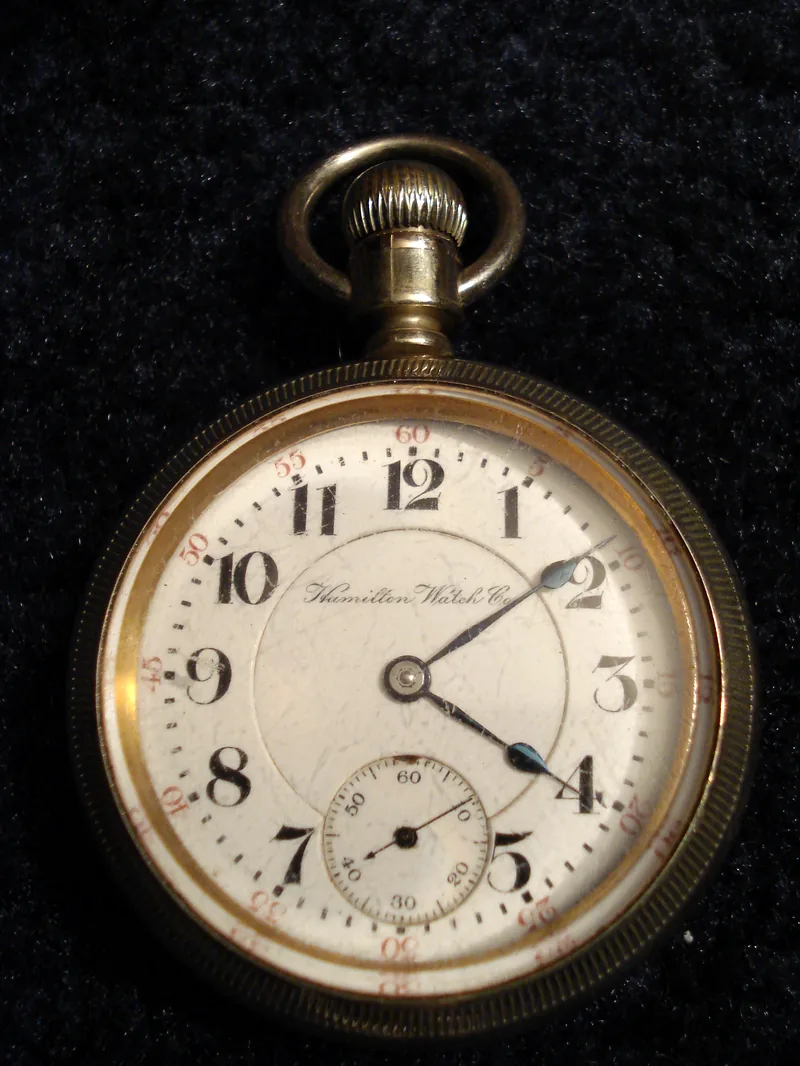
The dial and hands represent the face of any watch conversion, serving as the primary visual link between 1930s elegance and modern wrist aesthetics. Original Hamilton 10s pocket watch dials are often made of single-sunk or double-sunk fired vitreous enamel, or silver-plated brass with applied gold or black-printed numerals. Enamel dials are notoriously fragile; even slight pressure applied during removal can cause irreversible spiderweb hairline cracks. If utilizing an original dial, the dial feet positioning must align perfectly with the modern case alignment. When rotating an open-face dial 90 degrees to position the crown at 3 o'clock, the original dial feet will no longer line up with the movement plate holes, requiring the careful removal and micro-soldering or gluing of new copper dial feet.
Alternatively, many artisans fabricate bespoke replacement dials using CNC-milled brass blanks finished with hand-applied guilloché, grand feu enameling, or patinated brass techniques. When fabricating or choosing a replacement dial, the depth clearance between the lower dial surface and the canon pinion/hour wheel assembly must be precisely measured. The original hand post sizes on a Hamilton 10s movement are significantly larger than standard modern wristwatch hands. The center wheel pivot, hour wheel pipe, and second hand arbor dimensions must be matched precisely when selecting or re-reaming traditional hands.
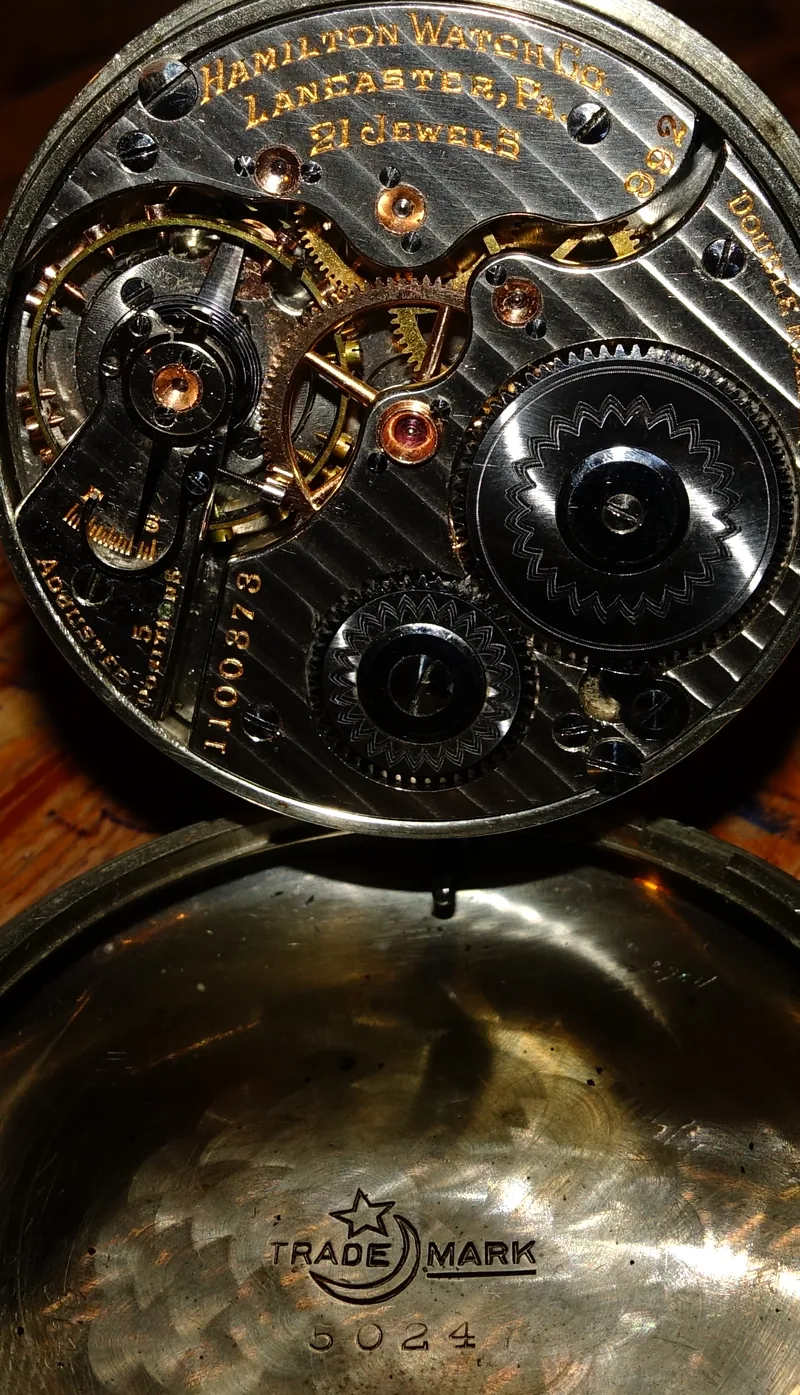
Below is a detail view illustrating hand fitting clearance, custom dial alignment, and sub-seconds hand mounting on a converted piece.
Hand selection requires meticulous attention to weight and balance. Vintage blue-steel spade, cathedral, or leaf hands possess a distinct historical charm, but they must be completely flat and free from burrs to prevent them from catching on one another or dragging against the inner surface of the crystal. Because the sub-seconds arbor sits at a fixed distance from the center arbor, hand lengths must be calculated to sweep precisely along the seconds track without extending past the outer minute ring. Properly blued hands, heat-treated over a brass-filing tray at 590°F (310°C), deliver a deep peacock-blue sheen that shifts dramatically depending on the angle of light.
7. Why 10s is More Common for Conversion
In the world of pocket watch conversions, builders work with various historic platform sizes, ranging from massive 18-size railroad grade beasts down to diminutive 0-size pendant watches. However, the Hamilton 10s platform has consistently emerged as the absolute favorite for master watchmakers and collectors alike. The reason comes down to proportional perfection, physical availability, and superior horological engineering.
An 18-size pocket watch movement measures roughly 44.8 mm in movement diameter alone. Once housed within a modern protective wristwatch case with adequate wall thickness and gasket channels, the resulting watch reaches an unwearable outer diameter of 48 mm to 52 mm, with a lug-to-lug distance spanning well over 58 mm. Conversely, a 12-size movement measures approximately 39.8 mm, which yields a finished watch measuring around 44-45 mm. The 10-size movement, with its precise 38.35 mm movement plate, fits comfortably into finished case diameters ranging from 41 mm to 43 mm—a size range widely considered the ideal modern proportion for technical and pilot-style wristwatches.
The table below highlights the comparative sizing and practical conversion characteristics across common American pocket watch platforms:
| Movement Size | Plate Diameter | Typical Finished Case Size | Wrist Ergonomics & Wearability |
|---|---|---|---|
| 18s | 44.86 mm | 48.0 mm – 52.0 mm | Extremely bulky; suited only for display or massive wrists. |
| 16s | 43.18 mm | 45.0 mm – 48.0 mm | Large oversized fit; visually commanding but heavy. |
| 12s | 39.75 mm | 43.0 mm – 45.0 mm | Moderately wearable; good modern presence. |
| 10s (Hamilton) | 38.35 mm | 41.0 mm – 43.0 mm | Optimal sweet spot; superb wrist proportions and balance. |
| 0s | 29.62 mm | 34.0 mm – 36.0 mm | Vintage unisex scale; delicate balance staffs and limited parts. |
Furthermore, Hamilton produced thousands of 10-size movements during the golden era of American manufacturing. Because so many of these movements were originally housed in solid gold or gold-filled cases, vast numbers of cases were melted down for scrap metal during historical gold booms. This economic phenomenon left behind an abundance of pristine, high-grade mechanical engines—specifically the 917 and 921 movements—that are structurally sound and complete, but lack original housings. This availability, paired with world-class nickel finishing and gold settings, makes the 10s caliber the unrivaled favorite for horological upcycling.
8. Final Thoughts on Hamilton 10s Conversions
The process to convert hamilton 10s pocket watch into wristwatch configurations bridges the gap between historical preservation and functional wrist art. Rather than letting these remarkable historical calibers gather dust in drawers or sit forgotten in repair shops, custom conversions allow us to celebrate the height of American industrial design on a daily basis. When executed with precision engineering—respecting movement clearances, installing proper shock precautions, and utilizing high-grade conversion cases—a converted Hamilton 10s transitions seamlessly into a reliable, heirloom-quality timepiece.
For collectors and bench watchmakers considering this journey, treating the movement with deep horological respect is paramount. Avoid destructive alterations to the historic plates, retain the original hand-finished train wheels wherever possible, and ensure the movement is fully overhauled, ultrasonic-cleaned, re-jeweled if necessary, and lubricated with modern synthetic oils before casing. A well-crafted 10s conversion is more than just a custom watch; it is a ticking monument to American horological history, wearing a legacy of precision and elegance right on your wrist.