1. Historical Background of Hamilton 14L Movements
The Hamilton Watch Company of Lancaster, Pennsylvania, earned its immortal reputation as "America's Railroad Timekeeper." By the early to mid-20th century, Hamilton dominated both commercial and military horology with unparalleled manufacturing tolerances and exquisitely finished calibers. While large 16-size and 18-size movements powered the pockets of conductors and engineers, Hamilton also produced smaller, highly refined calibers designed for dress pocket watches, lapel timepieces, and high-grade gentlemen’s accessories. Among these, movements adhering to the 14-ligne standard—frequently designated in collector and watchmaking circles as 14L architecture—represented a sweet spot of mid-sized American horological engineering.
Produced during an era of profound mechanical innovation, Hamilton's 14L movements bridged the gap between traditional pocket watch construction and the burgeoning demand for wrist-worn timepieces. These movements featured high jewel counts, damaskeened nickel plates, temperature-compensated balance assemblies, and hand-fitted train wheels. During the early decades of the 20th century, as soldiers during the Great War began strapping pocket timepieces to their wrists—giving rise to authentic WW1 trench watches—watchmakers recognized that smaller pocket watch calibers like the 14L were far better suited for wrist wear than their massive 16S counterparts.
Today, original Hamilton 14L pocket watch cases are often lost to history, having been melted down for their precious gold or silver content during economic downturns. However, the immortal movements within often survive in pristine operational condition. Watchmakers and historical preservationists now undertake the task to convert Hamilton 14L pocket watch movements into functional wristwatches, giving these masterpiece movements a second life on the modern wrist.
2. Technical Specifications and Movement Architecture
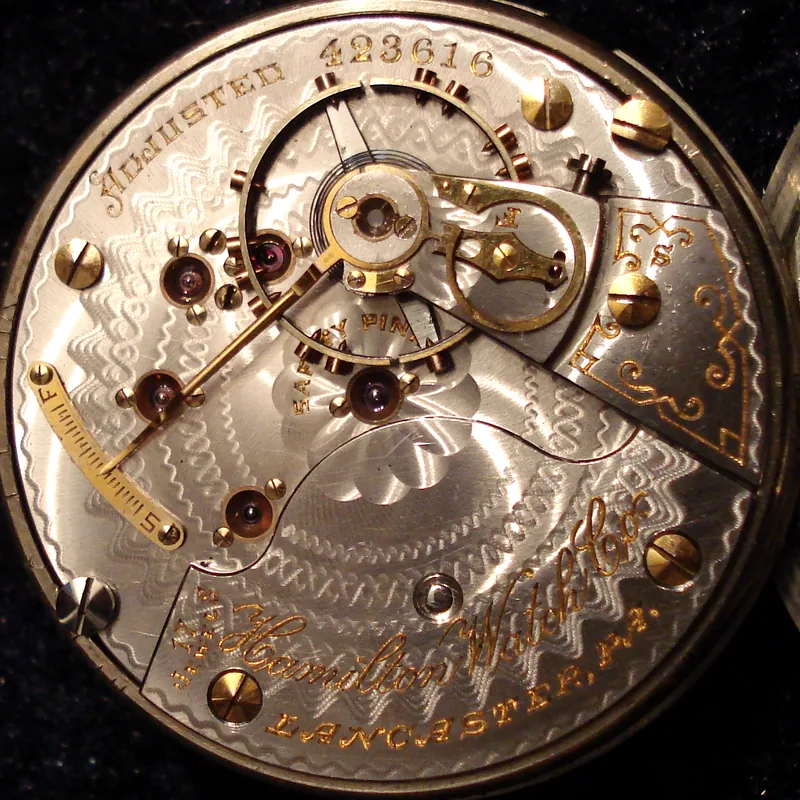
Understanding the exact architecture of a Hamilton 14L movement is critical before attempting any conversion process. A 14-ligne caliber measures approximately 31.58mm in movement diameter (1 ligne equals 2.2558mm). This dimensional footprint places it far below the unwieldy 43mm+ diameter of standard 16-size pocket watches, making it infinitely better suited for wrist wear. The balance wheel operates at a traditional frequency of 18,000 vibrations per hour (2.5 Hz), featuring a blued steel Breguet overcoil hairspring paired with a split bi-metallic balance wheel equipped with gold timing screws for temperature compensation.
The train gear architecture of high-grade Hamilton 14L calibers reflects quintessential American fine watchmaking. Typically equipped with 17 to 23 jewels, these movements feature raised gold jewel chatons held in place by microscopic screws, polished steel escape wheels, and fine-adjust micrometer regulators (such as the Reed or Swan-neck regulator system). The mainspring barrel is housed under a dedicated bridge or integrated into a three-quarter plate configuration, yielding exceptional power delivery across a typical 36-to-42-hour power reserve.
From a mechanical perspective, the gear train teeth are cut using high-precision involute profiles, reducing friction across the center wheel, third wheel, fourth wheel, and escape pinion. The sub-second dial configuration is located 180 degrees opposite the balance assembly or offset at 90 degrees depending on whether the specific movement base was originally designed for an open-face (pendant-set/crown at 12) or hunter-case (crown at 3) pocket watch shell. Identifying this train geometry dictates the entire layout of your modern wristwatch conversion.
3. Challenges of Converting Hamilton 14L to Wristwatch
When you attempt to convert hamilton 14L pocket watch into wristwatch configurations, you immediately encounter significant horological hurdles that do not exist in standard movement servicing. The primary technical challenge stems from stem orientation and dial layout. If you begin with an open-face Hamilton 14L pocket watch, placing the crown at 3 o'clock on a wristwatch case positions the sub-seconds register at 9 o'clock. Conversely, using a hunter-cased movement places the crown at 3 o'clock and the sub-seconds register at the traditional 6 o'clock position. Watchmakers must carefully choose their donor caliber based on the desired final dial geometry.
Another major obstacle is shock protection. Vintage Hamilton 14L pocket watch movements were engineered to sit cushioned inside a thick pocket watch case attached to a chain. They lack modern shock-absorption systems such as Incabloc or Kif. The balance staff pivots on a Hamilton 14L are extraordinarily thin—often measuring between 0.08mm and 0.11mm in diameter. Subjecting an unmodified 14L movement to daily wrist impacts, door-frame strikes, or heavy vibrations will easily snap these un-shocked balance pivots, requiring a full balance staff turning and replacement on a watchmaker's lathe.
Furthermore, pocket watch mainsprings deliver significantly higher torque than standard vintage wristwatch mainsprings. When converting a Hamilton 14L pocket watch, the train wheel depth and escapement lock/drop must be meticulously verified. Excess torque combined with an un-serviced wheel train can cause balance knocking (rebounding), where the impulse jewel hits the outside of the lever horns, causing erratic timekeeping and severe component wear over time.
4. Lug Welding and Case Selection
Achieving a flawless hamilton 14L pocket watch to wrist conversion requires precise case matching and structural integration. Selecting the best case size for hamilton 14L conversion depends entirely on movement retention methods and desired wrist ergonomics. Because the movement diameter sits precisely at 31.58mm, the absolute best case size for hamilton 14L conversion is an exterior case diameter between 38mm and 40mm, with an inner movement chamber machined to 32.0mm to 32.2mm. This ratio provides adequate wall thickness for structural rigidity while maintaining classical, highly wearable proportions on the wrist.
Watchmakers generally utilize two distinct approaches for housing: custom-machined modern 316L stainless steel conversion cases or adapted historical cases featuring welded lugs. When executing a traditional conversion using a period-correct silver or gold-filled pocket case, wire lugs or custom art-deco lugs must be silver-soldered or micro-TIG welded directly to the case body. The welding process requires complete disassembly of the case, removal of all crystal and bezel gaskets, and precise heatsinking to prevent warping the fine bezel threads.
If utilizing a modern custom conversion case, a custom movement retaining ring (spacer) must be turned on a lathe from marine-grade brass or stainless steel. The Hamilton 14L movement is secured into the case using traditional movement clamps and screws that anchor into the movement plate perimeter. The crystal clearance must also be calculated down to tenths of a millimeter; the high arc of a vintage Hamilton central cannon pinion and minute hand requires a high-domed sapphire or Hesalite crystal to avoid hand-friction against the underside of the glass.
5. Crown and Stem Solutions
Pendant-set pocket watch stem mechanisms operate fundamentally differently from modern wristwatch pull-out setting mechanisms. In a traditional Hamilton 14L pocket watch case, the sleeve mechanism responsible for switching between winding and setting modes was often built directly into the neck of the pocket watch case rather than fully contained within the movement mainplate. Therefore, when attempting to convert hamilton 14L pocket watch movements into custom wristwatch cases, the winding and setting stem configuration demands custom lathe fabrication.
To solve this, the watchmaker must install a winding stem that bridges the internal clutch wheel of the 14L movement with a modern gasket-sealed wristwatch crown. The original American thread sizes for Hamilton pocket watch stems (frequently non-standard Tap 8 or Tap 10 threads, or proprietary 0-80 pitch threads) must be converted or mated to a modern Tap 9 (0.90mm) stem extender. The watchmaker must turn a custom split-stem or thread adapter on a micro-lathe, hardening and tempering the high-carbon steel stem afterwards to prevent shearing under winding tension.
Water resistance and dust sealing present additional engineering considerations at the crown interface. Vintage pocket watches relied on close metal-to-metal fits along the pendant tube. A successful conversion case integrates a modern double-O-ring stainless steel crown tube pressed into the case flank at 3 o'clock. The custom crown must feature a deep internal recess housing a nitrile rubber gasket that seals against the tube, protecting the delicate steel winding pinions and mainplate of the Hamilton movement from ambient moisture and perspiration.
6. Dial and Hand Considerations
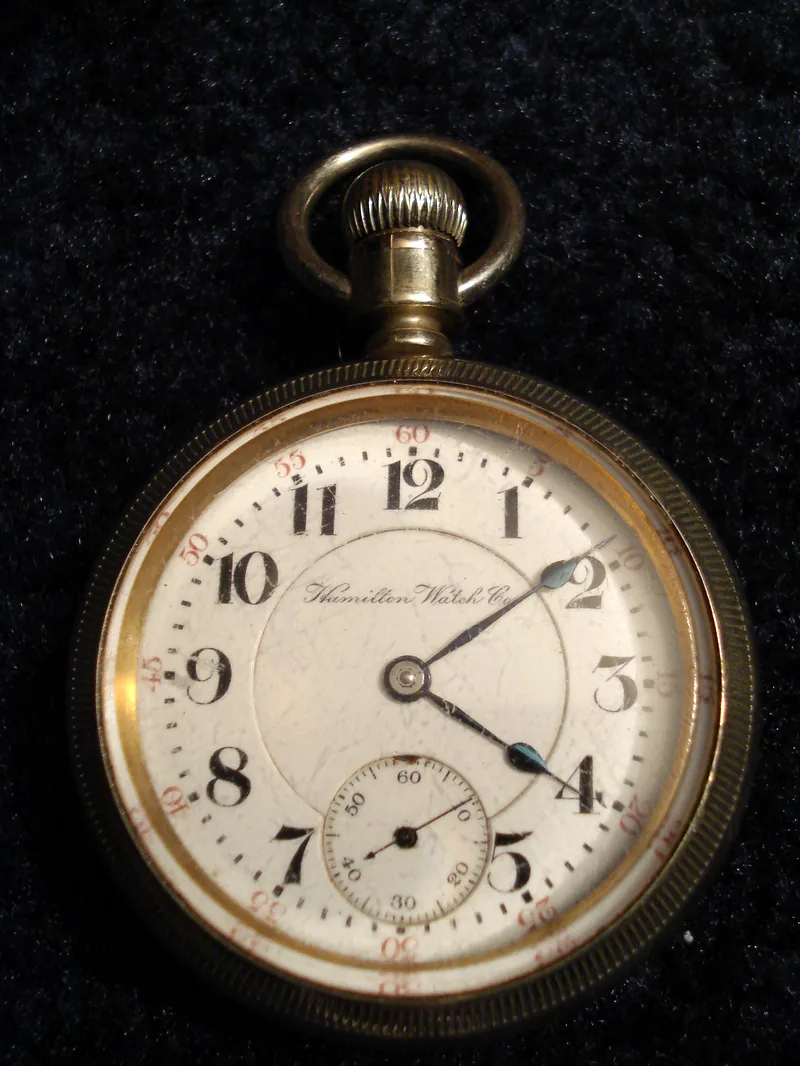
The dial and hand integration of a 14L conversion demands exceptional care, particularly regarding original enamel dials versus custom fabricated dials. Many Hamilton 14L movements originally featured exquisite double-sunk or single-sunk fired porcelain enamel dials. These dials are incredibly brittle. Attempting to bend or solder new dial feet onto an original glass enamel dial will instantaneously cause spiderweb cracking across the porcelain surface. If original dial feet do not align with the conversion case orientation, watchmakers must utilize specialized copper dial-foot soldering machines with localized capacitance discharge, or fashion precision movement-clamping dial rings that secure the dial along its outer perimeter without stressing the enamel substrate.
Hand fitting presents its own set of technical tolerances. The hand socket diameters of Hamilton 14L movements were turned to original American watchmaking fractions of an inch, which do not directly match modern metric Swiss hand standards. The cannon pinion tip, hour wheel tube, and fourth wheel sub-second pivot sizes typically measure as follows:
- Hour Hand Hole Size: ~1.50mm to 1.62mm (requires custom broaching or friction-closing of vintage hands)
- Minute Hand Hole Size: ~0.85mm to 0.92mm (demands precise friction fitting on the square or round cannon pinion shoulder)
- Sub-Second Hand Pivot Diameter: ~0.18mm to 0.21mm (extremely delicate pivot requiring delicate staking with a hollow punch)
If original blued-steel spade or cathedral hands are retained, they must be stripped of rust, carefully polished, and re-blued using thermal bluing trays at approximately 290°C (554°F) to restore a deep, uniform peacock-blue oxidation layer. The height of the hands above the dial surface must be meticulously adjusted using a hand-setting tool to ensure that the sweeping minute hand clears both the raised sub-second register and the perimeter index markers without touching the domed crystal.
7. Why 14L is more common for conversion
In the expansive realm of antique pocket watch conversions, the Hamilton 14L movement family occupies a legendary status among horologists. The primary reason for its immense popularity lies in its physical proportions. Standard 16-size (43mm caliber) or 18-size (44.8mm caliber) pocket watches result in monstrous wristwatches measuring 48mm to 52mm in total case diameter—far too large and top-heavy for comfortable daily wear. The 14L movement, measuring ~31.58mm, yields a finished wristwatch with a 38mm to 41mm diameter, matching the most desirable modern luxury watch proportions.
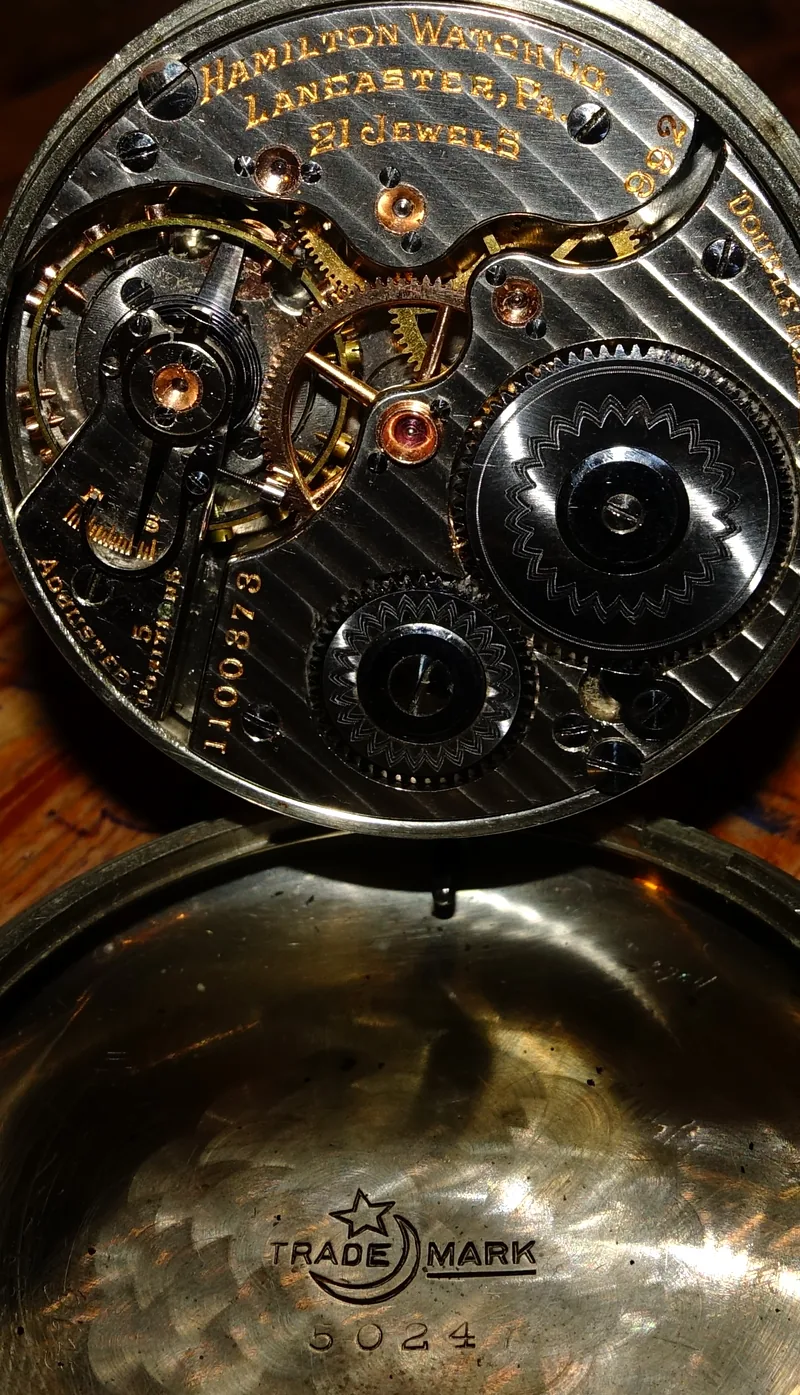
Furthermore, the build quality of Hamilton’s 14L calibers rivals the finest mid-century Swiss horology found in iconic vintage Rolex wristwatches and high-grade chronometers of the same era. Hamilton spared no expense in finishing these movements. The damaskeening—intricate nickel-plating wave patterns cut directly into the bridges—is visually striking when displayed through a modern sapphire exhibition case back. Unlike mass-produced utility movements, the 14L offers visible golden train wheels, polished steel screws, and hand-beveled plate edges (anglage) that capture light brilliantly from every angle.
Availability and mechanical resilience also contribute to the 14L’s dominance in the conversion market. Hamilton produced these high-grade movements in sufficient quantities during the golden age of American watchmaking, meaning high-quality donor movements with intact gear trains can still be acquired. Their oversized steel balance staffs, thick mainplates, and robust tooth profiles make them far more forgiving during complete watchmaker restoration than micro-wrist-caliber movements of the 1920s and 30s.
8. Final Thoughts on Hamilton 14L Conversions
Executing a high-level hamilton 14L pocket watch to wrist conversion is far more than a mere assembly job—it is an exercise in high-grade micro-engineering and historical conservation. When performed with meticulous attention to stem geometry, movement retention, hand clearances, and balance staff protection, the result is a truly bespoke timepiece that bridges over a century of American horological brilliance with modern wrist wearability.
For the watchmaker or collector embarking on this journey, respecting the original mechanical integrity of the movement is paramount. Modern synthetic lubricants, such as Moebius 9010 for high-speed balance pivots and Moebius HP-1300 for the heavy-torque wheel train, should be used during reassembly to ensure the 80-to-100-year-old steel pinions operate smoothly for decades to come. Selecting the best case size for hamilton 14L conversion—ideally around 39mm to 40mm with an exhibition caseback—allows the extraordinary craftsmanship of Lancaster, Pennsylvania to be admired with every glance at the wrist.
Ultimately, to convert Hamilton 14L pocket watch movements into wearable art is to preserve a legendary chapter of industrial history. These conversions take mechanical masterpieces out of dusty wooden drawers and put them back where they belong: ticking faithfully, measuring time with unwavering accuracy, and telling a profound story on the wrist of a true horological connoisseur.