Historical Background of Illinois 18s Movements
The Illinois Watch Company, established in Springfield, Illinois, in 1869, stands as one of the quintessential pillars of American industrial horology. During the late 19th and early 20th centuries, the American watchmaking industry was dominated by standard size classifications derived from the traditional Lancashire gauge system. Among these, the 18-size (18s) movement emerged as the heavy-duty workhorse of American timekeeping. These substantial movements were designed to power pocket watches that could withstand the demanding, vibration-heavy environments of expanding industrial infrastructure, most notably the rapidly growing railway networks across North America. To attempt to convert illinois 18s pocket watch into wristwatch configurations today is to engage directly with this rich, mechanical legacy.
In its heyday, the Illinois Watch Company produced millions of 18s movements spanning numerous grades, including early iterations of legendary lines such as the Bunn, the Stuart, the Miller, and the Washington. These movements represented the absolute pinnacle of high-grade, mass-produced mechanical engineering. Built with heavy brass or nickel plates, hand-damaskeened patterns, solid gold jewel settings, and massive bimetallic compensation balance wheels, the 18-size Illinois pocket watch was designed not merely to keep accurate time, but to endure for generations. Their robustness was necessary because early train dispatching demanded unwavering precision; a deviation of a few seconds could result in catastrophic railway collisions.
As the horological landscape shifted in the post-World War I era, smaller sizes like the 16-size and 12-size pocket watches became more fashionable, eventually giving way entirely to the emerging popularity of wristwatches. By the 1920s, the massive 18s movement was largely phased out of production in favor of more compact, wrist-friendly architectures. Today, watchmakers and custom horologists look upon these surviving 18s Illinois movements with profound reverence. Transforming these historic pocket watch movements into wearable art allows us to bring industrial-era masterpieces out of pocket watch display domes and back into daily human interaction, showcasing brilliant hand-finishing that modern industrial manufacturing rarely replicates.
Technical Specifications and Movement Architecture
To fully understand the mechanics involved when you attempt to convert illinois 18s pocket watch into wristwatch builds, one must first master the dimensions and movement architecture of the 18-size movement. Under the American sizing system, an 18-size movement features a base pillar plate diameter of 1 23/30 inches, which converts precisely to 1.766 inches or approximately 44.86 millimeters. This raw dimensional footprint means that the naked movement alone is larger than the entire casing of most modern men's sports watches. The overall movement height (thickness) is equally substantial, often measuring between 6.5 mm and 8.5 mm depending on whether the movement is built on a full-plate, three-quarter plate, or bridge-style layout.
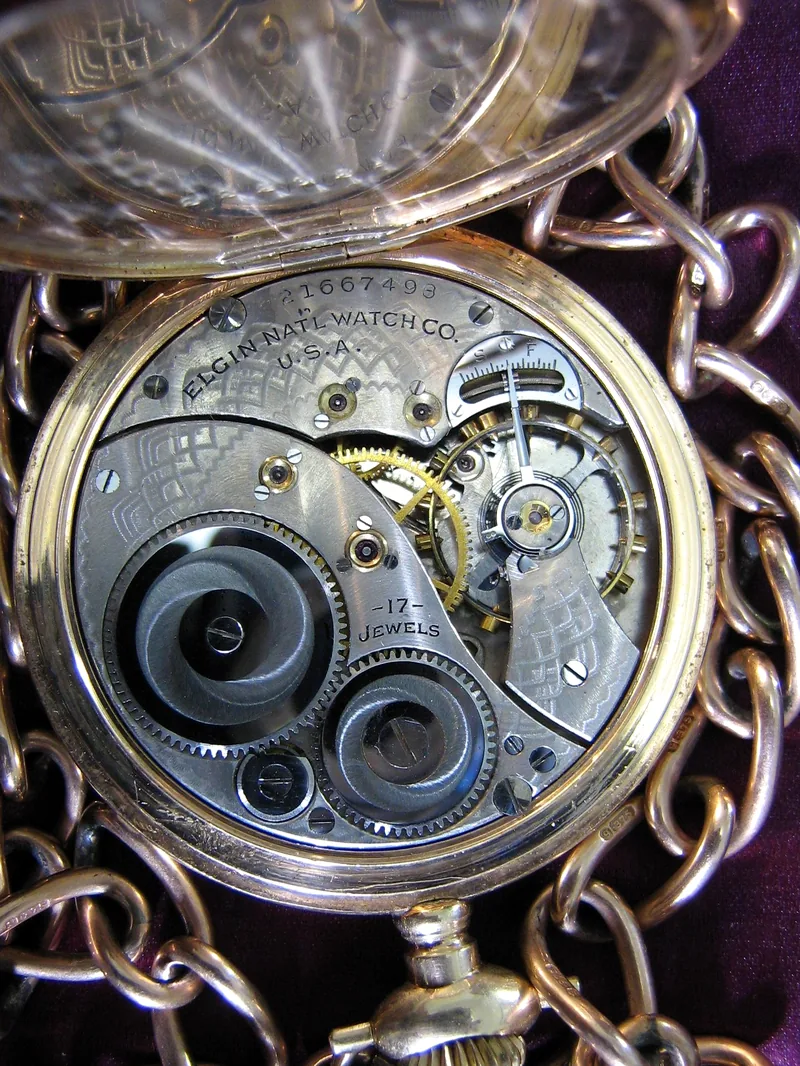
Architecturally, Illinois 18s movements evolved through several design generations, designated as Models 1 through 6. The earliest Model 1 through Model 4 movements frequently utilized full-plate construction, where the upper plate completely covers the gear train, supported by pillars attached to the main plate. Later refinements brought three-quarter plate designs and open-face layouts, which offered superior access to the escapement and wheel train for cleaning and adjustment. The gear trains operate at a traditional slow beat rate of 18,000 vibrations per hour (2.5 Hz), producing that distinct, deliberate ticking sound characteristic of vintage pocket horology. The balances feature heavy, split-bimetallic compensation rims with timing screws, paired with steel Breguet overcoil hairsprings and high-grade micrometer regulators, such as the famous Reed or Superior patent regulators.
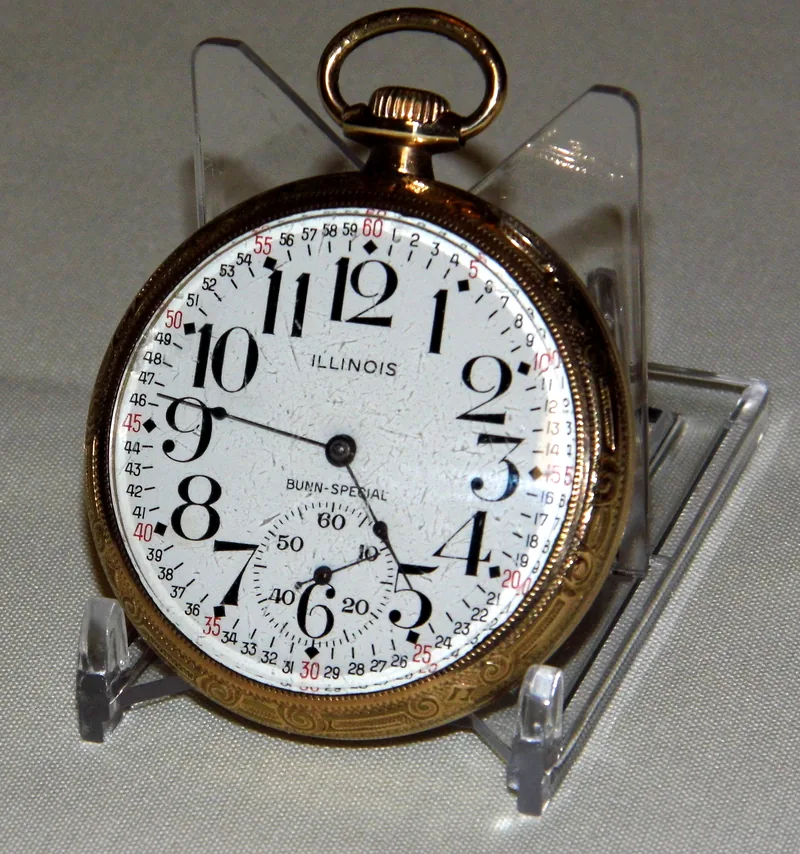
Jewel counts in Illinois 18s movements vary dramatically based on the original grade, ranging from fundamental 7-jewel utilitarian movements to exquisite 21-jewel rail-grade calibers. High-grade variants incorporate ruby and sapphire jewels set in screwed gold chatons, polished steel escapement parts, and balance staff pivots ground down to microscopic fractions of a millimeter. The mainspring barrel is typically a going barrel or a safety barrel design—the latter engineered to protect the gear train from devastating tooth strip-back if the mainspring snaps under tension. Understanding these technical nuances is essential for any watchmaker, as every component inside an 18s movement reflects an era when mass production still required extensive bench-hand fitting and manual regulation.
Challenges of Converting Illinois 18s to Wristwatch
A frequent question among horological enthusiasts and custom builders is: can you convert illinois 18s pocket watch movements into functional modern wristwatches? The practical answer is yes, but the technical reality presents extraordinary engineering hurdles that require advanced bench skills and custom-machined components. The foremost challenge is scale. Because an 18s Illinois movement has a plate diameter of nearly 45mm, adding even a minimally thin modern case wall yields a final outer watch diameter of 48mm to 52mm. On average human wrists, a watch of this size stretches the absolute limits of physical comfort and aesthetic proportion, wearing less like a standard wristwatch and more like a wrist-mounted instrument.
Beyond physical dimensions, the setting mechanism presents a major technical obstacle. The vast majority of high-grade 18-size Illinois pocket watches were constructed with a lever-setting mechanism, a safety feature mandated by railway safety authorities to prevent accidental time setting. To change the time on a lever-set movement, a small mechanical lever hidden beneath the bezel must be pulled outward before turning the crown. In an original pocket watch case, this was accessed by unscrewing the front bezel. Translating a lever-set movement into a modern wristwatch case requires either a specialized bezel system, an externally accessible setting slot with custom seals, or a complex internal mechanical conversion to pendant setting—a process that alters the original movement's historical integrity.
Furthermore, vintage 18s movements were never designed to withstand the violent dynamics of modern wrist wear. Pocket watches spent their functional lives cushioned inside vest pockets, held mostly in a single vertical orientation or resting flat on a nightstand. On a wrist, the movement is subjected to constant multi-axial rotation, lateral shocks, centrifugal force, and sudden impacts. Because original Illinois 18s balance staffs lack modern spring-loaded shock protection systems (such as Incabloc or KIF), the delicate, glass-hard balance pivots—measuring roughly 0.10mm in diameter—are exceptionally vulnerable to shearing off if the watch is bumped or dropped. Preserving these balance pivots requires cautious wear habits or custom anti-shock mounting rings built into the conversion housing.
Lug Welding and Case Selection
When engineering an illinois 18s pocket watch to wrist conversion case solution, case sourcing and structural engineering are critical factors. Original silver, gold-filled, or nickel pocket watch cases from the late 1800s were never designed to receive strap attachment points. Historically, early "trench watch" adaptations relied on silver-soldering metal wire loops directly onto the outer edge of an original pocket watch case body at the 12 o'clock and 6 o'clock positions. While this technique preserves the original antique pocket watch case, silver-soldering wire lugs onto thin vintage gold-filled or sterling silver cases demands master-level micro-welding or brazing techniques to avoid destroying the surrounding metal casing or burning off delicate engraving.
In modern high-end conversions, watchmakers generally bypass modifying fragile original pocket watch cases in favor of purpose-built, CNC-machined conversion cases manufactured from 316L stainless steel, titanium, or solid bronze. Choosing a modern illinois 18s pocket watch to wrist conversion case engineered specifically for 44.86mm movements ensures superior structural rigidity, water resistance through modern synthetic O-ring gaskets, and crystal clarity via scratch-resistant sapphire glass front and back. These modern cases feature integrated wrist lugs engineered with intentional downward curvature, allowing the massive 50mm-plus metal case to hug the contours of the wearer's wrist far better than flat, welded-wire alternatives.
Inside the conversion case, custom-machined movement holder rings (often turned on a lathe from brass or aluminum) are necessary to secure the 18s Illinois movement precisely centered within the housing. Because 18s movements were originally fixed into pocket watch cases using case screws that locked into internal casing lips, the custom ring must possess internal tolerances down to hundredths of a millimeter. The ring holds the movement rigidly in place, preventing micro-movements during winding or setting that could cause the hands to rub against the crystal or dial face. Furthermore, modern conversion cases usually incorporate a screw-down display case back, enabling the wearer to admire the beautifully damaskeened plates and polished steel balance bridge of the Illinois movement in motion.
Crown and Stem Solutions
Adapting the winding and setting stem of an Illinois 18s movement to a modern wristwatch case requires meticulous lathe work and thread geometry matching. In an original pocket watch setup, the winding stem was often split between a movement-mounted winding arbor and a case-mounted sleeve system (common in negative-setting configurations), or relied on a solid stem held by a setting detent in positive-setting designs. When translating an 18s caliber into a bespoke wrist housing, the original pocket watch stem is almost always too short or features a square winding hub that does not match modern screw-on wristwatch crowns.
Watchmakers must machine a custom stem adapter or thread an extension rod onto the existing winding stem. The mechanical interface requires precise sizing; standard modern wristwatch stems use Tap 10 (0.90mm) or Tap 9 (1.00mm) thread pitch, whereas vintage 18s Illinois stems frequently feature larger, non-standard American thread sizes such as Tap 6 (1.20mm) or custom thread pitches. Joining these components requires cutting micro-threads on a watchmaker's lathe or employing high-precision stem extenders paired with thread-locking compounds to guarantee that turning the crown transfers smooth, lossless torque directly into the winding pinion and mainspring barrel hub.
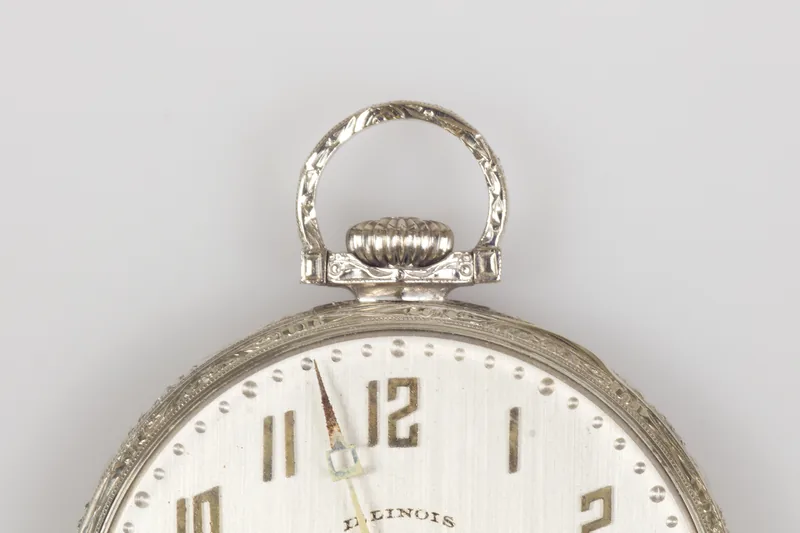
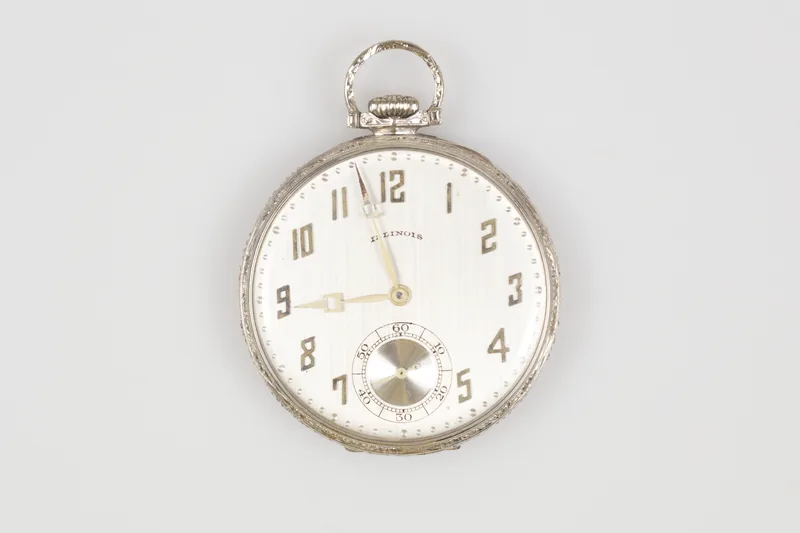
The position of the winding stem relative to the watch dial also dictates the overall layout of the converted watch. Illinois produced both open-face (Lépine) and hunter-case (Savonnette) movement configurations in their 18s line. In an open-face movement, the winding stem is located at the 12 o'clock position relative to the dial layout, with the small seconds sub-dial located opposite at 6 o'clock. In a hunter-case movement, the winding stem is situated at 3 o'clock, with the sub-seconds dial positioned at 9 o'clock. When converted to a wristwatch format, an open-face 18s movement places the crown at 12 o'clock (bullhead style) or requires rotating the entire movement inside the case so the crown sits at 3 o'clock—which shifts the small sub-seconds dial over to the 9 o'clock position. Choosing the appropriate layout is crucial for functional ergonomics during daily winding.
Dial and Hand Considerations
The dial and hands of an Illinois 18s pocket watch are defining elements of its vintage character, but they pose unique integration challenges during a conversion project. Illinois 18s dials were predominantly crafted from double-sunk or single-sunk vitreous enamel over copper plates. Vitreous enamel is essentially glass fused to metal at extreme temperatures, producing a brilliant, non-fading white dial surface adorned with crisp crisp painted Roman or Arabic numerals. However, vitreous enamel is inherently brittle. The flexing forces, violent shocks, and sudden thermal expansions associated with wearing a watch on the wrist can cause ancient enamel to develop hairline cracks, spidering, or severe flaking around the dial foot attachments.
When reorienting a movement inside a conversion case—for instance, rotating an open-face movement 90 degrees to place the crown at 3 o me clock—the original dial feet will no longer line up with the receiving holes in the main movement plate. Re-soldering copper dial feet onto the back of a pristine vintage enamel dial is extraordinarily risky, as the localized heat required for soldering will instantly shatter or craze the enamel dial face. To bypass this, watchmakers must utilize specialized copper dial feet adaptors, non-destructive mechanical clamping rings, or archival-grade, non-gassing horological adhesive pads to secure the dial safely to the movement plate without applying thermal strain to the fragile enamel structure.
Hand clearance and fitting are equally critical when working on an 18s Illinois conversion. Pocket watch hands are significantly larger and heavier than standard wristwatch hands. The center wheel tube, cannon pinion, and hour wheel post on an 18s movement require precise hand hole dimensions that rarely match modern off-the-shelf hands. Watchmakers must carefully inspect, brush, and re-blue the original steel hands, or hand-turn custom friction-fit collars on a lathe to mount new hands properly. Furthermore, because pocket watch cases allowed generous vertical space under the high-domed pocket watch crystals, the hour, minute, and sub-second hands must be gently friction-fitted and aligned with extreme precision to ensure adequate vertical clearance beneath the lower-profile flat or domed sapphire glass of a wristwatch conversion case.
Why 18s is Less Common for Conversion
While pocket watch conversions have enjoyed a significant resurgence among luxury enthusiasts and custom horologists, high-grade 16-size (16s) and 12-size (12s) movements are far more frequently selected for conversion than their 18-size counterparts. The primary reason behind this disparity is simple ergonomics. A 16-size movement features a plate diameter of 43.18mm, while a 12-size measures 39.37mm. A 12s or 16s movement can be built into a wristwatch case measuring between 42mm and 45mm in overall external diameter—a size range that matches popular modern sport watch dimensions and sits comfortably on a standard wrist without causing physical fatigue.
In contrast, when you attempt to convert illinois 18s pocket watch components, the baseline 44.86mm movement diameter demands an overall case diameter ranging from 48mm to as much as 54mm depending on case wall thickness and bezel architecture. A watch of this magnitude extends beyond the flat surface area of most human wrists, causing the watch lugs to overhang awkwardly in mid-air rather than wrap around the arm. This imbalance creates a top-heavy wearing experience, making the watch prone to snagging on clothing cuffs, banging against hard surfaces, and exerting continuous rotational pull on the leather strap, which ultimately compromises comfort and dramatically increases the risk of damage from accidental impacts.
From a historical preservation perspective, pristine 18-size Illinois movements are also becoming increasingly rare and historically valuable in their unmolested, original states. Horological purists and museum curators often argue against converting complete, original-matching 18s railroad-grade pocket watches. Because high-grade 18s Illinois movements represent critical landmarks in American industrial history, destroying an original gold-filled or sterling silver pocket watch case to harvest its movement for a oversized wristwatch build is increasingly viewed as destructive. Consequently, responsible watchmakers typically reserve 18s conversions exclusively for "orphan" movements—movements whose original precious-metal cases were melted down for bullion during past economic downturns, leaving behind high-grade mechanical art without a home.
Final Thoughts on Illinois 18s Conversions
Converting an Illinois 18-size pocket watch movement into a functional modern wristwatch is a dramatic technical exercise that bridges past and present. It represents an intricate convergence of historical preservation, mechanical engineering, custom micro-machining, and artistic aesthetic design. When executed with professional rigor, an 18s conversion turns an obsolete, forgotten piece of 19th-century industrial machinery into a breathtaking, wrist-mounted statement piece that commands immediate attention wherever it is worn.
However, the process is far from a simple DIY project or a quick swap of parts. Anyone attempting to convert illinois 18s pocket watch movements must respect the immense physical scale, the vulnerability of delicate balance pivots, the complexities of lever-setting mechanisms, and the delicate nature of antique vitreous enamel dials. Choosing high-quality components, such as a specialized illinois 18s pocket watch to wrist conversion case, custom-machined movement holder rings, and properly adapted winding stems, is absolute mandatory to guarantee that the historic movement remains secure, shock-resistant, and visually balanced.
Ultimately, while 18s conversions are larger and less common than smaller pocket watch adaptations, they possess an unmistakable, heroic presence on the wrist. Seeing the sweeping balance wheel, the hand-polished screws, and the intricate damaskeened nickel plates of an Illinois movement running smoothly on a wrist serves as a living tribute to the master horologists of Springfield, Illinois, who built these mechanical wonders over a century ago. By honoring the integrity of the original caliber while applying modern casing engineering, watchmakers ensure that the golden age of American watchmaking continues to tick vibrant and alive for future generations.