Historical Background of Lemania 10s Movements
Founded in 1884 by Alfred Lugrin in L'Orient, Switzerland, the company initially known as A. Lugrin & Cie earned an enviable reputation for producing exceptionally high-grade chronographs, stopwatches, and precision time-only ébauches. Lugrin’s early masterworks won gold medals at the Milan Exhibition in 1906 and the Bern Exhibition in 1914, solidifying the manufacture's place among Switzerland's premier movement makers. Rebranded as Lemania Watch Co. in the 1930s and eventually joining SSIH alongside Omega and Tissot, the manufacture became world-renowned for its mechanical robust engineering, supplying military forces—including the British Royal Navy and the Royal Air Force—with specialized timing instruments and military pocket watches.
Among the wide array of calibers crafted during the golden era of Swiss watchmaking, the Lemania 10s (10-size) pocket watch movement occupies a unique position. Designed during a transitional era when timekeeping moved from vest pockets to wrists, these movements bridged the gap between grand mid-sized pocket timepieces and the emerging demand for high-durability military gear. Similar in spirit to the early military field gear seen in authentic WW1 trench watches, these compact pocket watch calibers were engineered with oversized balance wheels, thick brass mainplates, and hand-finished bridges meant to survive demanding, real-world service environments.
Today, as horological purists and master watchmakers seek to preserve historic Swiss engineering, many choose to convert lemania 10s pocket watch into wristwatch configurations. These movements represent an era of pure mechanical integrity: heat-blued steel springs, Geneva stripes (Côtes de Genève), beautifully bevelled bridge edges, and hair-thin pivots turned by hand on traditional Swiss lathes. Breathing new life into a preserved Lemania 10s movement allows modern collectors to wear a piece of high Swiss horology directly on their wrist.
Technical Specifications and Movement Architecture
To successfully execute a pocket watch conversion, a watchmaker must thoroughly understand the movement architecture of the Lemania 10s caliber. Standard American 10-size pocket watches generally measure approximately 38.1mm in mainplate diameter, though Swiss sizing terminology often places these movements around the 16.5 to 17.5 ligne mark (roughly 37.0mm to 39.5mm). The Lemania 10s features a classic Swiss bridge layout, consisting of separate bridges for the barrel, center wheel, third and fourth wheels, and the escapement, providing exceptional rigidity and ease of servicing.
The escapement typically utilizes a traditional Swiss straight-line lever design with 15 to 17 jeweled bearings. High-grade variants feature jewels set in polished gold chatons secured by blued steel screws. The balance assembly relies on a large, compensated bimetallic balance wheel with gold or brass poising screws, paired with a hand-curved Breguet overcoil hairspring operating at a classic frequency of 18,000 vibrations per hour (2.5 Hz). This slow-beat cadence yields an unmistakable, deep mechanical ticking sound that cannot be replicated by modern high-frequency movements.
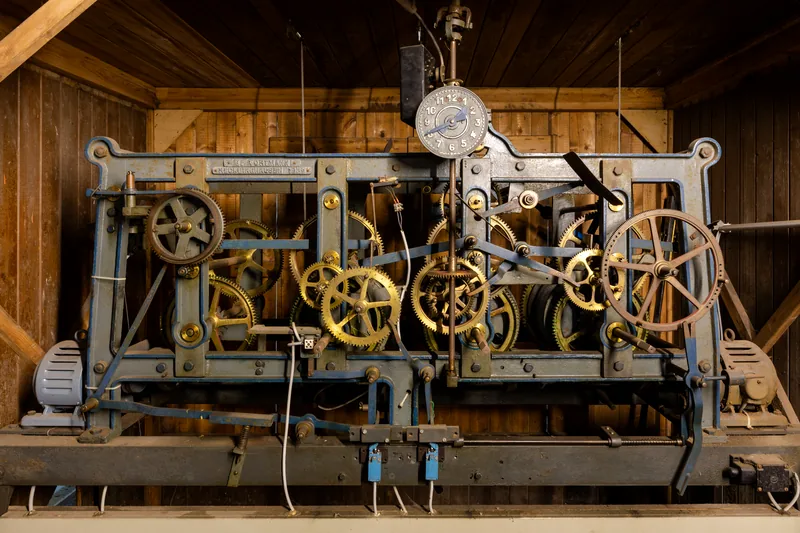
The keyless works on the Lemania 10s movement are built with extreme durability in mind. The winding pinion and clutch wheel feature aggressive, deep-cut gear teeth designed to handle the high mainspring tension required to drive the heavy balance wheel for 36 to 40 hours. Understanding the stem height—the exact distance from the center line of the winding stem to the face of the mainplate—is critical when engineering a custom case, as even a quarter-millimeter misalignment will cause binding across the winding pinion and setting lever assembly.
Challenges of Converting Lemania 10s to Wristwatch
Many horology enthusiasts ask: can you convert lemania 10s pocket watch movements without destroying their historic integrity or mechanical function? The answer is yes, provided the watchmaker addresses several distinct engineering challenges. Chief among these is the architectural difference between hunter-style (savonnette) and open-face (Lépine) dial layouts. In an open-face pocket watch, the crown is positioned at 12 o'clock with the small seconds sub-dial located directly opposite at 6 o'clock. When re-casing an open-face Lemania 10s movement into a wristwatch case with the crown placed at the traditional 3 o'clock position, the small seconds sub-dial shifts to the 9 o'clock position.
Conversely, a hunter-style movement places the winding crown at 3 o'clock relative to a 6 o'clock seconds sub-dial, which effortlessly translates to a standard wristwatch layout. However, hunter movements are less common in the 10s format. Beyond dial configuration, shock resistance presents a primary technical hurdle. Vintage Lemania 10s movements lack modern shock-absorbing jewel settings (such as Incabloc or KIF). The polished balance pivots measure only 0.08mm to 0.12mm in diameter; a sharp impact to an un-protected wristwatch case can easily snap the upper or lower balance staff pivots.
Finally, environmental sealing must be addressed. Vintage pocket watches were never designed to resist wrist perspiration, modern ambient humidity, or direct liquid contact. Installing a vintage Lemania 10s into a contemporary case requires modern silicone gasket seals at the case back, crystal seat, and crown stem tube. The watchmaker must balance preserving historic components with sealing the movement against the atmospheric forces of daily wrist wear.
Lug Welding and Case Selection
When undertaking a conversion, selecting or fabricating the proper enclosure is paramount. Watchmakers generally choose between two distinct pathways: modifying an original vintage pocket watch case by soldering custom wire lugs, or mounting the movement inside a purpose-built, modern stainless steel conversion case. The latter approach—utilizing a dedicated lemania 10s pocket watch to wrist conversion case—is widely preferred because it protects the fragile movement while providing modern water and shock resistance.
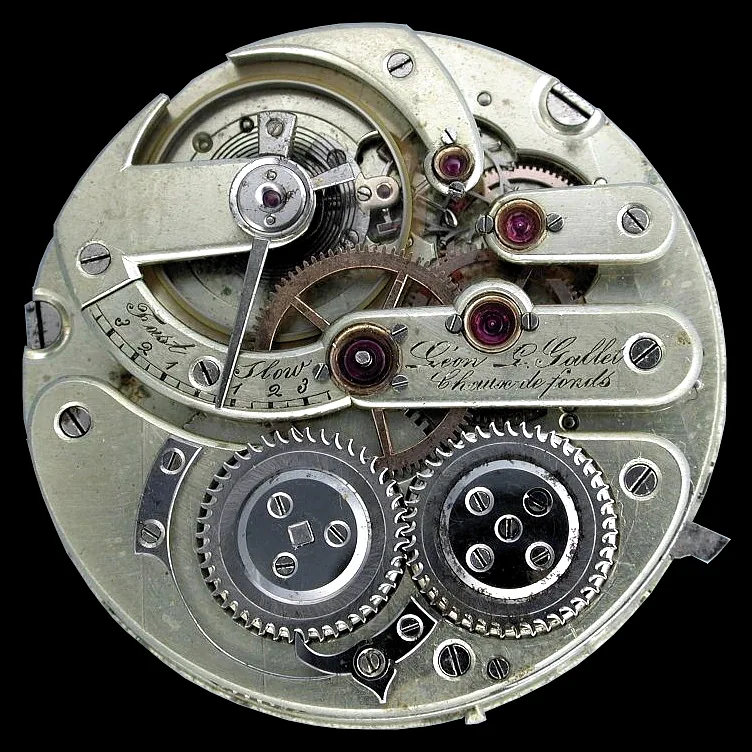
If retrofitting an original vintage silver or gold-filled case, the artisan uses low-heat micro-welding or silver-brazing techniques to attach custom wire lugs or solid horn lugs directly to the case band. Extreme thermal control is vital during this process; excessive heat will distort the case rim, preventing the bezel and snap-back from seating tightly. Furthermore, modern laser welding technology allows master watchmakers to add 316L stainless steel or sterling silver lugs without transferring damaging heat across the case body.
When selecting a modern CNC-machined conversion case, precision measurements are non-negotiable. Modern cases are typically turned from marine-grade 316L stainless steel and feature dual scratch-resistant sapphire crystals. Because vintage mainplates exhibit slight manufacturing variances, the watchmaker must turn a custom movement spacer ring (adapter ring) on a precision watchmaker's lathe (such as a Schaublin or Levin lathe). The brass or aluminum ring cradles the step of the Lemania mainplate, securing it firmly inside the steel case band using casing clamps and micro-screws to eliminate movement play during winding.
Crown and Stem Solutions
Establishing proper keyless works mechanics is one of the most precise aspects of any pocket watch conversion project. Vintage Lemania pocket watch stems were designed for pocket watch pendant tubes, which utilize square or round stem sleeves built directly into the pocket watch case neck. When transferring the movement into a custom wristwatch case, the original stem is rarely long enough or properly threaded to accommodate modern wrist crowns.
The watchmaker must carefully analyze the stem thread pitch (frequently metric Swiss threads such as Tap 9 / 0.90mm or Tap 10 / 1.00mm) and determine whether to fabricate a new stem from high-carbon steel rod or extend the original stem using a precision-machined stem extender. If turning a new stem from scratch, the rod stock is turned down on a lathe, cut with the appropriate square profile to slide through the winding pinion, hardened in an oil bath, and tempered to a straw color to achieve high tensile strength without brittleness.
Selecting the crown requires balancing aesthetic period-correctness with practical sealing. Large "onion" or "pumpkin" style crowns are popular choices for vintage pocket watch conversions because they mirror early 20th-century aviation and military styling while providing ample leverage to wind the stiff mainspring of a 10s movement. The crown must feature an internal double O-ring gasket that slides smoothly over the external case pendant tube, ensuring a moisture-tight seal without exerting radial stress on the winding stem arbor.
Dial and Hand Considerations
The visual identity of a Lemania conversion hinges on the dial and hand assembly. Vintage Lemania 10s pocket watches frequently feature double-sunk vitreous enamel dials or silvered metal dials with bold Art Deco or military radium numerals. Vitreous enamel dials are notoriously fragile; even slight pressure applied while removing dial feet can cause microscopic hairline cracks that ruin the dial face.
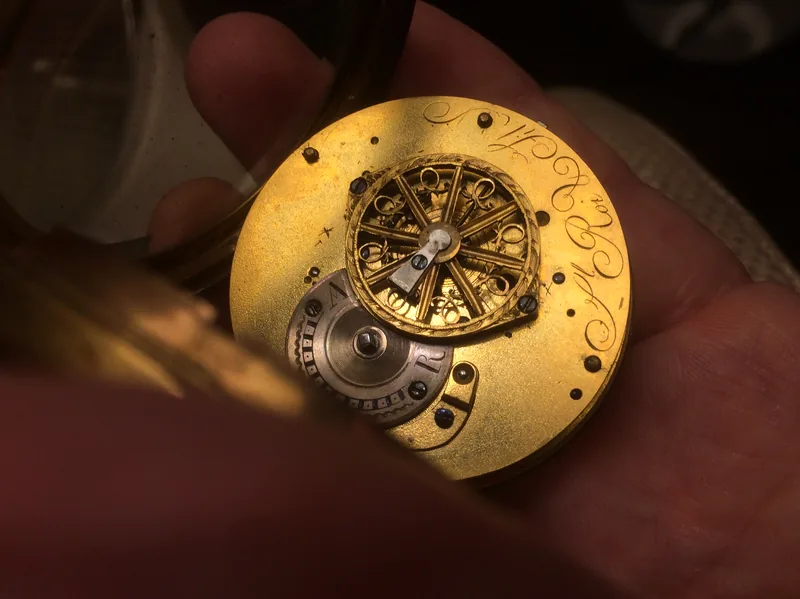
Modifying dial feet to align with a new case orientation requires immense caution. If the dial feet must be relocated, watchmakers avoid traditional high-heat soldering, which shatters enamel. Instead, specialized copper dial feet are attached using micro-spot welding or high-strength anaerobic epoxy. Alternatively, custom dial holding rings can clamp the perimeter of the dial base plate without requiring original feet modifications. For broader context on preserving vintage dials and cases during restoration, explore our guide on antique pocket watch conversions.
Hand fitting presents its own set of mechanical tolerances. Pocket watch hand posts—the hour wheel, cannon pinion, and fourth wheel arbor—are significantly thicker than standard modern wristwatch hands. Standard hole dimensions for a Lemania 10s fourth wheel sub-seconds pivot may measure 0.20mm to 0.30mm, while the hour and minute posts require precise friction-fit clearances. Watchmakers must either meticulously broach vintage blued-steel spade hands using micro-reamers or turn down custom hand collars on a lathe to fit the movement arbors perfectly. Proper vertical hand spacing is essential to ensure the hands clear both the raised dial numerals and the interior undersurface of the front crystal.
Why 10s is More Common for Conversion
In the world of custom watchmaking, 10-size (10s) pocket watch movements have emerged as the absolute sweet spot for wristwatch conversions. To understand why, one must examine the physical dimensions of standard vintage pocket watch sizes alongside modern wrist ergonomics. Larger American and Swiss movements—such as 18-size (approx. 44.8mm movement diameter) or 16-size (approx. 43.2mm)—yield finished wristwatch cases measuring between 48mm and 54mm wide. On all but the largest wrists, these oversized conversions feel unwieldy, top-heavy, and susceptible to severe side impacts.
By contrast, the Lemania 10s movement measures roughly 37mm to 39mm in mainplate diameter. When installed into a modern, low-profile stainless steel case with thin case walls, the resulting wristwatch measures a perfectly wearable 42mm to 44mm in outer diameter. This falls squarely within the contemporary sizing preferences for pilot, marine, and military-style sports watches. It provides massive wrist presence without compromising wearability or comfort.
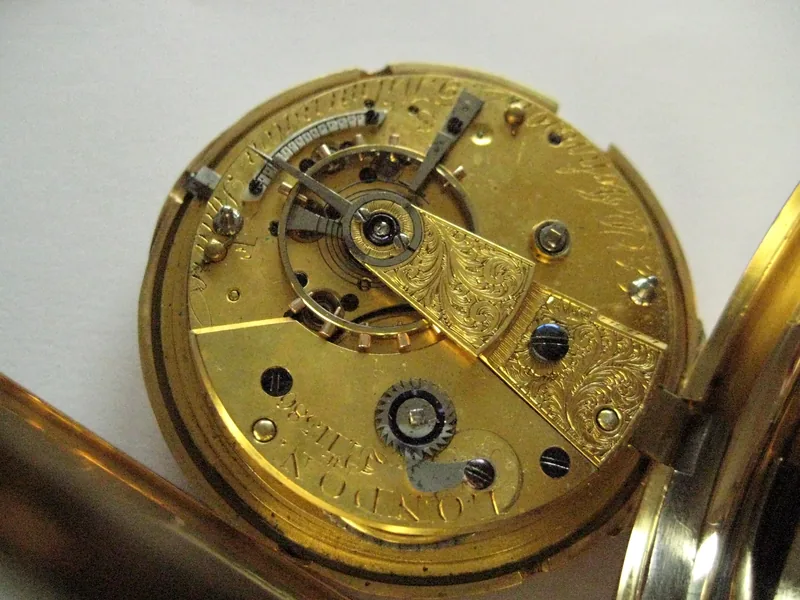
Furthermore, the 10s movement architecture offers superior structural stability compared to smaller 0-size or pendant-watch calibers (which measure under 30mm). Small pendant movements often feature fragile balance staffs, thin mainplates prone to flexing, and small mainspring barrels that provide poor power reserve. The Lemania 10s delivers the structural integrity, heavy gear train mass, and high balance momentum of a full-scale pocket watch caliber, while fitting comfortably into a everyday wristwatch silhouette. The result is a caliber that matches the mechanical prestige and hand-finished beauty found in high-tier historic timepieces like early vintage Rolex wristwatches and pocket chronometers.
Final Thoughts on Lemania 10s Conversions
When you convert lemania 10s pocket watch into wristwatch form, you do far more than assemble a custom timepiece—you perform a deeply technical act of horological preservation. Forgotten pocket watches that spent decades locked inside velvet boxes or missing their precious metal cases are given a dramatic second life. The heavy ticking of the low-frequency balance, the gleaming hand-finished bridges, and the tactile snap of the keyless works serve as a daily reminder of an era when watchmaking was an uncompromised art form.
Successfully performing a conversion requires a harmonious blend of classic micro-machining, careful horological engineering, and respectful aesthetic choices. From machining custom case adapter rings and turning balance staffs to broaching blued-steel hands and setting modern moisture gaskets, every step demands complete precision. For the master watchmaker and discerning collector alike, a properly converted Lemania 10s is not merely a custom watch—it is a wearable, living testament to historical Swiss horology.