Historical Background of Lemania 8s Movements
The story of Lemania is inextricably bound to the golden age of Swiss mechanical watchmaking. Founded in 1884 by Alfred Lugrin in L'Orient, Switzerland, under the name A. Lugrin & Cie, the manufacture rapidly earned an international reputation for constructing exceptionally precise chronographs, stopwatches, and high-grade pocket watch ebauches. Lugrin’s horological expertise yielded numerous patents, establishing Lemania as a pivotal supplier of raw movements to world-renowned houses, including Omega, Tissot, and Patek Philippe. During the early to mid-20th century, the factory distinguished itself by producing robust, highly reliable calibers designed to withstand the rigorous demands of military, maritime, and industrial timekeeping.
Among their varied offerings, the Lemania 8-size (8s) movement architecture occupies a unique niche in horological history. In traditional watchmaking nomenclature, an 8s movement refers to an ebauche with a plate diameter generally measuring between 38mm and 40mm. Unlike the massive 16s or 18s pocket watch calibers engineered primarily for railroad conductors and heavy pocket carry, the 8s standard was originally developed for smaller open-face pocket watches, military deck watches, and high-precision field timepieces. These movements bridged the gap between large, stationary pocket instruments and the nascent category of military wristlet watches.
Throughout both World Wars and into the mid-century period, Lemania supplied 8s pocket watch movements to European armed forces, including the British Ministry of Defence (MoD) and Swedish military branches. These movements were lauded for their structural stability, simple serviceability, and exemplary timekeeping under varying temperature conditions. Today, as vintage pocket watches often remain tucked away in drawers due to changing fashion norms, horologists and custom artisans frequently seek out these historical engines, prompting many enthusiasts to ask how to successfully convert lemania 8s pocket watch into wristwatch configurations for daily, modern wear.
Technical Specifications and Movement Architecture
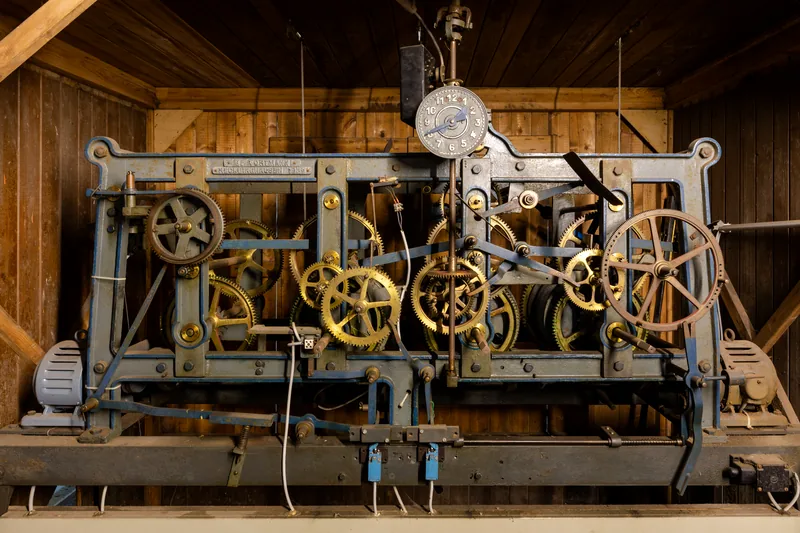
To evaluate a Lemania 8s movement for modern re-casing, a watchmaker must first understand its intricate mechanical layout. Most standard Lemania 8s calibers feature a traditional Swiss lever escapement driven by a high-grade mainspring housed in an open-arbor or safety-barrel assembly. The train wheel layout typically employs a traditional three-quarter bridge or separate finger bridges, meticulously hand-finished with Geneva stripes (Côtes de Genève) or perlage depending on the grade and contract specifications. These movements generally operate at a frequency of 18,000 vibrations per hour (vph) or 2.5 Hz, delivering a smooth, classic beat rate and a power reserve ranging between 36 and 42 hours.
The balance assembly in a high-grade 8s movement usually features a cut bimetallic compensation balance wheel or a Glucydur balance paired with a blued steel Breguet overcoil hairspring. This combination provides excellent compensation for thermal expansion and minimizes positional errors—qualities essential for precision timekeeping. Jewels on an 8s caliber range from 15 to 17 rubies in standard military or civilian models, up to 21 jewels in rare, adjusted chronometer-grade variants. These jewels are set in chatons or friction-set directly into the nickel-plated brass plates.
From an architectural standpoint, the keyless works (the winding and setting mechanism) on a Lemania 8s movement utilize a positive-set system where pulling the stem outward shifts the setting wheel into mesh with the motion work. Movement dimensions are critical when engineering a conversion: the overall plate diameter typically sits around 38.5mm, with a stack height (from the mainplate base to the top of the center wheel pivot) of approximately 4.5mm to 5.2mm. Understanding these precise dimensions is vital when designing custom movement holder rings and establishing proper stem height tolerances inside a new wrist enclosure.
Challenges of Converting Lemania 8s to Wristwatch
If you have ever wondered, "can you convert lemania 8s pocket watch into a modern wrist-worn instrument?", the short answer is yes—however, it presents significant technical hurdles that demand advanced bench skills. The primary challenge stems from the fundamental difference in physical orientation between pocket watches and wristwatches. Standard open-face pocket watches (Lépine style) position the winding crown at 12 o'clock, with the running seconds sub-dial located directly opposite at 6 o'clock. When this movement is rotated 90 degrees clockwise to position the crown at 3 o'clock for standard wrist operation, the original sub-seconds register moves to 9 o'clock. If the donor watch is a Hunter-style movement (crown at 3 o'clock), rotating it places the sub-seconds register at 6 o'clock, but finding clean Hunter 8s donor movements is far less common.
Another major challenge involves shock protection. Vintage Lemania 8s calibers were created before shock-absorbing balance jewels (such as Incabloc or KIF systems) became standard in horology. In a pocket watch, the movement sits relatively protected inside a coat or vest pocket, shielded from abrupt impacts. On the wrist, however, a watch is constantly exposed to shocks, swinging arms, and accidental strikes against hard surfaces. Without modern shock springs, an unexpected tap can snap the delicate balance staff pivots, which are often only 0.08mm in diameter, requiring a watchmaker to turn a custom balance staff on a watchmaker's lathe to restore the watch to working order.
Environmental sealing poses a third major challenge. Antique pocket watch cases relied on snap-fit or threaded bezels that provided minimal resistance against airborne dust, humidity, and atmospheric changes. When transferring an 8s caliber to the wrist, the master watchmaker must engineer a casing solution that shields the sensitive, non-stainless vintage steel components from sweat and moisture. Failing to insulate an un-shockproofed, carbon-steel hairspring from ambient moisture will quickly cause rust, degradation of timing performance, and eventual mechanical seizure.
Lug Welding and Case Selection
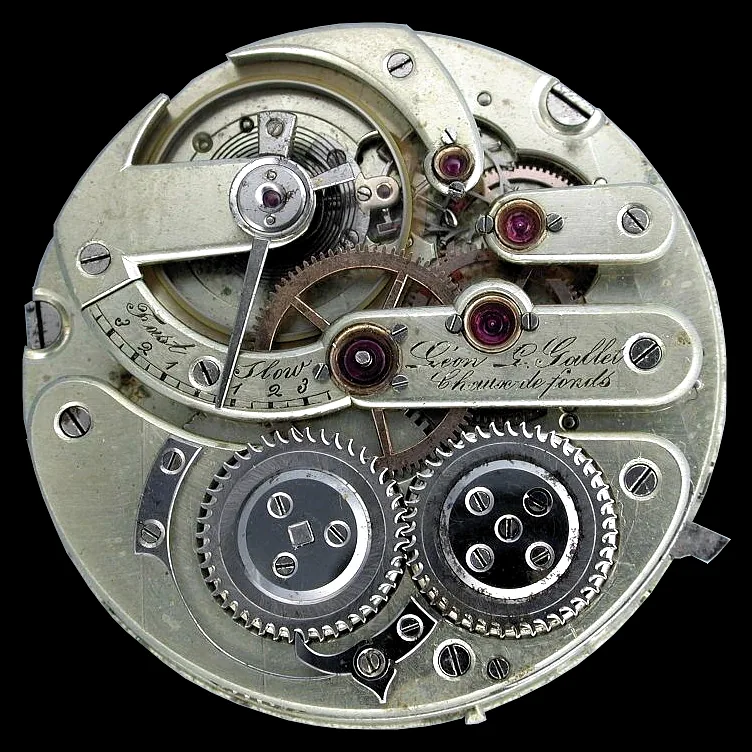
When executing a conversion project, selecting or manufacturing the proper case is the cornerstone of structural integrity. Watchmakers generally approach this through two distinct methodologies: retrofitting an original vintage pocket watch case by silver-soldering lugs directly onto it, or manufacturing a dedicated modern conversion case. In the vintage restoration realm, adopting a trench-style aesthetic is common. Craftsmanship here requires TIG welding or hard-soldering wire lugs onto the existing silver or nickel-brass pocket case, echoing the design language seen on authentic WW1 trench watches that pioneered wrist-worn timepieces during the early 20th century.
However, the modern standard relies on acquiring or machining a specialized lemania 8s pocket watch to wrist conversion case. Made from high-grade 316L stainless steel, these custom cases are specifically proportioned to accommodate 38mm to 40mm movements. A properly designed conversion case utilizes front and rear sapphire crystals, water-resistant synthetic gaskets, and a precision-turned internal movement spacer ring. The spacer ring, often turned from solid brass or stainless steel, bridges the clearance gap between the movement plate perimeter and the inner case wall, held securely by case clamping tabs and screws.
The table below summarizes the technical trade-offs between utilizing an original modified pocket watch case versus a modern 316L stainless steel custom conversion case:
| Parameter | Original Pocket Watch Case (Modified) | Custom 316L Stainless Steel Case |
|---|---|---|
| Historical Authenticity | High (retains original case & hallmarks) | Low (modern fabrication) |
| Water & Dust Resistance | Minimal (snap-fit, no rubber gaskets) | High (O-ring seals, screwed caseback) |
| Shock Protection | Poor (direct impact transfer to movement) | Enhanced (cushioned spacer rings) |
| Lug Integration | Requires silver-soldering or micro-welding | Integrated solid or spring-bar lugs |
| Daily Wearability | Delicate; vulnerable to sweat/moisture | Robust; suitable for regular wear |
Selecting the correct lug geometry is equally essential. Because an 8s movement creates an overall case diameter between 42mm and 44mm, the lugs must feature a pronounced downward curve (a steep drop angle) to ensure the watch sits comfortably against the contours of the wrist without uncomfortable overhang.
Crown and Stem Solutions
Achieving smooth winding and precise hand-setting in an 8s conversion requires meticulous stem geometry and alignment. Pocket watch stems are fundamentally different from modern wristwatch stems. In a traditional pocket watch, the winding stem often forms an integral part of the pocket case's pendant tube rather than remaining permanently fixed inside the movement. When the movement is extracted from its original casing, the original stem is frequently too short, missing, or cut to a non-standard length that cannot reach the crown position of a modern conversion case.
To overcome this issue, the watchmaker must source or turn a custom winding stem on a lathe. The critical dimensions include the square neck section (which engages the clutch wheel), the journal diameter (which pivots within the mainplate recess), and the threaded stem extension (typically Tap 9 or Tap 10 thread pitch). If an original stem is available but lacks sufficient length, a precision-machined stem extender can be fitted using thread-locking compound. However, crafting a continuous, single-piece replacement stem from hardened steel remains the superior engineering solution for smooth winding torque and longevity.
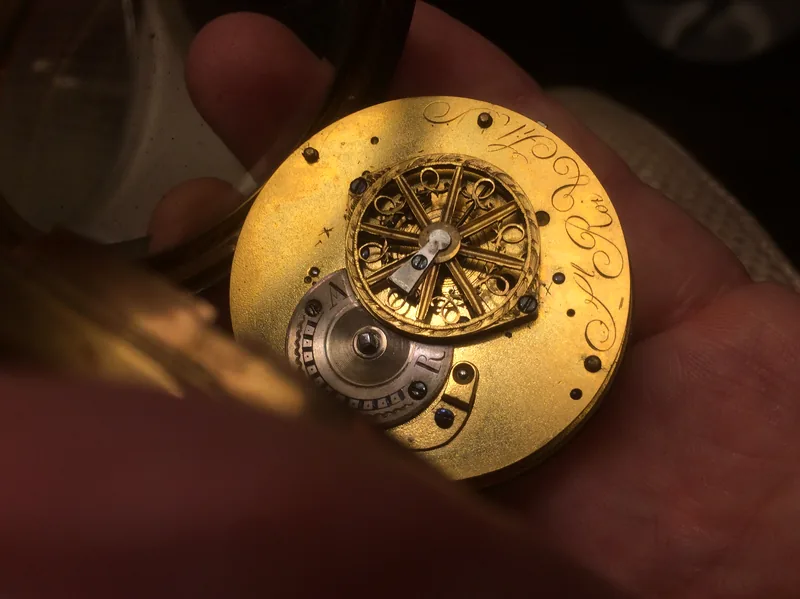
Crown selection must balance period-correct aesthetic appeal with modern ergonomics. Large onion or diamond-style crowns are traditionally favored for vintage military conversions because they mirror the historical tactile feel of early aviator timepieces. The internal crown recess must house a durable nitrile rubber gasket that slides over the case pendant tube, establishing an environmental seal against dust and atmospheric humidity while allowing smooth, low-friction rotational winding action.
Dial and Hand Considerations
The dial of a vintage Lemania 8s movement is often a masterpiece of enamel or fine silver finishing. Vitreous enamel dials (porcelain burned onto a copper base plate) offer timeless legibility and never fade with age, but they are exceptionally brittle. Removing, re-orienting, or adjusting an enamel dial requires supreme care. A single misstep with a dial-lifting lever can introduce micro-hairline fractures across the surface, permanently ruining an irreplaceable historical artifact.
When converting an open-face Lépine movement to a wrist configuration, the 9 o'clock position of the sub-seconds register must be accepted as an authentic characteristic of the conversion process. Attempting to alter or relocate dial feet to force a 6 o'clock seconds alignment will break the alignment between the sub-seconds pinion and the dial hole. If dial feet are damaged during restoration, a watchmaker must solder replacement copper feet using micro-spot welding techniques or low-temperature solder, ensuring the dial rests flat against the mainplate without interfering with the hour wheel height or cannon pinion clearance.
Hand fitting presents its own set of technical considerations. The original hands of a Lemania 8s movement are crafted from heat-blued steel or polished brass. The hole diameters of vintage hour and minute sockets rarely match off-the-shelf modern wristwatch hands. A watchmaker must carefully broach the hand sockets using precise horological broaches to enlarge them, or close them down on a staking set to ensure a press-fit onto the center arbor and cannon pinion. The clearance between the underside of the crystal, the sweeping hands, and the dial face is extremely tight; careful hand alignment along the horizontal plane is mandatory to prevent hands from catching on one another during operation.
Why 8s is More Common for Conversion
Among horological artisans specializing in antique pocket watch conversions, the 8s caliber size is widely considered the sweet spot for custom projects. To understand why, one must look at the physical dimensions of standard pocket watch movements. Larger 16s and 18s movements—while mechanically impressive and visually striking—possess plate diameters of 43mm to 45mm. When installed inside a protective wrist case, the resulting watch measures between 48mm and 52mm across, rendering it awkwardly large and uncomfortable for daily wear on average wrist sizes.
Conversely, movements smaller than 8s (such as 0s or 3/0s lady-size pocket movements) often suffer from fragile, delicate balance shafts and overly compact gear trains, making them prone to mechanical failure under regular wrist wear. The 8s size strikes an ideal mechanical balance: its components are large and robust enough to maintain excellent chronometric stability and durability, yet small enough to be fitted into a finished wrist case measuring a balanced 40mm to 42mm in diameter.
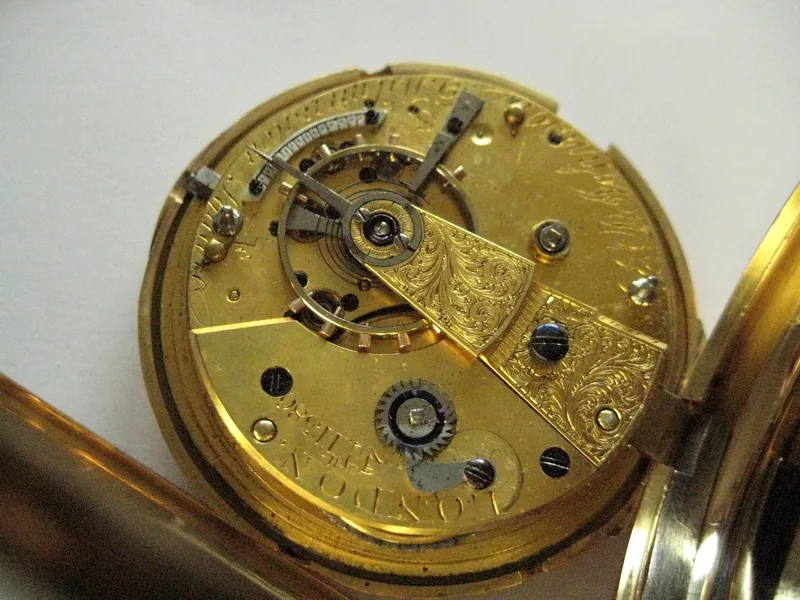
Furthermore, the historical scarcity and rising cost of high-grade, smaller vintage wrist movements from the early 20th century have driven collectors to seek alternative ways to wear legendary Swiss horological engineering. Early wristwatch developments—much like early vintage Rolex wristwatches utilizing Rebberg or Aegler ebauches—relied heavily on adapted pocket watch technology. The Lemania 8s movement stands out because of its exceptional manufacturing quality, high mechanical precision, ready availability of vintage donor parts, and ideal physical proportions for modern wrist wear.
Final Thoughts on Lemania 8s Conversions
Transforming an antique Lemania 8s pocket watch movement into a functional, wrist-worn timekeeper is a profound bridge between modern custom watchmaking and classic horological history. Rather than allowing a high-grade mechanical engine to sit unused inside an obsolete pocket case, a well-executed conversion brings history back to life. It gives the owner a unique, mechanical wrist instrument powered by an ebauche that reflects the rich heritage of Swiss watchmaking excellence.
However, the process should always be guided by an ethical approach to preservation. Master watchmakers emphasize non-destructive techniques whenever possible: preserving original dials without aggressive chemical cleaning, retaining undamaged original parts, and utilizing custom spacer rings instead of modifying the movement's mainplate. When performed with precision, custom stem alignment, and proper case sealing, the converted Lemania 8s becomes more than just a custom watch—it stands as a wearable tribute to the golden era of mechanical timing, ready to serve reliably for another generation.