1. Historical Background of New York Standard 16s Movements
The New York Standard Watch Company, established in Jersey City, New Jersey, in 1885, occupies a distinct and fascinating niche in American horological history. Unlike giants such as Waltham or Elgin, which focused heavily on top-tier railroad chronometers, New York Standard carved out a reputation by pioneering mass-production techniques that made reliable mechanical timekeeping accessible to the broader working class. Producing millions of movements before closing its doors in 1929, the manufacturer developed a wide array of calibers, among which the 16-size (16s) platform emerged as one of the most practical and versatile workhorses of the era.
During the late 19th and early 20th centuries, standard pocket watch design dictated that a gentleman’s timepiece reside safely inside a waistcoat pocket. However, as industrial demands increased and military logistical needs shifted during the early 1900s—a trend that culminated during the First World War—the convenience of the wrist-mounted watch became undeniable. Early horological pioneers began experimenting with military adaptations, converting pocket movements into wristlets, a practice that directly inspired early authentic WW1 trench watches. The New York Standard 16s movement, with its robust construction and standardized dimensions, was frequently a candidate for early re-casing and custom housing.
Today, the historical legacy of New York Standard movements makes them particularly appealing to collectors and custom horologists. Converting these pocket movements into modern wristwatches preserves a tangible artifact of American industrial innovation. While the company produced a range of grades—from simple 7-jewel unadjusted movements to higher-grade 17-jewel variants—the structural foundation of the 16s caliber offers a sturdy layout that lends itself remarkably well to modern bench modifications, provided the watchmaker possesses an intimate understanding of vintage American architecture.
2. Technical Specifications and Movement Architecture
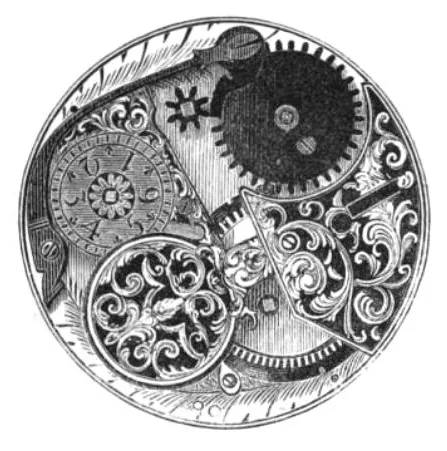
To successfully execute a conversion, a watchmaker must first analyze the physical dimensions and mechanical architecture of the New York Standard 16s caliber. In the American sizing system, a 16s movement features a mainplate diameter of 1.7 inches, or approximately 43.18 millimeters. This plate dimension forms the baseline for all casing calculations. The movement layout typically utilizes a full-plate or three-quarter plate configuration, held together by nickel or gilded brass plates decorated with traditional damaskeening patterns ranging from simple sunbursts to elaborate geometric striping.
Mechanically, these movements employ a traditional lever escapement operating at a frequency of 18,000 vibrations per hour (2.5 Hz). The gear train is driven by a mainspring housed within a heavy-walled barrel, delivering substantial torque to drive the wheel train. The balance assembly generally features a split-bimetallic compensated balance wheel paired with a steel hairspring—either flat or with a Breguet overcoil, depending on the movement grade. One critical architectural quirk of New York Standard movements is their setting mechanism: while many higher-end American pocket watches utilized lever-setting systems to prevent accidental time changes, many 16s New York Standard movements relied on a pendant-set or friction-sleeve mechanism that requires careful handling during stem fitting.
Understanding the train wheel layout and winding arbor geometry is essential when preparing to convert new york standard 16s pocket watch into wristwatch configurations. The depth of the movement, often measuring between 6.0mm and 7.5mm from the top of the center wheel pivot to the base of the winding wheel, demands substantial internal clearance within any custom case. Furthermore, the positioning of the sub-seconds pinion relative to the center arbor dictates the dial geometry, making exact microscopic measurements with digital calipers mandatory before attempting any alignment work.
3. Challenges of Converting New York Standard 16s to Wristwatch
A common inquiry among enthusiasts is simple: can you convert new york standard 16s pocket watch models into reliable daily wristwatches? The answer is an emphatic yes, but the process is fraught with technical obstacles that require advanced watchmaking skills to overcome. The most immediate challenge centers on shock resistance. Vintage 16s movements were built long before the invention of modern shock-absorbing systems such as Incabloc or KIF. The delicate balance staff pivots—often measuring less than 0.10mm in diameter—run directly in pressed or screwed jewels. Worn on the wrist, a watch is subjected to frequent impacts, motion, and sudden vibrations that pocket watches tucked in vest pockets never experienced, making pivot protection and careful wear paramount.
Another major structural hurdle is dial and orientation geometry. Pocket watches fall into two primary mechanical categories: open-face (Lépine) and hunter (Savonnette) movements. In an open-face movement, the winding stem is located at the 12 o'clock position, directly above the sub-seconds dial at 6 o'clock. If you mount an open-face movement into a wristwatch case with the crown positioned at 3 o'clock, the sub-seconds register moves to the 9 o'clock position. Conversely, a hunter movement features the crown at 3 o'clock and sub-seconds at 6 o'clock, which aligns naturally for a wristwatch but introduces complexities regarding dial feet alignment and stem release levers. Choosing how to orient the dial while maintaining proper stem functionality requires precise spatial planning.
Dust, moisture, and magnetic interference present additional hazards. Vintage mainplates and steel components possess zero inherent water resistance, and the balance springs are highly susceptible to magnetization from modern electronic devices. When undertaking antique pocket watch conversions, the watchmaker must engineer modern sealing solutions—such as synthetic gaskets and custom movement holder rings—to insulate the antique caliber from environmental degradation without altering the original movement structure permanently.
4. Lug Welding and Case Selection
When selecting or constructing a housing, obtaining a dedicated new york standard 16s pocket watch to wrist conversion case is the single most critical factor in achieving structural integrity and aesthetic balance. Because a 16s mainplate measures roughly 43.2mm, the exterior case diameter will inevitably reach between 45mm and 48mm. This creates a bold, oversized wristwatch profile reminiscent of classic aviation timepieces. Watchmakers generally choose between two pathways: modifying an original vintage pocket watch case by adding custom lugs, or installing the movement into a modern, CNC-machined conversion case specifically designed for American 16s dimensions.
If modifying an original pocket watch case—typically fabricated from coin silver, gold-filled brass, or nickel-silver alloys—the primary task involves fashioning custom wire or solid lugs and securely bonding them to the case ring. Hard soldering (silver brazing) or micro-TIG welding is required to achieve the structural strength necessary to endure daily strap tension. The watchmaker must precisely mark the 12 o'clock and 6 o'clock axis using a height gauge on a surface plate, ensuring the lugs are aligned parallel to the vertical centerline of the case. Overheating the case during welding must be rigorously avoided, as excessive heat can warp the case bezels, ruin original hinge solder joints, or deform thin-walled dust covers.
Modern conversion cases offer an attractive alternative, featuring sapphire crystals, modern screw-down display backs, and pre-machined 22mm or 24mm lug structures. However, because New York Standard movements exhibit slight variations in casing lip diameter and screw-tab locations across different production runs, off-the-shelf conversion cases rarely permit a direct drop-in fit. The watchmaker must custom-turn an brass or bronze movement movement spacing ring on a watchmaker's lathe. This ring bridges the gap between the inner wall of the modern steel case and the outer lip of the New York Standard mainplate, ensuring zero lateral or vertical movement when the movement is secured with casing clamps.
5. Crown and Stem Solutions
Engineered winding stem solutions represent one of the most mechanically demanding phases of converting a New York Standard 16s pocket movement. Pocket watch stems were originally integrated into the pocket watch case neck rather than remaining permanently attached to the movement itself. Most New York Standard 16s movements employ a "negative setting" mechanism, where a spring-loaded sleeve inside the case pendant holds the stem in the setting position until the case forces it down into the winding mode, or a friction sleeve arrangement. Modern wristwatches, by contrast, use "positive setting" mechanisms where the detente and setting lever reside entirely within the movement work.
To establish seamless winding and setting in a conversion case, the watchmaker must custom-machine a dual-section stem or adapt an vintage winding arbor using specialized lathe operations. The process begins by selecting a high-carbon steel stem blank. The squared section of the stem must be carefully ground on an arbor press or precision micro-grinder to match the internal square bore of the New York Standard winding pinion (typically ranging around 1.1mm to 1.3mm square). The threaded end must then be turned down and chased with standard watchmaker threads (such as Tap 9 or Tap 10) to accommodate a modern oversized crown.
Crown selection must strike a fine balance between authentic period aesthetics and practical functionality. Large "onion" or "pumpkin" style crowns are favored because they reflect the visual language of turn-of-the-century pocket watches while offering sufficient grip to wind the heavy mainspring of a 16s movement. The crown stem tube on the conversion case must be fitted with internal nitrile O-ring seals. The internal shoulder of the crown must seal snugly against the case tube without binding the stem, allowing smooth transition between manual winding and hand-setting modes without exerting lateral force on the winding arbor or mainplate jewel setting.
6. Dial and Hand Considerations
Preserving or adapting the dial of a New York Standard 16s timepiece demands extraordinary care, particularly when dealing with original double-sunk or single-sunk vitreous enamel dials. Vitreous enamel dials consist of thin glass powder fused onto a copper base plate at high temperatures. Over a century of existence, these dials develop internal stress lines. Removing or re-soldering dial feet using traditional torch methods will crack the enamel surface instantly. If the original dial feet do not match the new case orientation or movement mounting tabs, specialized mechanical clamps or non-destructive dial-foot soldering machines operating at controlled, localized capacitance-discharge levels must be employed.
In cases where an original enamel dial is damaged beyond repair, horologists often turn to custom brass or silver dials, hand-finished with engine-turned guilloché patterns or hand-painted enamel lacquer. Regardless of dial material, the dimensional relationships between the dial surface, the hour wheel pipe, the center wheel arbor, and the crystal clearance remain absolute. Because pocket watch crystals were high-domed mineral glass or acrylic, modern flat sapphire crystals can interfere with the tip of the central hand arbor. The clearance between the underside of the crystal and the top of the minute hand pivot must be measured precisely using depth micrometers, allowing at least 0.3mm of air space to prevent hand binding.
Hand fitting presents its own set of lathe work challenges. Original New York Standard hands are typically constructed from blued steel, boasting exquisite spade, cathedral, or Louis XV styling. However, the hole diameters of original pocket watch hands (hour hand hole ~2.10mm, minute hand hole ~1.15mm) rarely fit modern replacement wheel pipes directly. Watchmakers must either bush down oversized hand holes using small brass inserts turned on a lathe, or carefully ream undersized holes using micro-broaches. The hands must be polished, chemically cleaned, and re-blued over an alcohol flame or brass-shavings tray at approximately 290°C (550°F) to restore their deep, rust-resistant peacock blue finish.
7. Why 16s is More Common for Conversion
Among the various American pocket watch sizes, the 16s platform has firmly established itself as the absolute favorite for wrist conversions among custom horologists and collectors alike. To understand this preference, one must analyze the physical scale of alternative sizes, such as 18s, 12s, and 0s. The 18-size movement—measuring 44.86mm in plate diameter—results in a finished wristwatch with a case diameter exceeding 50mm to 52mm. Unless worn over a flight jacket, an 18s conversion watch is simply too massive and uncomfortable for daily wrist wear, subjecting the heavy movement to excessive leverage and impact forces.
On the opposite end of the spectrum, smaller sizes like 12s (38.1mm) or 0s (29.62mm) offer more compact wrist profiles, but present severe mechanical drawbacks during the conversion process. Smaller vintage movements utilize significantly thinner gear train pivots, delicate balance staffs, and fragile mainspring barrels that are far more prone to structural failure when subjected to the dynamic forces of modern wrist movement. Furthermore, spare parts—such as replacement balance staffs, winding pinions, and balance springs—for 12s and smaller New York Standard movements are exceedingly rare compared to the widely produced 16s calibers.
The 16s movement sits in the ideal mechanical "Goldilocks zone." With a 43.18mm movement diameter, it fills out a modern 45mm-47mm conversion case perfectly—a size profile popularized in modern horology by sports and aviator watches like those in high-end collections or vintage military pieces similar to historical vintage Rolex wristwatches and pocket-watch derived Panerai models. Mechanically, the 16s components are robust enough to withstand daily wear, the gear teeth profiles are large enough to permit straightforward servicing and hand-cleaning, and the vast historical production volume guarantees a steady supply of donor parts for long-term maintenance.
8. Final Thoughts on New York Standard 16s Conversions
Successfully attempting to convert new york standard 16s pocket watch into wristwatch configurations is a profound exercise in historical preservation and practical horological engineering. It bridges the gap between 19th-century American industrial craftsmanship and contemporary wrist-wear aesthetics. When executed correctly by a skilled craftsperson, a converted New York Standard watch is not merely a novelty; it is a fully functional, wearable mechanical monument that breathes new life into an movement that might otherwise languish forgotten in a drawer.
However, prospective owners and watchmakers must approach these conversions with realistic expectations regarding performance and care. These movements lack modern shock protection, magnetic shielding, and automated manufacturing tolerances. They must be wound by hand with a delicate touch, removed before engaging in physical labor or athletic activity, and strictly kept away from water. Regular servicing—involving total disassembly, ultrasonic cleaning, fresh synthetic lubrication of jewels and train pivots, and precise timing adjustments on a modern timegrapher—should be performed every three to five years to combat pivot wear.
Ultimately, the timeless charm of a New York Standard 16s conversion lies in its tangible connection to watchmaking history. Watching the slow, deliberate 18,000 vph beat of a split-bimetallic balance wheel through a sapphire display back—framed by hand-finished American damaskeening plates—offers a mechanical soul that no modern mass-produced watch can replicate. Through thoughtful casing, precise stem engineering, and meticulous dial adaptation, these historic American pocket movements continue to mark time faithfully, moving off the vest pocket chain and onto the modern wrist.