Historical Background of New York Standard 18s Movements
The New York Standard Watch Company holds a unique and crucial position in the history of American industrial horology. Operating out of Jersey City, New Jersey, from 1885 until its acquisition by Keystone in 1929, the firm revolutionized mass-market watch manufacturing. While companies like Waltham, Elgin, and Hamilton focused heavily on higher-grade railroad-approved timepieces, New York Standard carved out a market by producing affordable, robust, and clever workhorse movements accessible to the working class. Their 18-size (18s) pocket watch movements represented the quintessential late 19th-century American timekeeper: large, heavy, and engineered for straightforward mechanical reliability.
During the height of production, the 18s caliber was the standard size for men’s pocket watches in North America. Measuring roughly 44.87 mm in pillar plate diameter, these mechanisms were built to withstand demanding everyday use. New York Standard introduced several proprietary innovations to keep manufacturing costs down while maintaining utility, such as their famous "worm gear" escapements and simplified winding works on early models, transitioning later to conventional lever escapements. Today, horologists and custom builders looking to convert new york standard 18s pocket watch into wristwatch configurations are drawn to these movements because of their bold visual presence, open-bridge architecture, and undeniable historic charm.
Understanding the provenance of a New York Standard 18s caliber is essential before initiating a conversion. Many of these movements spent decades inside gold-filled or nickel silver pocket watch cases, exposed to dust and humidity. Restoring and re-casing a movement that powered the pocket of an industrial worker over a century ago requires a deep respect for original American manufacturing techniques, alongside modern watchmaking precision to adapt it for wrist wear.
Technical Specifications and Movement Architecture
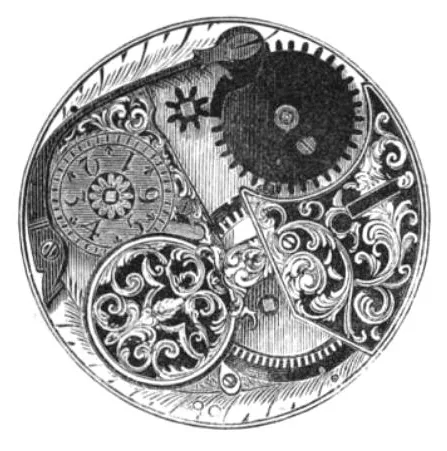
From a watchmaker's bench perspective, analyzing the architectural layout of an 18s New York Standard movement reveals fascinating mechanical details. The American 18-size platform is defined by a bottom plate diameter of 1.76 inches (44.87 mm). The full-plate and three-quarter plate designs common to New York Standard models present a substantial mass of nickel or gilded brass, often decorated with damaskeening patterns ranging from simple geometric striping to intricate radial sunbursts. These movements typically operate at a traditional frequency of 18,000 vibrations per hour (2.5 Hz), giving the balance wheel a slow, rhythmic, and visually captivating sweep.
The movement architecture usually features a heavy bimetallic split-compensation balance wheel with timing screws, paired with a flat or Breguet overcoil hairspring. Jewel counts on standard New York Standard 18s calibers generally range from 7 to 15 jewels, set in pressed or screwed brass settings. Lower jewel counts mean that steel pivots run directly in brass plates in non-critical positions, which often requires re-bushing pivot holes with modern bronze or synthetic ruby bushings during a complete mechanical overhaul. The wheel train consists of a heavy mainspring barrel, center wheel, third wheel, fourth wheel (which drives the sub-seconds hand at a 60-second rotation rate), and steel escape wheel driving a classic Swiss-style lever pallet assembly.
Another key technical consideration is the winding and setting arrangement. Unlike modern modern wristwatches equipped with unified keyless works, many 18s New York Standard movements utilize negative-set (pendant set) or lever-set configurations. In a negative-set movement, the sleeve located inside the original pocket watch case pendant holds the setting stem in position, engaging either the winding pinions or setting wheels depending on stem tension. Adapting this mechanism to function reliably inside a custom wristwatch case requires precise calculation of stem throw distance and crown tension.
Challenges of Converting New York Standard 18s to Wristwatch
When clients ask, "can you convert new york standard 18s pocket watch movements into wearable wristwatches?" the short answer is yes, but it presents significant engineering hurdles. The primary challenge is the sheer physical scale of the movement. At nearly 45 mm in diameter for the movement plate alone, the finished watch case will inevitably measure between 48 mm and 52 mm in diameter. On the wrist, this creates an uncompromising, oversized profile that demands careful ergonomic design of the lugs to prevent uncomfortable overhang.
A second major challenge involves shock protection—or the lack thereof. Antique pocket watch movements were designed to sit vertically inside a vest pocket, shielded from sudden impacts. The balance pivots of an 18s New York Standard caliber are thin, polished steel pins measuring less than 0.12 mm in diameter, resting on fixed jewels without any spring-loaded Incabloc or KIF shock absorption systems. Wearing an 18s conversion watch during modern daily activities exposes these delicate balance pivots to severe shock risks. Drop the watch or hit it against a hard surface, and a balance pivot will snap instantly, requiring custom lathe work to re-pivot the balance staff.
Furthermore, movement orientation dictates the final layout of the dial. Open-face (Lépine) pocket watch calibers have the winding stem located at 12 o'clock and the sub-seconds register at 6 o'clock. When re-cased into a wrist architecture, keeping the stem at 3 o'clock shifts the sub-seconds dial to the 9 o'clock position. Alternatively, keeping the stem at 12 o'clock yields a classic bullhead or "trench watch" profile. Hunter-case (Savonnette) movements naturally position the stem at 3 o'clock with sub-seconds at 6 o'clock, making them highly prized for conversions, though they are far less common among surviving New York Standard 18s production runs.
Lug Welding and Case Selection
Selecting or fabricating the proper new york standard 18s pocket watch to wrist conversion case is the cornerstone of a successful build. Watchmakers generally take one of two pathways: fabricating custom lugs onto a modified original pocket watch case, or housing the movement inside a purpose-built modern stainless steel conversion case designed specifically for American 18-size pocket watch movements.
If retaining the original pocket watch case, wire lugs or modern spring-bar lugs must be permanently joined to the case band. This process mirrors early 20th-century techniques used during the transition to authentic WW1 trench watches. Micro-TIG welding or laser welding is necessary to fuse silver, brass, or gold-filled case bands with solid silver or stainless steel wire lugs without annealing the surrounding metal or distorting the hinged bezel. Hard soldering with high-grade silver solder can also be employed, though extreme heat management is crucial to avoid ruining decorative engraving on the case back.
Alternatively, utilizing a modern CNC-milled 316L stainless steel conversion case offers vastly superior environmental protection. These modern cases feature threaded exhibition case backs equipped with synthetic sapphire or mineral crystals, allowing full view of the hand-finished New York Standard damaskeened plates. The inner cavity of an 18s conversion case features a stepped movement seat. A custom-machined brass or aluminum movement adapter ring must be turned on a watchmaker’s lathe to hold the 44.87 mm New York Standard plate firmly, preventing any lateral movement when operating the winding stem.
Crown and Stem Solutions
Resolving stem geometry is often the most technical phase when you convert new york standard 18s pocket watch into wristwatch cases. Modern wristwatch cases operate on standard metric stem threading (typically Tap 9 / 0.90 mm or Tap 10 / 0.80 mm). Conversely, late 19th-century American pocket watch stems used obsolete imperial thread pitches or square winding arbors. Finding an original stem that is long enough to span the distance from a modern conversion case wall to the central winding pinion of a New York Standard movement is nearly impossible off the shelf.
To overcome this, a watchmaker must execute one of three precision stem modifications:
- Stem Extension and Thread Adapting: The original short steel stem is trimmed on a lathe, turned down, and threaded to accept a custom-machined steel coupling sleeve. This sleeve connects the original square or threaded square profile of the NY Standard winding stem to a modern stem extension piece.
- Custom Stem Turning: Starting from high-carbon steel rod stock (such as O1 or gauge steel), the watchmaker turns a completely original winding stem on a precision watchmaker's lathe (e.g., Lorch or Levin). The square winding section, setting shoulder, pilot pivot, and outer threads are cut to exact tolerances, followed by hardening and tempering to a deep blue color.
- Positive/Negative Conversion Sleeves: For negative-set movements, an internal case sleeve featuring an adjustable spring-loaded clutch collar must be fitted inside the stem tube of the new case. This collar reproduces the friction click necessary to hold the stem in either the winding or hand-setting position.
The crown itself must match both the mechanical scale and aesthetic period of the watch. Oversized onion-style, pumpkin, or vintage pilot crowns measuring 7.0 mm to 9.0 mm in diameter provide the necessary torque to turn the heavy mainspring click wheel of an 18s mainspring barrel without putting excessive mechanical strain on the wearer's fingers.
Dial and Hand Considerations
The dial of a New York Standard 18s pocket watch is a work of art in its own right, typically constructed from a copper baseplate coated with double-sunk vitreous enamel. These dials are incredibly brittle. Removing, repinning, or modifying them requires extreme care. Thermal shock or uneven stress will instantly cause fine hair-line fractures across the porcelain surface.
Dial foot alignment is a primary mechanical consideration. American pocket watch manufacturers located dial feet according to their own internal factory standards rather than modern movement mounting points. When fitting a New York Standard movement into a modern case, the original copper dial feet must be checked for straightness. If a new custom dial is fabricated to achieve a traditional wristwatch orientation (with 12 o'clock at the top instead of 3 or 9 o'clock), new dial feet must be spot-soldered using a specialized capacitive discharge dial-foot soldering machine that applies heat so rapidly that the face enamel remains undamaged.
Hand fitting presents another dimensional challenge. The center pipe, hour wheel arbor, cannon pinion, and fourth wheel pivot diameters on an 18s American movement are far larger than modern ETA or Unitas hand dimensions. The following table highlights typical dimensional differences encountered during conversion work:
| Component Arbor | NYS 18s Typical Diameter | Modern Conversion Standard (ETA 6497) |
|---|---|---|
| Hour Hand Hole | ~2.20 mm - 2.40 mm | 1.30 mm |
| Minute Hand Hole | ~1.40 mm - 1.55 mm | 0.80 mm |
| Sub-Seconds Hole | ~0.38 mm - 0.45 mm | 0.20 mm |
Because of these discrepancies, original Spade, Blued Steel Louis XIV, or Pear-style hands should be preserved and restored whenever possible. If original hands are missing, modern hands must be custom-bushed: brass sleeves are turned on the lathe, pressed into the mounting holes of the new hands, and broached to exact friction-fit tolerances to slide securely onto the antique New York Standard arbors.
Why 18s is Less Common for Conversion
While projects involving 16-size (16s) and 12-size (12s) calibers dominate the market for antique pocket watch conversions, 18-size conversions remain relatively rare. The core reason boils down to daily wearability. A 16s movement (approx. 43.18 mm) yields a finished wristwatch case size of roughly 43 mm to 45 mm, which aligns comfortably with modern wrist sizes. An 18s movement, by contrast, demands a case that measures 48 mm to 52 mm in outer diameter, with a total thickness often exceeding 15 mm.
The sheer physical volume of an 18s watch makes it prone to snagging on cuffs and striking doorframes, increasing the risk of shocking the un-protected balance staff. The heavy mainspring required to drive the substantial wheel train of an 18s mechanism also exerts high torque, meaning winding resistance is noticeable, and internal component wear over years of wrist motion is elevated compared to smaller calibers.
Additionally, historical availability plays a role. New York Standard produced fewer high-jewel, chronometer-grade movements compared to titans like Elgin or Waltham. Watchmakers often hesitate to invest 30+ hours of bench labor turning stems, machining movement rings, and repairing balance pivots for a 7-jewel or 11-jewel movement unless the movement holds deep sentimental or horological value for the owner. However, for collectors who admire industrial bold design, raw wrist presence, and the historic weight of late 19th-century American mechanics, a well-executed 18s conversion is an undeniable masterpiece of mechanical art.
Final Thoughts on New York Standard 18s Conversions
Transforming an antique pocket watch into a functional wrist-worn timepiece is one of the most rewarding challenges a watchmaker can undertake. The process bridges two distinct eras of horological philosophy: the heavy industrial manufacturing of late 19th-century New Jersey and the modern artisan craft of custom bespoke casing. Every step—from re-bushing worn pivot holes and setting endshakes to turning custom stems and preserving fragile enamel dials—demands patience and precision.
If you choose to convert new york standard 18s pocket watch into wristwatch form, treat the movement not merely as a candidate for a modern accessory, but as a living piece of American industrial heritage. When properly serviced, encased in a rugged modern shell, and worn with an understanding of its vintage mechanical limitations, a New York Standard 18s conversion will continue ticking reliably for generations to come—a dramatic, sweeping testament to the master craftsmen of the golden age of American watchmaking.