Historical Background of New York Standard 6s Movements
The New York Standard Watch Company, established in Jersey City, New Jersey, in 1885, holds a unique and industrious place in the annals of American horological history. Operating until roughly 1929, the firm specialized in mass-producing affordable, reliable timepieces for the working-class American market. While titan manufacture houses like Waltham, Elgin, and Hamilton dominated the high-jeweled railroad grade market, New York Standard carved out a massive market share by utilizing simplified production techniques, innovative escapement designs, and standardized sizing schemes. Among their vast output, the size 6s movement emerged as a definitive staple of turn-of-the-century American watchmaking.
The late 19th and early 20th centuries saw a dramatic shift in how timepieces were worn. Larger pocket watches, such as the 18-size and 16-size models, were traditional men's dress and work watches, whereas the smaller 6-size (6s) was originally targeted toward ladies' pendant watches and gent's slim dress pocket models. As wrist-borne timekeeping began transitioning from a niche military necessity during the Boer War and World War I into mainstream fashion, small pocket movements found a second life. Collectors and custom watchmakers today frequently seek out these historic movements for antique pocket watch conversions, restoring historic American mechanical art into wearable daily timepieces.
Mechanically, New York Standard was known for experimenting with unique designs, such as their early crown-wheel escapements, though their standard lever-escapement 6s movements remain the most reliable candidates for recasing. Manufactured in millions of units, the 6s line was offered across a variety of finishing grades, ranging from simple 7-jewel unadjusted movements to finely gilt and nickel-plated 15-jewel options. Understanding this historical context is crucial when evaluating a vintage movement, as manufacturing variances across different production runs directly influence how a watchmaker must approach the modern conversion process.
Technical Specifications and Movement Architecture
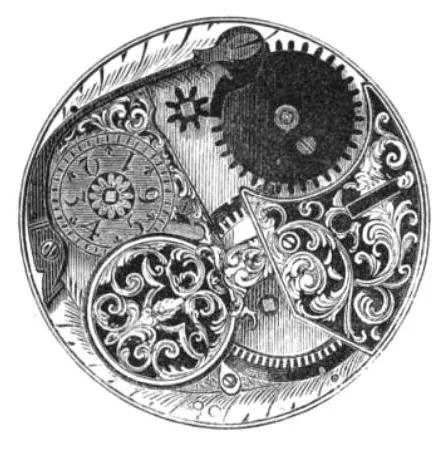
In standard Lancashire gauge measurements, an American size 6s movement features a main plate diameter of 1.3 inches, or approximately 33.02 millimeters. This dimension makes the 6s caliber exceptionally suited for modern wrist proportions, offering an ideal sweet spot between mechanical visibility and case wrist presence. The movement architecture typically follows a traditional three-quarter plate or full-plate bridge layout, secured with blued or polished steel screws. Depending on the era of manufacture, the gear train wheels are crafted from yellow brass or nickel-silver, driven by a heavy mainspring housed inside a standard safety barrel system.
The escapement configuration on a typical New York Standard 6s utilizes a cut bimetallic expansion balance wheel or a solid unadjusted brass balance paired with a flat steel hairspring. Operating at a traditional beat frequency of 18,000 vibrations per hour (2.5 Hz), the movement delivers the rhythmic, slow beat typical of golden-era American horology. Winding and setting mechanics are predominantly executed via a stem-wind, pendant-set system, though earlier models occasionally featured lever-set mechanisms located near the dial edge under the bezel snap ring. Jewel counts generally range from 7 to 15 jewels, with higher-grade variants featuring chatons and ruby cap jewels on the balance staff pivots.
From a mechanical perspective, the mainplate layout provides reasonable clearance for mainspring barrel housing and gear train bridge placement. However, tolerance tolerances from the late 1800s were not hold to modern CNC standards; plate endshake and sideshake must be manually measured with a micrometric dial gauge during overhaul. The balance staff pivots are typically fine, ranging between 0.09mm and 0.12mm in diameter. Because these older balances lack modern anti-shock systems like Incabloc or KIF, understanding the movement's dimensional tolerances and structural fragile points is mandatory before attempting to convert a New York Standard 6s pocket watch into a wristwatch.
Challenges of Converting New York Standard 6s to Wristwatch
When horologists ask, "can you convert new york standard 6s pocket watch mechanisms into a modern wristwatch?", the answer is a definitive yes, but it is accompanied by a host of technical challenges. The primary obstacle is shock protection. Pocket watches spent their functional lives cushioned inside waistcoat pockets, whereas wristwatches are subjected to constant impact, wrist rotation, and sudden accelerations. Because a vintage NYS 6s movement uses rigid balance jewels without spring-loaded shock absorbers, a sharp drop or impact can instantly snap the balance staff pivots. A master watchmaker must carefully check pivot straightness on a lathe and ensure the balance is perfectly poised before casing.
Another major technical hurdle involves positional errors and lubrication migration. Pocket watches were designed to operate primarily in two to three positions: stem-up (vertical), dial-up, and dial-down (horizontal). On the wrist, a movement experiences dynamic 6-position changes throughout the day. The flat hairspring used in most NYS 6s calibers lacks a Breguet overcoil, meaning terminal curve adjustments must be manually manipulated to minimize isometric errors across dynamic positions. Furthermore, oil retention in open-jewel sinks without modern epilame surface treatment can cause lubricant to run off the balance pivots under constant wrist motion, necessitating frequent service intervals.
Lastly, movement layout orientation presents a distinct aesthetic and ergonomic challenge depending on whether the donor movement is an open-face (Lépine) or hunter (Savonnette) caliber. In an open-face NYS 6s, the winding stem sits at 12 o'clock, with the small sub-seconds register positioned directly opposite at 6 o'clock. If cased into a standard 3 o'clock crown wristwatch housing, the sub-seconds register shifts to the 9 o'clock position, requiring a custom dial layout or accepting an unconventional dial orientation. Hunter movements, by contrast, feature the stem at 3 o'clock and seconds at 6 o'clock, making them naturally suited for standard wristwatch geometry.
Lug Welding and Case Selection
Finding or building an appropriate new york standard 6s pocket watch to wrist conversion case is the foundational step of a successful project. Historical conversions from the WWI era relied on hard-soldering or silver-welding wire lugs directly onto original pocket watch cases, creating what collector's know as authentic WW1 trench watches. While this method preserves the original gold-filled or sterling silver pocket case, vintage cases rarely offer adequate water resistance or dust sealing for contemporary wear, and the soft solder joints can fail under wrist torsion over time.
Modern horology favors custom-machined 316L stainless steel conversion cases engineered specifically to house 33mm (6s) pocket movements. When selecting or turning a custom conversion case, internal dimensional tolerances are critical. The inner movement chamber must feature a precise seating ledge, and a custom movement adapter ring (casing ring) must be turned on a lathe to secure the 33.02mm NYS mainplate within the larger 38mm to 40mm inner diameter of modern wristwatch cases. Secure casing screws or tab clamps must be indexed to lock the movement tightly against the dial seat, preventing internal movement wobble during wrist impact.
Lug design selection also dictates both comfort and historical authenticity. Fixed wire-style lugs welded with silver solder recreate an authentic early 20th-century aesthetic, while spring-bar lugs (typically 20mm or 22mm spacing) offer versatility for modern leather strap options. The watchmaker must ensure that the lug drop angle extends below the plane of the case back. Because pocket watch movements are thicker than dedicated wrist movements, a flat case back can cause a converted watch to sit unnaturally high on the wrist; contoured, angled lugs compensate for this extra height and improve ergonomic fit.
Crown and Stem Solutions
Integrating a functional winding and setting mechanism represents one of the most intricate engineering steps when you convert a New York Standard 6s pocket watch into a wristwatch. New York Standard pocket watch cases utilized a negative-setting system or sleeve-setting design built directly into the pocket watch case neck. In a negative setting mechanism, the stem inside the watch movement is spring-loaded into the setting position, and a steel sleeve inside the case pendant holds it down in the winding position. Modern wristwatch cases, however, operate almost exclusively on positive setting systems, where the shifting mechanism (clutch wheel and setting lever) is held entirely inside the movement itself.
To overcome this mismatch, the watchmaker must construct a custom winding stem or modify the existing NYS stem on a watchmaker lathe (such as a Levin or Bergeon precision lathe). The square section of the stem—which engages the winding pinion—must match the internal dimensions of the NYS center wheel train precisely. The outer threaded portion of the stem must then be matched or adapted to standard modern tap sizes (typically Tap 10 or Tap 9) to accept a contemporary crown equipped with double internal O-ring gaskets for moisture protection.
Correct crown selection is equally vital for operational ergonomics and aesthetic harmony. Oversized onion or pumpkin crowns are historically faithful to early trench conversions and provide excellent tactile grip when hand-winding the heavy mainspring of a 6s caliber. The stem height must align perfectly with the case tube axis within a tolerance of +/- 0.05mm. Any vertical misalignment between the stem hole in the casing ring and the case tube will cause binding on the stem shaft, leading to premature wear on the winding pinion teeth or a snapped stem during manual winding.
Dial and Hand Considerations
The visual identity of a converted New York Standard 6s depends heavily on dial presentation and hand fitting. Original NYS dials are predominantly vitreous enamel fired over copper plates. While visually stunning and resistant to fading, antique enamel dials are exceptionally brittle. Hairline cracks and edge chipping around dial feet are common. Removing, cleaning, and remounting a vintage enamel dial requires delicate hand pressure and specialized dial washers to prevent structural flaking around the center arbor and sub-seconds bit clearance holes.
Re-attaching or positioning dial feet presents another mechanical challenge. Pocket watch dial feet locations rarely align with modern custom casing rings or modified mainplates. Watchmakers typically have two options: silver-solder new brass dial feet to the back of the copper dial base using a precision dial-soldering jig, or utilize ultra-thin adhesive dial dots for non-destructive mounting. Dial feet soldering provides a superior mechanical bond but carries a heat-transfer risk that can fracture vintage enamel if not executed with micro-flame precision or a capacitive discharge spot welder.
Hand fitting on a 6s movement requires custom broaching and staking. The center wheel cannon pinion and hour wheel pipe dimensions of historical New York Standard calibers do not match modern off-the-shelf hand hole diameters. The hour and minute hands must be manually broached using micro-tapered reamers to fit the exact fractions of a millimeter of the vintage arbors. The sub-seconds hand pipe must similarly be measured under a microscope and adjusted using a staking set to ensure it clears the dial surface without rubbing against the main minute hand during operation.
Why 6s is More Common for Conversion
Among the vast array of American pocket watch dimensions—ranging from massive 18s railroad pocket watches down to tiny 0s dress pendants—the size 6s movement occupies a uniquely ideal position for wrist conversion. Modern wrist sizes typically range from 6.5 to 7.5 inches, making watch cases between 38mm and 41mm in overall diameter the industry standard for comfort and visual appeal. Because a 6s movement measures roughly 33mm across, adding a proper casing ring, custom steel case wall, and protective bezel results in a finished wristwatch diameter of exactly 38mm to 40mm.
By comparison, converting a large size 18s (44.86mm movement diameter) or size 16s (43.18mm movement diameter) pocket watch results in a massive wrist housing exceeding 48mm to 52mm across. These oversized conversions are often uncomfortably heavy, prone to severe wrist impacts, and visually disproportionate. On the other end of the spectrum, tiny 0s or 3/0s movements (under 30mm) feature extremely delicate balance shafts and gear teeth that are difficult to service and offer poor power reserves. The 6s size hits the horological "Goldilocks zone": robust enough to retain high mechanical integrity while remaining perfectly proportioned for modern wrist wear.
Furthermore, New York Standard produced millions of 6s movements during their operational lifespan, making donor movements, replacement gear trains, mainspring barrels, and balance staffs widely available on the vintage market. This abundance keeps parts sourcing realistic and cost-effective compared to ultra-rare Swiss calibers or high-grade independent American brands. The inherent durability, intermediate physical size, and ready availability explain why watchmakers consistently prefer to convert new york standard 6s pocket watch components into bespoke wristwatches.
Final Thoughts on New York Standard 6s Conversions
Successfully attempting to convert a New York Standard 6s pocket watch into a wristwatch is a deeply satisfying marriage of historic preservation and precision mechanical engineering. When properly executed, a conversion breathes new life into a century-old American mechanical artifact that would otherwise languish forgotten in a drawer or display case. The finished timepiece stands as a wearable tribute to the industrial heritage of Jersey City and late 19th-century American manufacturing ingenuity.
However, prospective wearers must respect the inherent limitations of converted antique mechanical watches. A converted NYS 6s lacks modern shock resistance, modern automatic winding, and robust water resistance. Owners should treat these timepieces as high-grade vintage instruments: avoiding sports activities, removing the watch prior to handwashing or exposure to rain, and adhering to a strict 3-to-5-year mechanical service schedule. Standard maintenance should always include a complete ultrasonic clean, fresh synthetic horological oils (such as Moebius 9010 and HP-1300), and the installation of a fresh, modern unbreakable mainspring (like a custom-sized Nivaflex alloy spring) to prevent mainspring breakage from damaging the vintage gear teeth.
Ultimately, a custom-cased New York Standard 6s wristwatch offers something no modern mass-produced watch can replicate: tangible mechanical history on the wrist. With its distinct rhythmic ticking, hand-finished bridge plates, and rich historical lineage, a masterfully converted 6s movement bridges the gap between historical pocket watch craftsmanship and contemporary horological style.