Historical Background of New York Standard 8s Movements
The New York Standard Watch Company, operating out of Jersey City, New Jersey, from 1885 until the late 1920s, holds a unique and historically fascinating position in American horological history. Founded during the height of the American Industrial Revolution's watchmaking boom, New York Standard carved out a market niche by manufacturing affordable, mass-produced pocket watches aimed at working-class consumers. Unlike high-end contemporary giants like Waltham, Elgin, or Hamilton—which focused heavily on precision railroad chronometers—New York Standard prioritized accessibility, producing millions of robust timepieces that fueled daily American life around the turn of the century.
Among their various offerings, the 8-size (8s) movement emerged as a versatile middleweight caliber. During the late 19th and early 20th centuries, standard men's pocket watches were large, heavy timepieces typically built in 18s or 16s sizes, while ladies' pendant watches were much smaller (0s or 3/0s). The 8s caliber occupied a practical middle ground: large enough to maintain stability and ease of repair, yet compact enough for smaller pocket cases, dress vests, and transitional lapel watches. This specific sizing made the 8s movement an important evolutionary bridge in American watchmaking design.
As wristwatches began to supplant pocket watches during the post-World War I era, many traditional pocket watch sizes became obsolete. The transition from pocket to wrist-borne timekeeping was accelerated by early military adaptations, such as those seen in authentic WW1 trench watches. Today, surviving New York Standard 8s movements represent prime candidates for horological restoration and re-casing, offering enthusiasts a tangible piece of American industrial craftsmanship that can be worn comfortably on the modern wrist.
Technical Specifications and Movement Architecture
To successfully convert new york standard 8s pocket watch into wristwatch designs, a watchmaker must first thoroughly understand the architectural dimensions and mechanical layout of the movement. Under the American sizing system, a size 0 movement measures 1.166 inches (29.63 mm) across the main plate, with each additional size increment adding 1/30th of an inch (0.846 mm). Consequently, a New York Standard 8s movement features a main plate diameter of approximately 1.433 inches, or roughly 36.4 mm. This movement plate diameter provides a superb foundation for modern wrist wearability.
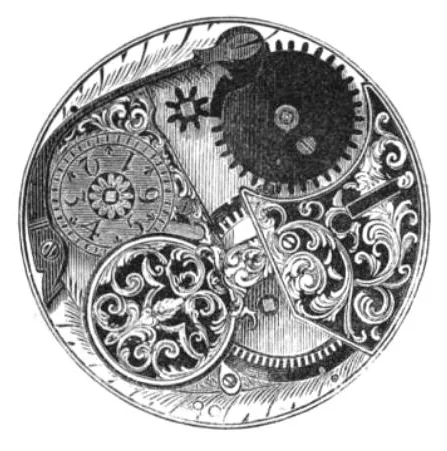
Mechanically, New York Standard 8s calibers were produced in several variations, ranging from modest 7-jewel unadjusted grades to higher-grade 15-jewel movements equipped with adjusted balances. The movement architecture typically features a three-quarter plate or finger-bridge layout, executed in nickel-plated or gilded brass decorated with traditional damaskeening patterns. The escapement is a classic Swiss-style or American inline lever escapement, driven by a untuned or single-position tuned flat hairspring paired with a expansion balance wheel. Power is delivered via a traditional mainspring housing sitting beneath a central barrel bridge.
A critical technical detail for any watchmaker executing a conversion is the setting mechanism. Most New York Standard 8s movements utilized a pendant-setting (sleeve-setting) mechanism standard to American pocket watches of the era. In this system, the setting sleeve resides inside the pocket watch case neck rather than within the movement plate itself. When removing the movement from its native pocket watch case, the detent mechanism that holds the stem in the "set" versus "wind" position is detached. Understanding this architecture is essential when engineering modern stem and casing adaptations.
Challenges of Converting New York Standard 8s to Wristwatch
When clients ask, "can you convert new york standard 8s pocket watch movements into wearable modern wristwatches?" the short answer is yes, but the process presents distinct technical hurdles that demand traditional watchmaking skills. The primary challenge stems from shock resistance—or the complete lack thereof. Antique pocket watch movements were engineered to sit safely inside a vest pocket, protected from severe impacts. Their balance staffs feature hardened, micro-polished pivots resting in static jewel cap settings without shock-absorbing springs like Incabloc. Wearing an un-modified 8s movement on the wrist exposes these delicate balance pivots to high kinetic energy, making careful handling and sensible wear mandatory.
The second major hurdle involves orientation and dial layout. Pocket watches were designed either as "open-face" (Lépine) models with the crown at 12 o'clock and seconds sub-dial at 6 o'clock, or "hunter" (Savonnette) models with the crown at 3 o'clock and sub-seconds at 6 o'clock. If an open-face 8s movement is converted directly into a wristwatch case with the crown at 3 o'clock, the main dial rotates 90 degrees, moving the sub-seconds register to the 9 o'clock position. While visually appealing and reminiscent of early aviator or field watch designs, this requires precise alignment of dial feet and casing rings to preserve symmetry and gear train clearance.
Finally, environmental protection poses a continuous threat to antique movements. Modern wristwatches benefit from synthetic rubber gaskets, screw-down casebacks, and water-resistant crown tubes. Antique New York Standard 8s movements feature open winding arbors, non-gasketed lever slots, and unsealed plate boundaries. Achieving a dust-proof and moisture-resistant seal within a modern custom case requires meticulous tolerances, custom-turned casing spacers, and proper crown-tube sealing techniques to prevent atmospheric corrosion from ruining delicate steel pinions and brass wheels.
Lug Welding and Case Selection
Securing an antique pocket watch movement to the wrist can be accomplished through two primary methodologies: traditional case modification (attaching wire lugs directly to the original pocket watch case) or utilizing a modern custom-engineered wristwatch enclosure. Finding or fabricating a proper new york standard 8s pocket watch to wrist conversion case is often the most practical route for creating a durable, daily-wearable timepiece.
For purists seeking an authentic trench-watch aesthetic, silver soldering or micro-TIG welding custom wire lugs directly onto the original nickel, silver, or gold-filled New York Standard pocket watch case is a classical approach. However, this process requires complete stripping of the case, precise jigging to ensure lug parallelism, and careful heat management to prevent warping or debonding gold-filled layers. Furthermore, original pocket watch cases rarely feature modern strap clearances or comfortable wrist ergonomics.
Modern conversion cases engineered specifically for 8s movements present a superior engineering alternative. Typically CNC-machined from 316L stainless steel, these cases are designed with an outer diameter between 40 mm and 42 mm—a sweet spot for contemporary wrist ergonomics. The interior chamber of the case must be precision-turned on a lathe or fitted with a custom brass or 3D-printed metal movement ring to lock the 36.4 mm mainplate securely in place. Movement retaining tabs or set-screws must then be integrated to eliminate any axial or radial movement within the case housing.
Crown and Stem Solutions
Engineered stem adaptation represents one of the most mechanically demanding phases of converting a New York Standard 8s caliber. As noted, traditional American pocket watch movements relied heavily on sleeve-setting mechanisms housed within the case pendant rather than a positive, movement-integrated detent system. When transferring an 8s movement into a modern wristwatch case, the watchmaker must bridge the mechanical gap between the movement's sliding winding pinion and the external crown.
To overcome this issue, the watchmaker must determine whether the movement utilizes a positive set mechanism or a negative (sleeve) set mechanism. For negative-set New York Standard movements, the watchmaker must either install a specialized setting sleeve inside the modern case tube or convert the winding arbor assembly to function with a positive detent spring. This often requires turning a custom winding stem on a watchmaker's lathe (such as a Lorch or Schaublin lathe), precise thread cutting to match modern crown taps (typically Tap 10 or Tap 9), and hardening and tempering the high-carbon steel stem to withstand repeated winding torque.
The choice of crown is equally critical. To maintain historical harmony while ensuring functional ergonomics, onion-shaped or pumpkin-shaped crowns with internal O-ring seals are preferred. The crown must clear the outer case tube smoothly without binding, while providing enough lateral displacement to allow clear, crisp engagement between the winding and hand-setting modes. Proper stem length calculations must be accurate to within tenths of a millimeter; a stem cut too short will fail to engage the setting wheel, while a stem left too long will exert excessive pressure on the winding pinion, risking teeth breakage.
Dial and Hand Considerations
The aesthetic core of any conversion project lies in the dial and hand assembly. Most original New York Standard 8s pocket watches featured vitreous enamel (porcelain) dials fired over copper baseplates, decorated with crisp Roman or Arabic numerals. These enamel dials are extraordinarily beautiful and impervious to UV fading, but they are exceptionally brittle. Removing, cleaning, and remounting an antique enamel dial requires extreme caution, as any uneven flex can instantly create hairline fractures or catastrophic surface chipping.
If the original dial feet do not align with the securing locations inside the new wrist conversion case—or if an open-face dial is being reoriented to a 3 o'clock crown configuration—custom dial feet must be attached. Solder cannot be applied directly to the back of an enamel dial due to heat cracking. Instead, watchmakers utilize specialized cold-soldering techniques, dial-foot soldering machines with localized electrical resistance, or precision-turned dial copper feet set into milled recesses using industrial-grade structural epoxies.
Hand fitting presents its own set of technical specifications. Antique pocket watch hands were friction-fit onto tapered steel arbors (hour wheel tube, cannon pinion, and fourth wheel pivot). The hole diameters for 8s movements often do not match modern off-the-shelf hands. Original blued-steel hands should be retained, polished, and re-blued whenever possible. If hands must be resized or replaced, the watchmaker must ream or close the hand bushings on a staking set to match the precise arbor dimensions. Additionally, hand height clearances must be calculated carefully to ensure the minute hand clears the crystal interior and the hour hand floats comfortably above the raised sub-seconds register.
Why 8s is More Common for Conversion
In the broader landscape of antique pocket watch conversions, movement size dictates overall wearability. While 18-size (44.86 mm movement diameter) and 16-size (43.18 mm movement diameter) pocket watches are exceptionally common in American horology, installing them into custom wrist cases yields massive timepieces measuring 46 mm to 52 mm in total diameter. For most modern wrist sizes, these oversized conversions are unwieldy, heavy, and prone to catching on sleeves or suffering impacts.
Conversely, smaller pocket watch sizes like 0s, 3/0s, or 6s offer compact dimensions but present extreme repair difficulties, fragile gear trains, and limited power reserves. The 8-size movement strikes an ideal mechanical balance. With a plate diameter of ~36.4 mm, an 8s caliber fits perfectly inside a 39 mm to 41 mm outer case—the universal standard for comfortable, modern dress and utility wristwatches. This dimension mirrors the proportions seen in early mid-century timepieces and classic oversized vintage designs, such as iconic oversized vintage Rolex wristwatches and pocket-watch-derived pilot calibers.
Furthermore, New York Standard produced a significant volume of 8s movements, making donor movements, balance staffs, mainsprings, and replacement gear trains accessible to skilled restorers. The relatively robust gear tooth profiles and thick plate construction of the 8s caliber mean that these movements can endure the structural stresses of wrist wear far better than delicate small-gauge pendant watches, making them the absolute sweet spot for custom horological conversion projects.
Final Thoughts on New York Standard 8s Conversions
Converting a New York Standard 8s pocket watch into a functional, beautifully finished wristwatch is a deeply rewarding project that unites vintage industrial history with practical modern utility. Rather than leaving a piece of late 19th-century American manufacturing to gather dust in a drawer, modern recasing allows horological enthusiasts to appreciate mechanical history dynamically on the wrist. Every click of the winding ratchet and steady sweep of the balance wheel serves as an homage to the Jersey City watchmakers who built these movements over a century ago.
However, successful conversion demands a serious commitment to traditional watchmaking protocols. From re-pivoting balance staffs and servicing open gear trains with modern synthetic lubricants (such as Moebius 9010 and HP1300) to custom-turning stems and lathe-fitting casing rings, shortcuts will inevitably lead to poor timekeeping or mechanical failure. When executed correctly by an experienced craftsman, an 8s New York Standard wristwatch becomes a striking, one-of-a-kind heirloom piece that effortlessly bridges the gap between historical pocket watch art and contemporary wrist culture.