1. Historical Background of Valjoux 10s Movements
The name Valjoux—derived from the famous Vallée de Joux in the Swiss Jura mountains—has long been synonymous with high-grade chronograph and movement blank (ébauche) manufacturing. Founded by the Reymond brothers, John and Charles, as Reymond Frères SA in 1901 before adopting the name Valjoux SA in the 1920s, the atelier specialized in robust, precise, and modular mechanical movements. While Valjoux earned global renown for its landmark chronograph calibers like the 22, 23, and later 72, its early production included exceptional time-only and small-complication pocket watch movements. Among these, the 10s (10-size) caliber series holds a unique position at the intersection of late pocket watch craftsmanship and the early dawn of wrist-worn horology.
During the late 19th and early 20th centuries, pocket watches were built according to standardized sizing systems. In the Swiss and international watchmaking parlance, a 10s (or 10-size) caliber traditionally measures approximately 38.1 millimeters (1.5 inches) in plate diameter. This dimension sits squarely between larger 16s/18s gentleman's pocket watches and smaller ladies' pendant watches. The Valjoux 10s was engineered during an era when pocket watches were expected to maintain chronometer-grade accuracy under demanding conditions, often featuring hand-finished train wheels, polished steel screws, screwed chatons, and finely turned bridges. As military officers and early aviators began demanding hands-free timekeeping, these movements were occasionally cased into hybrid transition timepieces—a precursor to authentic WW1 trench watches.
Today, vintage horologists and master watchmakers view the Valjoux 10s movement as a prized subject for restoration and conversion. Its historical lineage connects directly to the golden age of Swiss mechanical movement manufacturing, where gear tooth profiles were cut on traditional wheel-cutting engines and escapements were adjusted by hand in multiple temperature and positional settings. Understanding this heritage is crucial before attempting any conversion project, as modifying a vintage Valjoux caliber requires balancing modern wearability with deep respect for historic horological art.
2. Technical Specifications and Movement Architecture
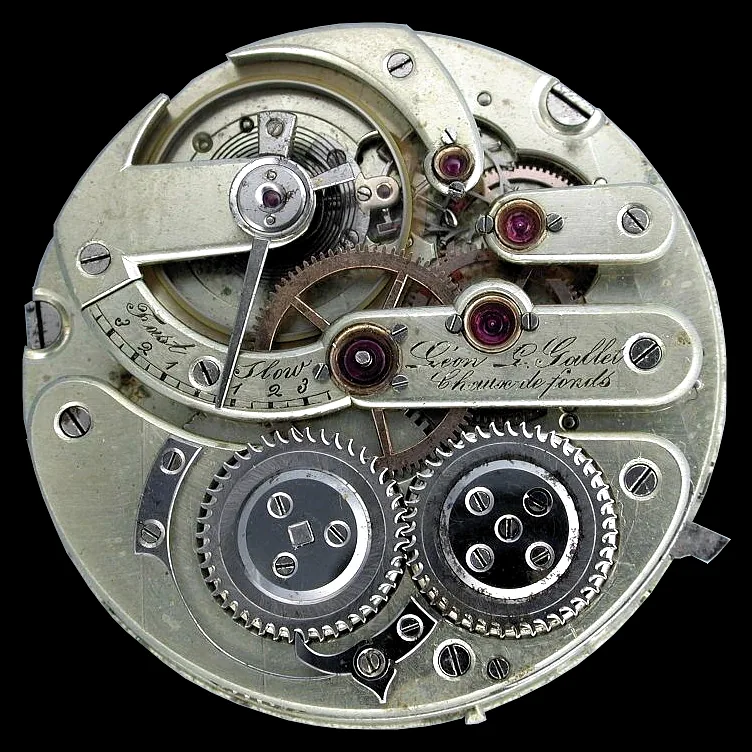
To successfully convert a Valjoux 10s pocket watch into a wristwatch, a watchmaker must first analyze its underlying architecture. The Valjoux 10s movement typically features a traditional Swiss lever escapement operating at a standard frequency of 18,000 vibrations per hour (vph) or 2.5 Hz. This slow, deliberate beat produces the characteristic deep ticking sound prized by mechanical purists. The movement architecture relies on a classical finger-bridge or three-quarter plate configuration, crafted from nickel-plated or gilded brass (often decorated with Geneva stripes/Côtes de Genève or fine graining/perlage).
The gear train layout consists of a center wheel driving the minute wheel, a third wheel, a fourth wheel with an extended pivot driving the small seconds indicator, and an escape wheel delivering impulses to the pallet fork. Higher-grade Valjoux 10s variants feature 15, 17, or even 19 functional jewels, complete with cap stones on the balance wheel and escape wheel pivots to minimize friction and retain oil. The balance assembly itself is a study in early 20th-century precision: typically a cut bimetallic compensation balance or Glucydur balance paired with a blued steel Breguet overcoil balance spring. The overcoil curve allows the spring to expand and contract concentrically, significantly improving overall isochronism across varying states of wind.
Winding and hand-setting mechanisms in the Valjoux 10s rely on a keyless works system integrated directly into the main plate. Unlike modern quick-set movements, the stem operating system utilizes a sliding pinion and clutch wheel mechanism controlled by a setting lever and yoke spring. Depending on whether the movement was originally intended for a Lépine (open-face) or Savonnette (hunter) case, the crown wheel and ratchet wheel are positioned relative to the balance staff to optimize gear meshing. Understanding these mechanical clearances—particularly the height of the canon pinion, hour wheel, and winding stem centerlines—is essential when designing custom casing components.
3. Challenges of Converting Valjoux 10s to Wristwatch
When horological enthusiasts ask, "can you convert valjoux 10s pocket watch movements into functional modern wristwatches?" the answer is yes, but the endeavor is fraught with technical hurdles. The primary obstacle revolves around shock resistance. Pocket watch movements manufactured in the early-to-mid 20th century were never designed to endure the rapid, multidirectional impacts experienced by a human wrist. The balance staff pivots on a Valjoux 10s are razor-thin—often measuring less than 0.08 mm in diameter—and lack modern spring-loaded shock absorption systems such as Incabloc or KIF. A sudden drop or a hard bump against a table can easily snap the balance staff pivots, requiring painstaking lathe work to turn a new staff from raw steel wire.
Another significant challenge is positional variance and gravitational influence. A pocket watch spends most of its operational life in two primary positions: vertical (pendant up, inside a vest pocket) or horizontal (dial up, resting on a nightstand). In contrast, a wristwatch undergoes dynamic, continuous rotational changes throughout the day. Translating a movement adjusted for two positions into a wearable wristwatch requires a full escapement overhaul, including meticulous poising of the balance wheel, adjusting hairspring clearance between the index pins, and re-truing the pallet stone lock and drop to minimize dynamic poise errors.
Finally, dust, moisture, and magnetic field exposure present ongoing threats to converted timepieces. Vintage pocket watch cases relied on snap-fit bezel rings and press-fit back covers that offer zero protection against modern environmental moisture or water immersion. When attempting to convert a Valjoux 10s pocket watch into a wristwatch, the watchmaker must isolate the movement from external forces while engineering modern sealing mechanisms into the new case design without compromising the movement’s mechanical operational tolerances.
4. Lug Welding and Case Selection
Selecting or constructing a proper valjoux 10s pocket watch to wrist conversion case is arguably the most critical structural decision in the entire conversion process. There are two primary technical pathways available to the master watchmaker: adapting an original pocket watch case through lug silver-soldering/welding, or engineering a modern custom-machined wristwatch case designed specifically around the 10s movement dimensions.
The traditional conversion methodology—frequently seen in early 20th-century military conversions—involves taking the original sterling silver or gold-filled Lépine pocket watch case, removing the top pendant loop, and hard-soldering custom wire lugs directly to the case body at the 12 o'clock and 6 o'clock positions. This process requires stripping the movement entirely out of the case, applying high-purity silver solder or micro-TIG/laser welding equipment, and carefully managing heat application to prevent deforming the thin pocket watch metal or annealing hinges. Wire lugs crafted from 1.5mm to 2.0mm sterling silver or stainless steel wire yield an authentic vintage aesthetic reminiscent of early trench timepieces.
For those seeking superior durability and modern daily utility, fabricating or sourcing a modern CNC-machined 316L stainless steel case built specifically for the 10s caliber is the gold standard. The outer diameter of a typical 10s conversion case ranges between 41mm and 43mm, providing perfect visual proportions while honoring the caliber inside. The internal movement cavity must be machined to precise tolerances, incorporating a custom brass or aluminum bronze movement holding ring (casing ring). This ring bridges the gap between the movement pillar plate and the inner case wall, held securely in place by case clamps and micro-screws that lock into the movement's peripheral clamping grooves. Modern cases can also accommodate sapphire crystals front and rear, transforming the piece into an exhibition model while integrating synthetic rubber O-rings around the case back and crown tube for dust and splash resistance.
5. Crown and Stem Solutions
The winding stem is the primary mechanical conduit connecting the user to the internal movement. Converting a 10s Valjoux movement requires solving complex winding stem geometry issues, as original pocket watch stems are invariably too short, improperly threaded, or structurally integrated into the original pocket watch pendant tube rather than the movement plate itself.
In many classic pocket watches, the winding stem was part of the case assembly (a negative setting mechanism), whereas wristwatches require a positive setting system where the stem is held directly inside the movement by the setting lever screw or detent pin. When attempting to convert a Valjoux 10s pocket watch into a wristwatch, the watchmaker must determine if the caliber utilizes a positive or negative keyless works layout. If transitioning a negative-set movement, the watchmaker must modify the setting lever and yoke assembly or machine a custom adapter sleeve to convert the movement into a self-contained positive-set mechanism.
Fabricating a custom stem requires precision micro-lathe turning. The watchmaker starts with high-carbon steel rod stock, turning down the pilot pivot, square winding arbor, clutch groove, and threaded section on a jeweler's lathe (such as a Levin or Schaublin 70). The thread pitch must be cut to match modern crown tap sizes (typically Tap 10 or 0.9mm threads) or vintage Swiss thread pitches depending on the crown chosen. The pendant tube of the modern conversion case must house internal nitrile rubber gaskets that seal against a oversized onion or pumpkin-style crown, granting smooth winding leverage without exerting excessive lateral pressure on the movement’s center wheel shaft or keyless works components.
6. Dial and Hand Considerations
Dial configuration and hand fitting represent both an artistic and technical challenge during the conversion process. Pocket watches generally fall into two layout categories: Lépine (open-face) calibers, where the winding stem is located at 12 o'clock and the running sub-seconds hand sits at 6 o'clock, and Savonnette (hunter case) calibers, where the winding stem is positioned at 3 o'clock while the sub-seconds hand sits at 6 o'clock relative to the stem axis.
If you take a traditional Lépine Valjoux 10s movement and convert it to a wristwatch with the winding stem placed at the standard 3 o'clock wrist position, the entire dial rotates 90 degrees clockwise. Consequently, the running seconds sub-dial shifts from its traditional bottom position to the 9 o'clock position on the wrist. If the goal is maintaining a traditional sub-seconds layout at 6 o'clock with a 3 o'clock stem, a Savonnette-configured Valjoux 10s caliber must be chosen, or a custom dial must be designed that accommodates the altered geometry. For readers interested in exploring other historically significant timepieces with similar architectural characteristics, our archive of antique pocket watch conversions provides extensive examples of these varying dial orientation strategies.
Handling vintage enamel or brass painted dials requires extreme care. Grand Feu enamel dials are prone to micro-fractures (hairlines) if subjected to mechanical stress. When re-securing a dial to a converted movement, the dial feet must line up perfectly with the receiving holes in the Valjoux main plate. If new dial feet must be installed, traditional soldering irons cannot be used directly on enamel dials due to thermal shock risks; instead, copper dial feet must be attached using specialized cold-curing epoxy, dial foot soldering rigs with heat sinks, or copper foot pads. Furthermore, hand hole dimensions (pipe diameters) on vintage 10s movements differ from modern wristwatch standards. The hour wheel pipe, cannon pinion, and fourth wheel pivot must be carefully measured with a micrometer, and original hands must be adjusted, broached, or custom-bushed using soft brass tubing to ensure a friction-tight, wobble-free fit.
7. Why 10s is More Common for Conversion
Among the vast spectrum of antique pocket watch sizes—ranging from tiny 0-size pendant movements to massive 18-size railroad grade timekeepers—the 10s scale, and specifically the Valjoux 10s platform, is widely regarded by horologists as the ideal candidate for wrist conversion. The primary driver behind this preference is wearable ergonomics. A standard 16s or 18s pocket watch movement measures between 43mm and 45mm in diameter alone; once cased in a modern wristwatch enclosure, the finished timepiece explodes to an unwearable 48mm to 52mm overall diameter. Conversely, a 10s movement (around 38mm plate diameter) allows for a final cased wristwatch diameter of 41mm to 42mm—a modern sweet spot that sits comfortably on contemporary wrists.
Beyond physical dimensions, the Valjoux 10s offers superior mechanical robustly compared to smaller 0s, 3/0, or 10.5-ligne wrist calibers of the same era. Larger gear train components mean wider gear teeth module pitches, thicker arbors, and sturdier jewel settings. This mechanical heft translates directly to reliability and serviceability. Spare parts, while vintage, share structural traits across various Valjoux ebauche families, making hand-fabrication of replacement click springs, stems, or balance staffs significantly easier for a skilled watchmaker than working on microscopic, fragile ladies' pendant watch parts.
Furthermore, Valjoux’s historical reputation as a top-tier ebauche supplier to elite horological houses—including early partnerships that supplied raw movements to brands alongside vintage Rolex wristwatches and Patek Philippe chronographs—means the base metal finishing, tooth profile metallurgy, and overall tolerances of a Valjoux 10s are inherently exceptional. Watchmakers are far more inclined to invest dozens of hours of labor into converting a movement that possesses genuine historic, artistic, and horological merit rather than an unbranded mass-produced cylinder escapement caliber.
8. Final Thoughts on Valjoux 10s Conversions
The process to convert a Valjoux 10s pocket watch into a wristwatch is a demanding bridge between traditional horological restoration and modern micro-engineering. It is not merely a casing swap; it is an extensive mechanical adaptation that requires micro-lathe fabrication, custom case fitting, dial geometry realignment, precision escapement adjustment, and an acute awareness of shock protection and environmental sealing.
From a collector’s and watchmaker’s perspective, horological ethics should always guide the workbench. Preserving pristine, rare, or historically significant museum-grade pocket watches in their original cases is paramount. However, when a high-grade Valjoux 10s caliber is rescued from an orphaned or scrapped precious metal pocket watch case, undertaking a wrist conversion breathes vibrant new life into a mechanical masterpiece that would otherwise sit forgotten in a drawer.
When executed with uncompromising standards—utilizing precise custom casing rings, expertly turned stems, proper dial foot alignment, and custom-engineered cases—a Valjoux 10s wrist conversion is transformed from a simple vintage artifact into a wearable piece of living history. It stands as a tactile testament to early 20th-century Swiss micro-mechanics, bringing century-old craftsmanship out of the vest pocket and onto the modern wrist where its heartbeat can be appreciated daily.