1. Historical Background of Valjoux 6s Movements
The story of the Valjoux 6s movement is deeply intertwined with the golden age of mechanical chronograph manufacturing in the Val-de-Travers and Vallée de Joux regions of Switzerland. Founded originally as Reymond Frères by brothers John and Charles Reymond in 1901 in Les Bioux, the company eventually adopted the name Valjoux SA (short for Vallée de Joux) in 1929. Long before the era of automatic wrist chronographs like the Caliber 7750, Reymond Frères established an unrivaled reputation for producing exquisite, highly reliable column-wheel pocket watch chronograph ébauches supplied to the most prestigious Swiss watch houses.
Among these early architectures, the Valjoux Caliber 6 (and its variants, frequently designated or classified within workshop records under the 6s family umbrella) emerged during the 1910s and 1920s as an 18- or 19-ligne benchmark for precision timing. Designed during an era when pocket watches were the primary timekeeping tool for railway conductors, artillery officers, and naval navigators, the Valjoux 6s was engineered to withstand rigorous operational demands while offering split-second accuracy. Its architecture reflected the pinnacle of traditional Swiss hand-finishing, featuring meticulously bevelled steel levers, mirror-polished column wheels, and heavy-duty brass mainplates.
As the horological landscape shifted dramatically during the interwar period, many high-grade pocket watch movements were left encased in heavy gold or silver pocket watch shells that were gradually retired in favor of wrist-worn timepieces. While houses like Patek Philippe and Vacheron Constantin relied on custom-finished Valjoux blanks for their high-end complications, many of these raw movements shared architectural DNA with early military timepieces and even early vintage Rolex wristwatches that utilized modified Rebberg and Valjoux ébauches. Today, these historical Valjoux 6s movements represent a prime candidate for horological preservation through conversion, offering modern enthusiasts a direct tangible connection to early 20th-century Swiss watchmaking mastery.
2. Technical Specifications and Movement Architecture
To understand the mechanical appeal of the Valjoux 6s, one must examine its architectural layout. Measuring approximately 18 to 19 lignes (roughly 40.6mm to 42.8mm in diameter), the 6s is a traditional manual-wind, column-wheel chronograph movement. Operating at a classic frequency of 18,000 vibrations per hour (2.5 Hz), the movement delivers the deliberate, resonant tick characteristic of large-format antique pocket watches. The escapement features a cut bimetallic compensation balance wheel equipped with gold timing screws, paired with a blued steel Breguet overcoil hairspring that ensures excellent isochronism across various positions.
The chronograph mechanism itself is a masterclass in classic lateral-gear coupling. Unlike modern vertical clutch systems, the Valjoux 6s employs a traditional horizontal clutch driven by an oscillating pinion and intermediate wheel mounted on a delicate bridge. When the chronograph pusher is depressed, the column wheel rotates, allowing the clutch bridge to pivot and mesh the driving wheel directly with the central chronograph wheel. The movement typically incorporates 15 to 17 jewels, with ruby cap jewels setting the balance staff endstones and precision bronze or steel bushings securing the chronograph operating levers.
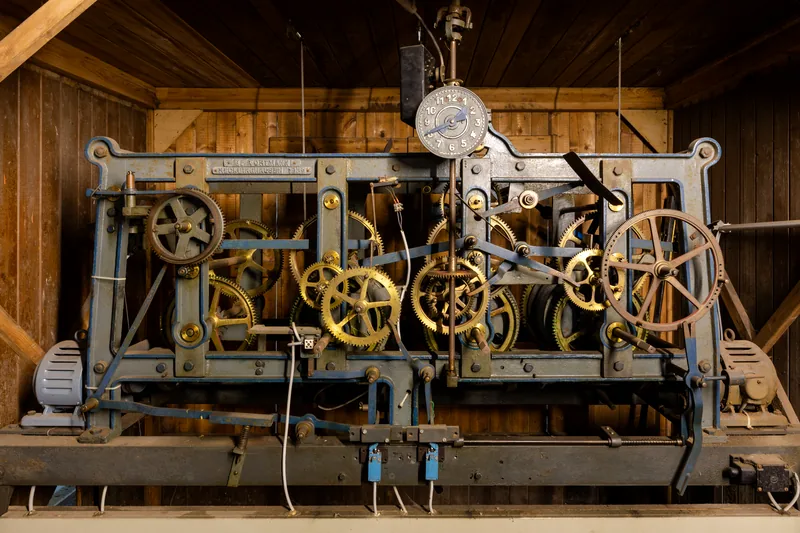
Power distribution is handled by a robust mainspring contained within a large barrel, providing a power reserve of approximately 36 to 42 hours when fully wound. Winding and hand-setting are controlled through a traditional crown wheel and ratchet mechanism mounted directly atop the barrel bridge. The overall bridge geometry is uniquely open, allowing bench watchmakers an unobstructed view of the column wheel's ratchet teeth, the hammer reset spring, and the minute-register jumper spring. This high level of visual transparency and sculptural depth makes the Valjoux 6s one of the most visually captivating movements ever crafted for a display caseback.
3. Challenges of Converting Valjoux 6s to Wristwatch
When clients approach a watchmaker asking, "can you convert valjoux 6s pocket watch into a wearable wristwatch?", the answer is almost always a qualified yes—provided one possesses advanced micro-machining capabilities and a deep understanding of vintage horological geometry. The primary obstacle in converting a Valjoux 6s pocket watch into wristwatch configuration lies in the physical sheer scale of the movement combined with its inherent orientation layout. Pocket watches were designed as either Lépine (open-face, with the crown at 12 o'clock and running seconds at 6 o'clock) or Savonnette (hunter-case, with the crown at 3 o'clock and running seconds at 6 o'clock relative to the stem).
If a Lépine Valjoux 6s movement is rotated 90 degrees to position the winding stem at 3 o'clock on the wrist, the running small seconds sub-dial shifts from the 6 o'clock position to the 9 o'clock position. Fortunately, for a two-register chronograph, this shift places the running seconds at 9 o'clock and the 30-minute chronograph accumulator at 3 o'clock—a balanced bicompax layout identical to modern wrist chronographs. However, aligning the chronograph activation pushers presents an immense challenge. Depending on whether the movement is a single-pusher (monopusher co-axial through the crown) or a two-button design, the internal operating levers must line up with absolute sub-millimeter precision against the external case pushers.
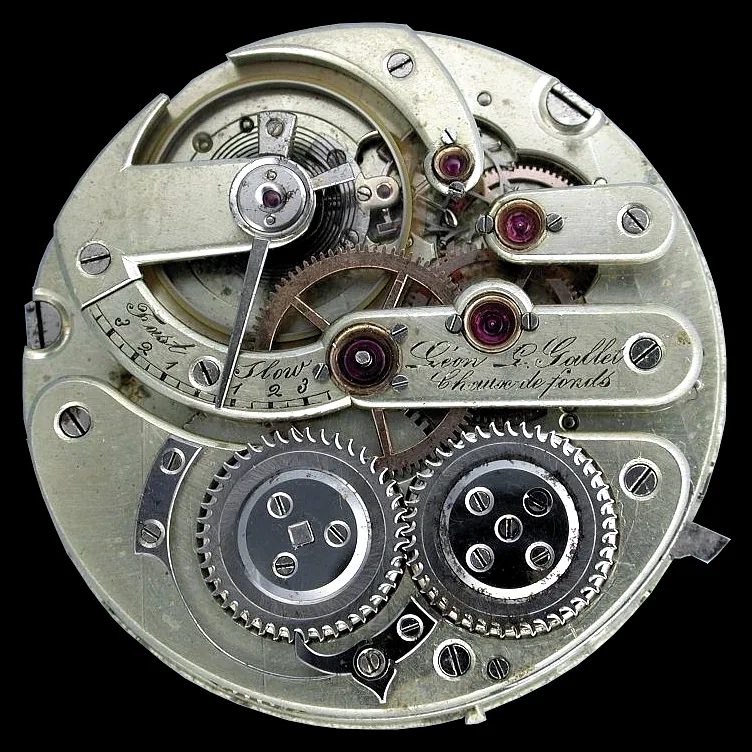
Another profound technical challenge involves shock resistance and structural protection. Vintage Valjoux 6s movements were manufactured long before the invention of modern shock-absorption systems such as Incabloc or KIF. The delicate balance pivots—often measuring a mere 0.08mm in diameter—are held rigidly between fixed jeweled settings. Wearing a 42mm movement on the wrist exposes it to far greater kinetic energy, rotational inertia, and accidental impacts than it ever experienced inside a vest pocket. Watchmakers undertaking the process to convert valjoux 6s pocket watch into wristwatch projects must ensure custom movement rings, elastic casing tabs, or synthetic dampening inserts are implemented to cushion the movement within its modern housing.
4. Lug Welding and Case Selection
Selecting or fabricating a suitable valjoux 6s pocket watch to wrist conversion case is the single most crucial structural decision in the entire transformation process. There are two primary avenues available to the restoration watchmaker: converting the original vintage pocket watch case by welding external lugs, or manufacturing/sourcing an entirely bespoke stainless steel conversion case engineered to modern wrist standards.
The traditional historic approach involves retaining the movement's original silver, nickel, or gold pocket watch casing and adapting it for wrist wear. This method requires removing the top pocket watch bow and silver-soldering or micro-laser welding vintage wire lugs onto the 12 o'clock and 6 o'clock case flanks. This style pays homage to the earliest converted timepieces seen in military history, akin to authentic WW1 trench watches where soldiers adapted pocket timepieces for battlefield utility. While retaining authentic period aesthetics, original cases often lack modern dust and moisture sealing, leaving the delicate steel chronograph levers vulnerable to environmental degradation.
Alternatively, the superior modern approach utilizes a purpose-built 316L stainless steel valjoux 6s pocket watch to wrist conversion case equipped with front and rear anti-reflective sapphire crystals. These cases are custom-machined on CNC lathes to accept an internal movement spacer ring turned from marine-grade brass or stainless steel. The spacer ring compensates for minor variations in outer mainplate diameter, secures the movement via screw-down casing clamps, and features precision sleeve pass-throughs for the chronograph pushers. This creates a fully sealed, contemporary enclosure—typically measuring between 43mm and 45mm in overall diameter—that protects the historic Valjoux movement while providing comfortable lug curvature for daily wear on the wrist.
5. Crown and Stem Solutions
Establishing proper winding stem engagement and crown functionality is a task that separates amateur conversions from true master watchmaking. Pocket watch stems feature unique tap sizes and thread pitches—frequently non-standard Tap 9 or Tap 10 threads—that do not match contemporary wristwatch crowns. Furthermore, antique pocket watch stems often utilized a "negative set" mechanism (where the setting spring resides inside the case tube) or a traditional "positive set" mechanism where the detent mechanism is housed entirely on the movement's mainplate under the setting lever bridge.
When executing a Valjoux 6s conversion, the original winding stem is rarely long enough to span the distance from the mainplate, through an internal casing spacer ring, across the case tube wall, and into an external crown. Watchmakers must either turn a custom replacement winding stem on a precision horological lathe from annealed steel stock (subsequently hardened and tempered), or fabricate a hardened stainless steel stem extender featuring precision micro-threads. The stem length must be calculated to within 1/100th of a millimeter; if the stem is too long, the crown will not sit flush against the case tube; if it is too short, the sliding pinion will fail to engage the setting wheel during hand-setting mode.
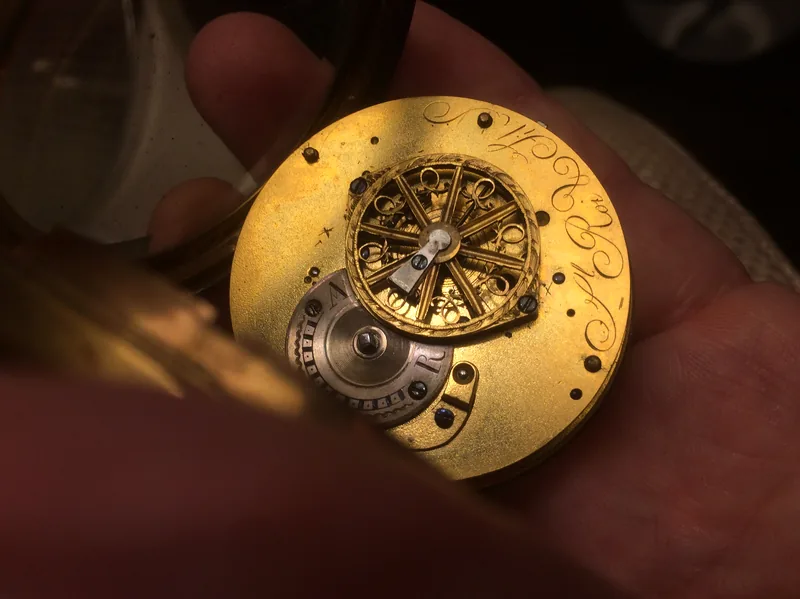
The crown choice must reflect both period accuracy and mechanical utility. An oversized "onion" or "pumpkin" style crown turned from solid stainless steel or silver-plated brass matches the historical heritage of the Valjoux 6s while providing ample tactile grip to turn the heavy mainspring barrel. Modern conversion cases integrate dual inner O-ring gaskets within the crown tube assembly, ensuring that the custom-fitted stem remains dust-proof and moisture-resistant without exerting excessive lateral pressure on the vintage winding pinion.
6. Dial and Hand Considerations
The dial and hands serve as the visual identity of any converted timepiece, and working with vintage Valjoux 6s components requires immense delicate care. The vast majority of original Valjoux 6s pocket watches featured true vitreous enamel dials fired over copper baseplates. While enamel dials offer eternal color stability and never fade under UV exposure, they are extremely brittle. Attempting to modify, drill, or adjust the dial feet on an original vintage enamel dial can instantly cause spider-web cracks across the entire surface.
To secure an original dial inside a new wrist case, watchmakers carefully inspect the original dial feet locations. If the dial feet must be relocated to accommodate a shifted movement geometry or custom casing ring, traditional high-heat soldering cannot be used on enamel. Instead, watchmakers utilize specialized micro-spot cold welding or custom eccentric dial clamps attached to the perimeter movement spacer ring. If an original dial is unsalvageable, a custom sterling silver or hand-lacquered brass dial must be designed, ensuring the sub-dial center distances (the exact distance between the central pinion, running seconds post, and 30-minute accumulator post) match the specific geometry of the Valjoux 6s mainplate.
Hand fitting presents its own set of technical demands. Antique pocket watch hands feature much larger pipe diameters than modern wristwatch movements. The central cannon pinion, hour wheel pipe, central chronograph runner pivot, and sub-dial posts must be measured using precision micro-calipers. Original blued steel hands (often finished in rich cobalt blue via traditional thermal heat treating) are broached carefully using fine pentagonal hand broaches to fit slightly oversized posts, or re-bushed with turned brass sleeves if the original hand pipes are too loose. Ensuring adequate clearance between the hour hand, minute hand, central chronograph sweep hand, and the underside of the sapphire crystal is crucial to prevent mechanical drag on the train wheels.
7. Why 6s is More Common for Conversion
Among the vast landscape of antique pocket watch movements, collectors and horologists frequently turn to the 6s when considering projects to antique pocket watch conversions. Why is the decision to convert valjoux 6s pocket watch into wristwatch hardware so remarkably popular within high-end custom watchmaking circles? The primary reason lies in the movement's exceptional structural geometry, inherent mechanical symmetry, and historical prestige.
Unlike standard three-hand pocket watch calibers (such as the ubiquitous Unitas 6497/6498 or Illinois/Hamilton workhorses), the Valjoux 6s is a high-complication column-wheel chronograph. Column-wheel movements are widely regarded as the pinnacle of traditional mechanical chronograph design, offering a crisp, tactile push-button action that modern lever-cam chronographs cannot replicate. Furthermore, the physical proportions of the Valjoux 6s—roughly 41mm in movement diameter—translate perfectly into a modern 43mm to 45mm oversized wrist watch footprint, catering directly to contemporary tastes for substantial, wrist-present timepieces.
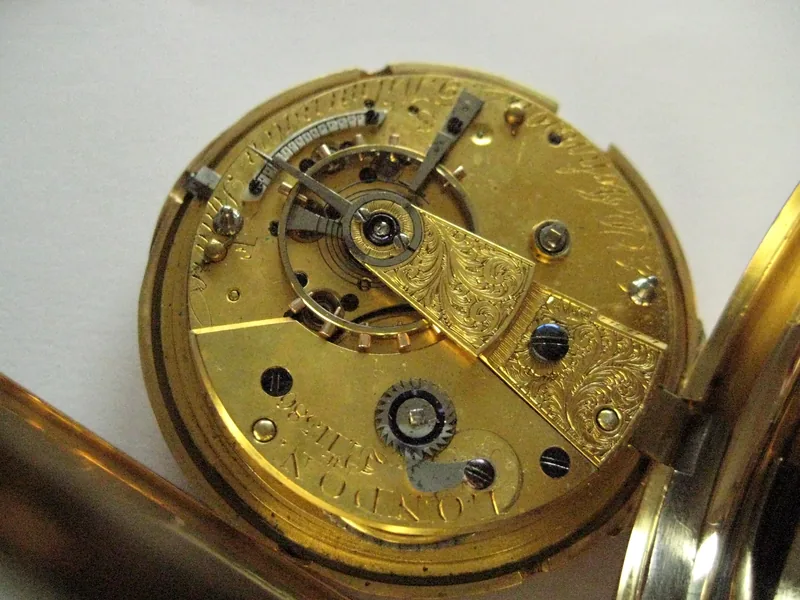
Additionally, the availability of high-grade donor ébauches makes the Valjoux 6s particularly attractive. Because these movements were produced in reasonable quantities for various military contracts, timing institutions, and luxury Swiss retailers throughout the early 20th century, watchmakers can still source clean movements with intact balance pivots and complete chronograph gear trains. The end result of a Valjoux 6s conversion is a wearable piece of haute horlogerie that offers the visual drama of a 100-year-old hand-finished Swiss chronograph movement visible through a modern sapphire display back.
8. Final Thoughts on Valjoux 6s Conversions
Converting a Valjoux 6s pocket watch into a modern wristwatch is far more than a simple re-casing exercise; it is an act of high-level horological conservation and creative engineering. By taking a historical mechanical movement that would otherwise spend decades forgotten inside a safe or display case and transforming it into a functional wrist-worn timepiece, watchmakers bridge the gap between historic Swiss artisanal heritage and contemporary wearing habits.
However, successful conversion requires an uncompromising commitment to technical rigor. Every step of the process—from custom machining the valjoux 6s pocket watch to wrist conversion case and fabricating precision winding stems, to preserving fragile enamel dials and adjusting friction tolerances on century-old chronograph levers—demands the skill of a master horologist. When executed with precision, the result is a truly bespoke wearable masterpiece: a watch that pairs the soul, tick, and sculptural beauty of a 1920s Valjoux column-wheel chronograph with the durability, protection, and daily utility of a modern timepiece.