1. Historical Background of Waltham 12s Movements
The American Waltham Watch Company (AWWCo) stands as a titan in the history of industrial horology. Founded in Waltham, Massachusetts, in the mid-19th century, the company revolutionized watchmaking by introducing interchangeable, machine-made precision components to an industry previously dominated by hand-fitted European artisan methods. Among the vast array of sizes produced by Waltham, the 12-size (12s) movement emerged during the late 19th and early 20th centuries as a premier choice for gentlemen desiring a refined, slim, and highly accurate pocket watch that was far less cumbersome than the heavy 18s and 16s workhorses of the railroad era.
During the production peak of models like the Model 1894 and Model 1908, Waltham offered 12s movements in a spectrum of grades ranging from dependable 7-jewel everyday timepieces to exquisite, high-art horological masterpieces containing 17, 19, 21, or 23 jewels. Higher-grade variants, such as the Riverside, Royal, and Vanguard, featured intricate nickel damaskeening, gold screw-set chatons, raised jewel settings, cut bimetallic balance wheels, and micrometer regulators. These 12s movements represented the pinnacle of American manufacturing prowess, combining aesthetic elegance with extraordinary timekeeping capabilities across varying temperatures and positions.
As wristwatches rapidly eclipsed pocket watches in popularity following World War I, millions of high-grade 12s movements eventually lost their original precious metal cases to scrap melters during economic downturns, particularly during the gold rushes and scrap rallies of the 20th century. Today, these surviving "orphan" movements remain abundant, beautifully preserved, and technically sound. They represent a golden era of American micro-engineering, making them ideal candidates for horologists and modern customizers seeking to breathe new life into a historic caliber by transforming it into a functional piece of wristwear.
2. Technical Specifications and Movement Architecture
To successfully perform a conversion, a watchmaker must understand the architectural parameters of the Waltham 12s caliber. Under the traditional Lancashire gauge system used by American watch manufacturers, size 0 corresponds to a diameter of 1 and 5/30 inches, with each additional size adding 1/30 of an inch. Consequently, a Waltham 12s movement measures approximately 1.55 inches, or 39.37 millimeters, in raw plate diameter. This dimension is critical, as it dictates the minimum internal diameter required for any prospective wrist enclosure and places the finished timepiece squarely within the bold modern wristwatch category.
Architecturally, Waltham 12s movements generally utilize a three-quarter plate or bridge plate layout. The gear train is arranged to drive a sub-seconds hand located 180 degrees opposite the winding stem on open-face configurations, or 90 degrees adjacent to the stem on hunting-case configurations. Most high-grade 12s movements incorporate a lever-escapement system with a impulse angle designed for stable oscillation, a Breguet overcoil hairspring to ensure isochronism, and a split-bimetallic balance wheel fitted with gold or brass timing screws. Power delivery flows from a safety-barrel mainspring assembly designed to protect the gear train teeth in the event of a mainspring breakage.
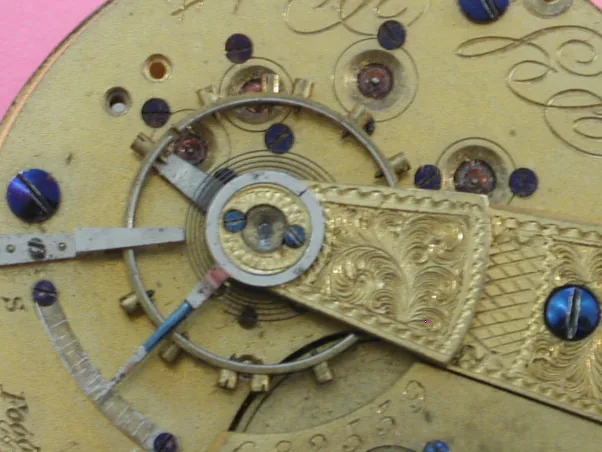
Another crucial technical element of the Waltham 12s architecture is its setting mechanism. Unlike contemporary wristwatches that employ modern keyless works integrated entirely within the movement plates, many vintage Waltham 12s movements utilize a "negative setting" system (also known as the sleeve-wrench setting mechanism). In this configuration, the movement itself is naturally biased toward the hand-setting position, and the case's pendant contains a spring-loaded split sleeve that forces the stem into the winding position when fully depressed. Mastering this mechanical interplay is one of the foundational requirements for any watchmaker executing a conversion.
3. Challenges of Converting Waltham 12s to Wristwatch
When clients ask, "can you convert waltham 12s pocket watch mechanisms into reliable wristwatches?", the technical answer is a resounding yes—but it comes with distinct engineering caveats that every watchmaker must navigate. The foremost hurdle is the total absence of modern shock protection. Pocket watch balance pivots were designed to operate inside fixed, non-yielding jewel settings. The balance staff pivots on a Waltham 12s measure mere fractions of a millimeter (typically 0.08mm to 0.10mm in diameter). Worn on the wrist, a movement is subject to sudden kinetic shocks, accidental knocks against doorframes, and constant vibration, all of which can easily snap an unshocked vintage balance staff.
Environmental sealing poses a second major technical hurdle. Pocket watch movements were never engineered to resist moisture, human perspiration, atmospheric humidity, or ambient dust at the levels experienced by wristwatches. Vintage 12s cases possessed no synthetic rubber gaskets, screw-down crowns, or water-resistant stem ports. Converting a movement to the wrist requires housing it within an enclosure that introduces modern sealing systems, or accepting that the converted watch must be treated as a delicate dress piece strictly protected from water, extreme humidity, and high-impact physical exertion.
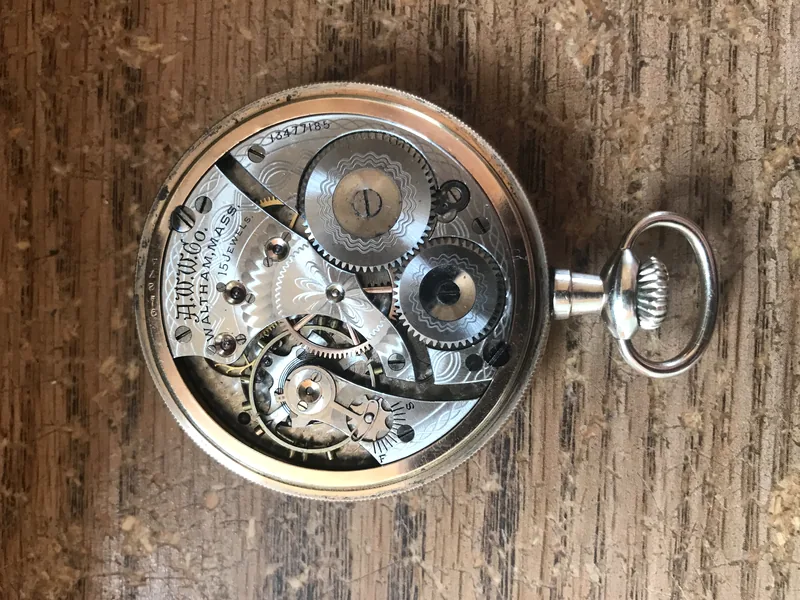
Finally, spatial orientation creates ergonomic complexities. On an open-face Waltham 12s movement, the winding stem is located at the 12 o'clock position with the sub-seconds dial at 6 o'clock. If a watchmaker simply mounts this movement in a traditional wristwatch format with the crown at 3 o'clock, the dial rotates 90 degrees, shifting the sub-seconds register to 9 o'clock and turning the numeric layout on its side. Overcoming this requires either selecting a bullhead-style case (crown at 12 o'clock), sourcing or redialing a custom layout, or utilizing a hunter-movement caliber where the stem naturally aligns at 3 o'clock while the sub-seconds rest at 6 o'clock.
4. Lug Welding and Case Selection
When executing a conversion, the watchmaker generally faces two distinct pathways: modifying an original vintage pocket watch case through lug attachment, or installing the movement inside a modern, purpose-built conversion enclosure. Traditionalists often prefer retaining an original silver, gold-filled, or nickel pocket watch case. This method involves removing the pocket watch bow, machining down the pendant neck, and silver-soldering or TIG-welding custom wire lugs or solid lugs directly onto the perimeter of the case band. While preserving the original antique patina, this approach requires immense metallurgical precision to avoid warping the case frame or damaging decorative engraving under high heat.
Alternatively, the modern market offers the specialized waltham 12s pocket watch to wrist conversion case. These custom-engineered cases are CNC-milled from 316L stainless steel, titanium, or bronze, specifically dimensioned to accept the exact 39.37mm footprint of the American 12s platform. These modern cases incorporate solid screw-down display casebacks fitted with sapphire crystals, internal movement mounting rings, and modern crown tube assemblies. Using a dedicated conversion case drastically enhances structural rigidity, isolates the balance staff from minor chassis flexing, and provides proper gasket sealing around the crystal and caseback joints.
Ergonomics must be evaluated carefully regardless of the casing method chosen. Because a 12s movement already spans roughly 39.4mm, the addition of case walls, bezel rings, and projecting lugs often results in an overall case diameter of 42mm to 45mm, with a lug-to-lug distance reaching 50mm to 54mm. To prevent the finished timepiece from wearing awkwardly, the watchmaker must select or fabricate lugs with a pronounced downward curvature (wrist drop). This allows the strap attachment points—typically spaced for 22mm or 24mm high-grade leather straps—to hug the contours of the wearer's wrist comfortably.
5. Crown and Stem Solutions
The winding and setting infrastructure represents the mechanical nerve center of any successful conversion project. As noted previously, standard pocket watch architectures, particularly those from American makers like Waltham, often utilized negative-setting systems where the detent mechanism was built into the case pendant rather than the movement's mainplate. Modern wristwatch cases, conversely, operate almost exclusively on positive-setting systems, where the pull-out detent system resides entirely within the movement's keyless works. Bridging this mechanical divide demands precise lathe work and custom component fitting.
To convert a negative-setting Waltham 12s movement for use in a modern positive-setting wristwatch case, the watchmaker must construct or retrofit a specialized winding stem. Using a precision watchmaker's lathe (such as a 7mm or 8mm Schaublin or Levin), high-carbon steel stem blanks are turned, threaded, and hardened. The stem must feature a square pivot section that meshes precisely with the Waltham winding pinion, a smooth journal section to ride within the case tube, and a threaded stem end (typically Tap 9 or Tap 10 thread pitch) to accept the chosen wristwatch crown. In some cases, a small internal spring mechanism or sleeve adaptor must be fitted inside the crown tube to convert the movement's negative pull system into a reliable friction-based toggle.
Proper stem alignment is vital to prevent premature wear on the delicate winding components. If the stem axis is misaligned by even a fraction of a millimeter relative to the mainplate stem channel, the winding pinions will bind, leading to excessive friction, stripped gear teeth, or a snapped stem during daily winding. The crown itself must be selected to match both the scale of the 43mm+ wristwatch case and the torque required to wind a heavy pocket watch mainspring. An oversized onion, pumpkin, or diamond-style crown provides the necessary mechanical leverage for comfortable daily hand-winding without transferring undue lateral stress to the stem journal.
6. Dial and Hand Considerations
Dials on vintage Waltham 12s movements fall into two primary structural categories: genuine vitreous enamel (porcelain) dials and printed metal dials (aluminum, brass, or silver-plated). Vitreous enamel dials are breathtakingly beautiful, offering brilliant white surfaces and crisp black Roman or Arabic numerals that never fade over time. However, porcelain dials are extraordinarily fragile. Attempting to modify, solder, or trim an enamel dial will instantly shatter the glass layer, causing irreparable spiderweb cracking. Therefore, when working with original enamel dials, the watchmaker must preserve the dial in its exact factory state, designing the case mounting architecture around the dial's native outer diameter.
Hand fitting presents its own set of technical micro-adjustments. Pocket watch hand arbors—specifically the hour wheel pipe, cannon pinion, and second bit pivot—are noticeably thicker than standard modern wristwatch movement arbors. Standard modern watch hands will not press onto a Waltham 12s wheel train without modification. The watchmaker has two options: meticulously broach, resize, and friction-fit original vintage hands to the restored arbors, or fabricate custom modern hands with brass bushing sleeves turned on the lathe to match the exact hole diameters of the Waltham hour, minute, and sub-seconds pivots.
Visual proportion and hand length are crucial for a balanced dial aesthetic. Pocket watch hands were designed to extend precisely to the outer railroad minute track of a pocket watch bezel. When installing a 12s movement inside a modern conversion case, the crystal opening might expose slightly more or less of the dial perimeter. High-grade blued steel spade, moon, or Breguet-style hands must be painstakingly polished, thermally blued to a deep peacock blue at approximately 290°C (554°F), and aligned to clear both the dial indices and the underside of the crystal with ultra-tight vertical tolerances.
7. Why 12s is More Common for Conversion
To successfully convert waltham 12s pocket watch into wristwatch configurations is widely considered by horologists to be the "sweet spot" of pocket watch conversion craft. The primary reason for this lies in the laws of physical scale. While 18s movements (measuring ~44.86mm movement diameter) and 16s movements (measuring ~43.18mm movement diameter) yield massive wristwatches with final case sizes exceeding 48mm to 52mm, a 12s movement (~39.37mm) yields a finished wristwatch with an outer case diameter of 42mm to 44mm. This size mirrors the proportions of iconic modern timepieces, such as oversized pilot watches and sports chronographs, making it supremely wearable on an average human wrist.
Furthermore, the physical availability of high-grade movements makes the 12s platform ideal. During the golden age of American watchmaking, Waltham manufactured hundreds of thousands of 12s movements across various grades. Because 12s pocket watches were sold in high volumes to businessmen, executives, and dress-wear clients, a large percentage of these movements were preserved in relatively clean, low-wear condition compared to rougher industrial or railroad-grade pocket watches. Watchmakers today can readily acquire pristine 17-jewel, 19-jewel, or 21-jewel 12s calibers complete with micrometer regulators and beautiful nickel damaskeening at accessible price points.
From an engineering standpoint, the 12s framework strikes an optimal balance between micro-mechanical robustness and spatial efficiency. The gear train components, balance assemblies, and mainspring barrels of a 12s movement are large enough to facilitate straightforward cleaning, hand-pivoting, and manual adjustment on the watchmaker's bench, yet compact enough to fit gracefully within modern CNC-machined cases. This unique convergence of wearability, historical availability, and mechanical serviceability ensures that the Waltham 12s remains the absolute favorite candidate among master watchmakers performing custom wrist conversions.
8. Final Thoughts on Waltham 12s Conversions
The process of converting a vintage Waltham 12s pocket watch into a functional modern wristwatch is far more than a simple re-casing procedure—it is an art form that bridges two centuries of horological philosophy. By taking a high-grade American movement that would otherwise sit forgotten in a drawer or safe, and re-housing it inside a structurally sound, ergonomically crafted wrist case, the watchmaker honors the extraordinary skill of the 19th-century craftspeople who designed and built these mechanical treasures.
Owners of converted Waltham 12s wristwatches must remember that they are wearing a century-old mechanical relic on their arm. These timepieces demand respect, mindfulness, and proper operational care. Because they lack modern incabloc shock absorbers and rubber-gasket water isolation, they should never be worn during physical sports, heavy manual labor, or in wet environments. Winding the mainspring should be done off-wrist, applying gentle, consistent torque to the custom crown to preserve the gear teeth and click assembly for generations to come.
Ultimately, a completed Waltham 12s wrist conversion stands as a magnificent conversation piece—a living, ticking piece of American industrial history worn proudly on the wrist. The mesmerizing sight of a nickel-plated, engine-turned 12s movement beating at 18,000 vibrations per hour through a sapphire display caseback offers a tactile connection to horological history that no mass-produced modern watch can ever truly replicate.