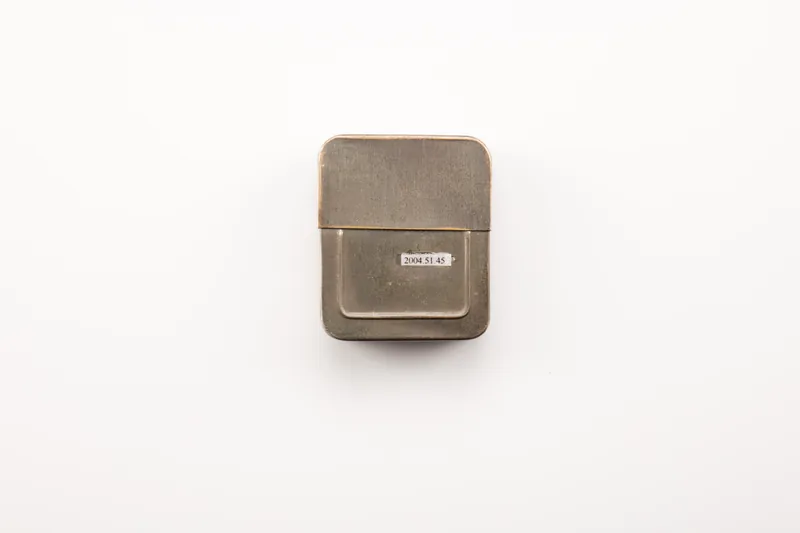
Historical Background of Waltham 14L Movements
The American Waltham Watch Company, operating out of Waltham, Massachusetts, stands as a titan in the history of industrial horology. As pioneers of the American System of Watch Manufacturing, Waltham shifted watchmaking away from handcrafted, individual-part fitting toward precision machine fabrication with fully interchangeable components. Among their vast output during the late 19th and early 20th centuries, intermediate sizes like the 14-size (often referred to in conversion circles as the 14L or 14-ligne class equivalent) occupied a unique space. Designed originally as mid-sized pocket watches for men or robust open-face timepieces for active use, these movements embodied the height of Gilded Age American mechanical engineering.
During the height of production, Waltham produced millions of high-grade movements, ranging from utility-grade 7-jewel workhorses to stunning 17- and 21-jewel adjusted masterpieces featuring raised gold screw settings, damaskeened nickel plates, and micrometer regulators. As wristwatches began replacing pocket watches around the period of World War I, larger pocket watch movements were gradually phased out of daily carry. However, the survival rate and mechanical brilliance of these movements have made them prime candidates for modern horological artisans seeking to create bespoke wear. Today, antique pocket watch conversions allow horologists to breathe second life into these historic American movements, bringing pocket-grade mechanical excellence onto the human wrist.
Understanding the historical context of the Waltham 14-size layout is essential before embarking on a conversion project. Unlike Swiss movements of the same era, which were often laid out with bridge styles easily adaptably to wrist cases, American movements used full-plate, three-quarter plate, or split-bridge designs optimized for rigid pocket watch cases. Converting these calibers requires respect for their structural origins, preserving the original damaskeening and mechanical architecture while adapting their mounting and winding systems to contemporary wristwear demands.
Technical Specifications and Movement Architecture
To successfully convert a Waltham 14L pocket watch into a wristwatch, a watchmaker must first analyze its underlying architecture. The standard Waltham 14-size movement measures approximately 38.1 millimeters (1.5 inches) in plate diameter, operating at a traditional frequency of 18,000 vibrations per hour (2.5 Hz). This leisurely beat rate provides the characteristic, authoritative tick-tick-tick sound highly prized by vintage mechanical enthusiasts. The power train typically utilizes a gooing lever escapement paired with a cut bimetallic expansion balance wheel designed to compensate for temperature fluctuations, completed by a hardened steel Breguet overcoil hairspring.
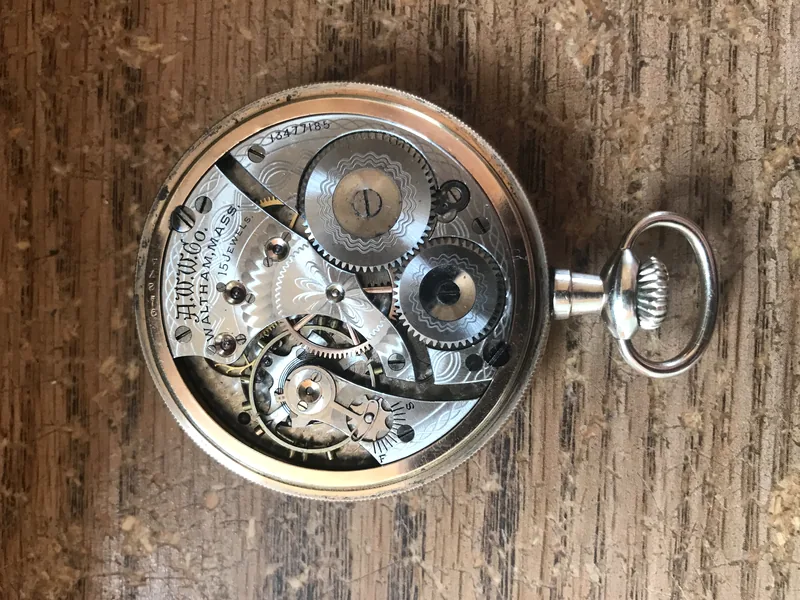
From an architectural standpoint, Waltham 14-size movements were produced in both hunting-case configurations (winding stem at 3 o'clock, sub-seconds dial at 6 o'clock relative to the stem) and open-face configurations (winding stem at 12 o'clock, sub-seconds dial at 6 o'clock). This distinction is critical when planning a conversion. The movement train features a central center wheel, a third wheel, a fourth wheel driving the sub-seconds pivot, and an escape wheel. The top plates display intricate gold-filled or nickel damaskeening—a decorative engine-turning process that gives American pocket watch movements their signature optical brilliance.
Jeweling in these movements varies significantly by grade. Entry-level models incorporate 7 jewels protecting the balance staff, escape wheel, and pallet arbor, while high-grade iterations sport 15 to 17 jewels set in chatons. High-grade models also incorporate gold train wheels, micro-metric whiplash regulators for precise rate adjustments, and double-sunk enamel dials. Understanding these technical specifications allows the watchmaker to calculate mainspring torque tolerances, stem friction loads, and spatial clearances required inside the newly built wristwatch housing.
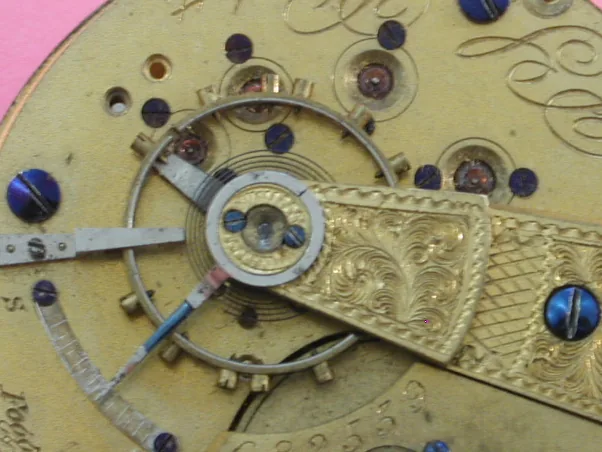
Challenges of Converting Waltham 14L to Wristwatch
While the prospect of wearing a 100-year-old piece of American manufacturing history is appealing, the technical hurdles to convert a Waltham 14L pocket watch into a wristwatch are substantial. The primary structural challenge lies in the stem and setting mechanism. Pocket watch movements of this era typically rely on a sleeve-setting system built into the original pocket watch case pendant rather than an integral setting detent mechanism inside the movement itself. When removed from its original case, the movement lacks the spring friction sleeve necessary to hold the stem in the "setting" position versus the "winding" position, requiring custom mechanical engineering.
Another monumental challenge is shock resistance—or the total lack thereof. Antique Waltham movements feature balance staff pivots turned down to micro-millimeter tolerances resting in rigid, non-shock-absorbed jewel settings. While a pocket watch rested safely inside a vest pocket, a wristwatch is subjected to kinetic impacts, accidental bumps, and sudden wrist movements. Without modification or extreme user caution, a minor impact can easily snap the delicate balance pivots. Watchmakers executing a conversion must ensure that the movement ring and case dampening systems minimize the transfer of sudden external shock directly to the balance staff bridges.
Finally, orientation presents an aesthetic and functional challenge. Converting an open-face Waltham 14-size movement results in the winding crown positioning at the 12 o'clock location on the wrist, mimicking early "trench watch" ergonomics. Converting a hunting-case movement places the crown at 3 o'clock with the sub-seconds register at 9 o'clock. Balancing case dimensions, crown tube alignment, and dial orientation requires meticulous bench work and custom casing ring fabrication to achieve proper alignment and prevent dust or moisture ingress.
Lug Welding and Case Selection
When executing a waltham 14L pocket watch to wrist conversion, selecting or fabricating the appropriate case is the single most critical aesthetic and structural decision. Modern conversion master artisans generally choose between two pathways: modifying an original vintage pocket watch case by silver-soldering/welding wire lugs directly to its perimeter, or commissioning a modern, custom CNC-machined stainless steel or bronze wristwatch case engineered specifically for pocket watch movements.
If utilizing the traditional method of lug attachment to an original case, silver soldering or micro TIG welding wire lugs directly onto a silver or gold-filled case requires stripping the movement entirely to protect it from thermal stress. The lugs must be geometrically centered relative to the 12-6 axis and angled downward slightly to conform to the curvature of the human wrist. This approach preserves the historical charm and original case engravings, drawing direct mechanical inspiration from authentic WW1 trench watches crafted during the initial transition from pocket to wrist wear.
For modern wearability, custom CNC cases are preferred because they offer modern rubber gasket seals, sapphire crystals, and exhibition glass casebacks to showcase the finished movement. Determining the best case size for waltham 14L conversion projects requires careful spatial budgeting. Given the movement's 38.1mm outer diameter, the ideal wristwatch outer case size usually ranges between 42mm and 44mm. A case under 42mm leaves wall thickness too thin for proper structural rigidity and threading, while a case exceeding 45mm creates an overly bulky footprint that compromises ergonomics and wrist comfort.
Crown and Stem Solutions
Engineered solutions for the winding stem and crown represent the technical heart of any successful attempt to convert a Waltham 14L pocket watch into a functional wristwatch. Because American pocket watches of the late 19th and early 20th century utilized square-shank winding arbors or proprietary thread pitches, standard off-the-shelf modern wrist watch stems will not fit. The watchmaker must turn a custom winding stem on a precision watchmaker’s lathe or carefully adapt a stem extension to match the original internal stem thread geometry.
To overcome the lack of an internal setting detent, the watchmaker must engineer a mechanical stem solution within the crown tube or movement ring. A common method involves utilizing a spring-loaded stem adapter or installing an internal friction sleeve within the neck of the new case tube. This sleeve grips the winding stem with enough force to hold it in the pulled-out setting position against the mechanical pressure of the sliding pinion, yet allows smooth rotation when turned by hand to wind the mainspring or advance the hand train.
The crown itself must be selected to match the scale of a 42-44mm case while offering sufficient tactile grip to turn the heavy mainspring click mechanism characteristic of American pocket watches. Oversized onion crowns, pumpkin crowns, or vintage diamond-style crowns are traditional choices. The crown must feature a high-quality internal rubber O-ring stem seal that slides smoothly over the stainless steel case tube, protecting the delicate internal mechanical carbon steel parts from moisture, perspiration, and environmental humidity.
Dial and Hand Considerations
The visual signature of a Waltham conversion resides in its dial and hands. Original Waltham 14-size dials were crafted from vitreous enamel baked onto copper plates, featuring hand-painted Roman or Arabic numerals and crisp, sunken sub-seconds tracks. Because enamel is essentially glass, extreme caution must be exercised during disassembly, cleaning, and remounting. Even minor lateral stress applied near the dial feet can cause microscopic hair cracks (crazing) or irreparable chips across the enamel surface.
Dial feet placement on a vintage Waltham movement is fixed to match its specific plate layout. When re-casing the movement into a new wristwatch housing, the dial feet must mate perfectly with the receiving holes in the pillar plate and be secured by the side-locking dial foot screws. If an original dial is damaged or unavailable, custom brass dials must be engine-turned, lacquered, and fitted with hand-soldered feet turned to exact decimal tolerances on a precision watchmaker’s lathe to align perfectly with the movement arbors.
Hand fitting requires an understanding of traditional friction tolerances. Pocket watch hands feature larger pipe diameters than modern wristwatches. The hour wheel pipe, cannon pinion, and fourth wheel pivot must be measured with a micrometer before selecting or modifying hands. Vintage blued steel hands—often crafted in Cathedral, Spade, or Poire styles—should be retained whenever possible. If the original hands require restoration, they can be carefully cleaned, polished, and re-blued thermally over a brass heat tray until the steel reaches the classic peacock-blue oxidation phase (approximately 290°C to 300°C).
Why 14L is More Common for Conversion
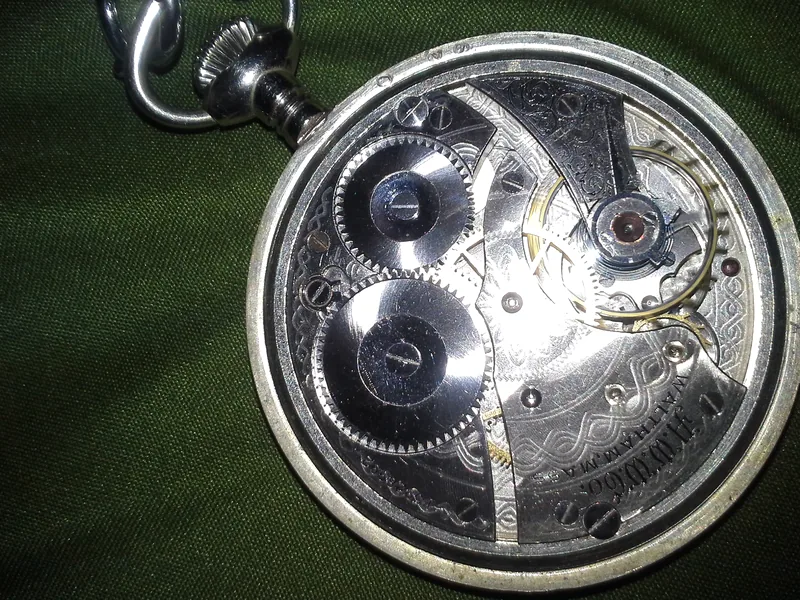
In the world of custom horology, enthusiasts frequently ask why watchmakers specifically prefer to convert a Waltham 14L pocket watch over other sizes such as the massive 18-size or the smaller 0-size movements. The answer comes down to spatial proportion, wearability, and mechanical durability. An 18-size movement measures roughly 44.8mm in diameter on the movement alone; once housed in a protective wristwatch case with adequate wall thickness, the resulting watch measures a massive 48mm to 52mm, rendering it uncomfortably heavy and impractical for daily wrist wear.
Conversely, smaller 0-size, 3/0-size, or 6-size movements—originally designed for ladies' pendant watches—feature much smaller components that are significantly more fragile. Their balance staffs are extremely thin, mainspring torque is low, and finding replacement parts for worn train wheels can be difficult. The 14-size format offers a balance between these extremes: it possesses large, heavy-duty components that are easy to service and adjust, yet features a physical footprint that allows it to sit perfectly inside a modern standard 42mm to 44mm men's wristwatch case.
Additionally, the availability of high-grade Waltham 14-size movements on the secondary market makes them ideal candidates for custom watchmakers. Waltham manufactured hundreds of thousands of these calibers during their production runs, meaning donor parts, mainsprings, staff replacements, and jewel settings are still relatively accessible compared to rarer Swiss calibers like vintage Rolex wristwatches or early Rebberg calibers. This combination of mechanical robustness, optimal modern casing dimensions, and parts availability makes the 14L class the gold standard for high-end American pocket watch conversions.
Final Thoughts on Waltham 14L Conversions
A successful conversion of a Waltham 14L pocket watch bridges the gap between historical preservation and practical modern style. Transforming an antique pocket movement—originally designed to rest securely inside a waistcoat—into a fully functional, wearable wrist instrument is a testament to the versatility of classical American engineering. When executed correctly by an experienced horologist, the result is a unique piece of wearable art that celebrates the industrial history of the Waltham Watch Company.
However, owning and maintaining a converted pocket watch requires an appreciation for its mechanical limitations. Because these historic movements lack modern shock-absorbing systems like Incabloc or Parechoc, they should be treated as fine mechanical dress watches rather than sports timepieces. Regular servicing every three to five years—including complete teardown, ultrasonic cleaning, pivot polishing, and re-lubrication with modern synthetic lubricants like Moebius 9010 and HP1300—will ensure that the movement continues to keep excellent time for generations to come.
Ultimately, choosing to convert a Waltham 14L pocket watch into a wristwatch gives new purpose to an object that might otherwise remain hidden away in a drawer or collector's display box. On the wrist, the slow, rhythmic 18,000 vph beat rate, the gleam of hand-finished damaskeened nickel plates through an exhibition caseback, and the depth of an authentic vitreous enamel dial offer a tactile connection to horological history that no modern mass-produced timepiece can replicate.