1. Historical Background of Waltham 18s Movements
The American Waltham Watch Company (AWWCo), established in Waltham, Massachusetts, stands as the indisputable pioneer of industrial precision horology. Before Waltham perfected the American System of Watch Manufacturing in the mid-to-late 19th century, timepieces were crafted individually by hand, resulting in non-interchangeable components and laborious fitting processes. Waltham revolutionized this paradigm by introducing automated, high-precision machinery capable of producing standardized components with microscopic tolerances. Central to this industrial revolution was the 18-size (18s) pocket watch movement, which served as the workhorse of American timing from the 1850s through the early 20th century.
The 18s designation refers to a standardized movement diameter in the Lancashire gauge system used by American manufacturers, where size 0 represents 1 5/30 inches and each incremental size adds 1/30th of an inch. An 18s movement measures precisely 1.767 inches, or 44.87 millimeters, in bare plate diameter. Iconic Waltham models such as the Model 1857 (the first successful mass-produced pocket watch), the Model 1877, the ubiquitous Model 1883, and the highly refined Model 1892 were built around this robust footprint. High-grade variants like the Appleton Tracy & Co., Crescent St., and early Vanguard models met stringent Railroad Chronometer standards, demanding exceptional accuracy across multiple temperature variations and spatial positions.
Because millions of these 18s movements were produced over decades, many survived long after their original solid gold or silver pocket watch cases were melted down during economic downturns. Today, horologists and custom builders frequently ask: can you convert waltham 18s pocket watch movements into wearable wristwatches? While the historical significance of these movements makes them prized artifacts, re-casing an uncased 18s movement into a wristwatch offers a compelling way to revive a masterpiece of 19th-century American engineering, provided the conversion is approached with absolute technical rigor.
2. Technical Specifications and Movement Architecture
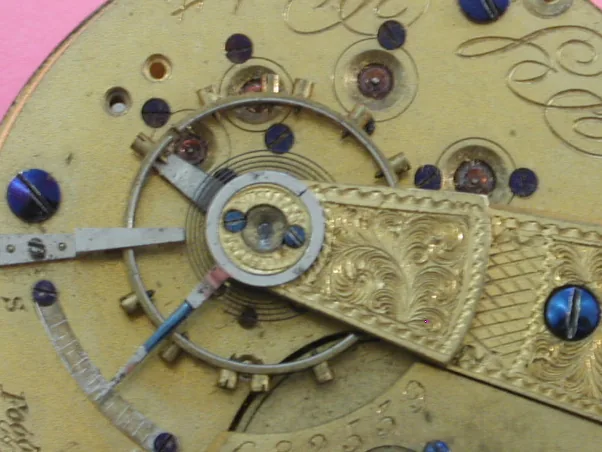
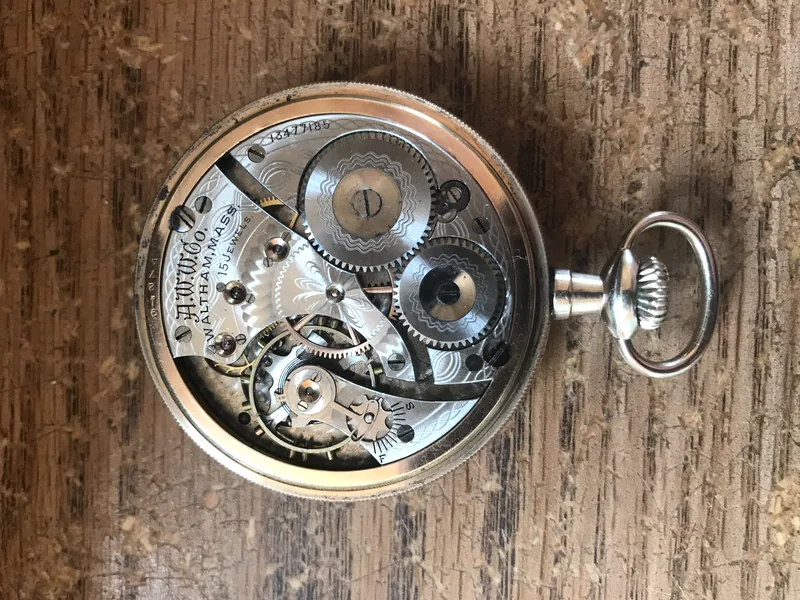
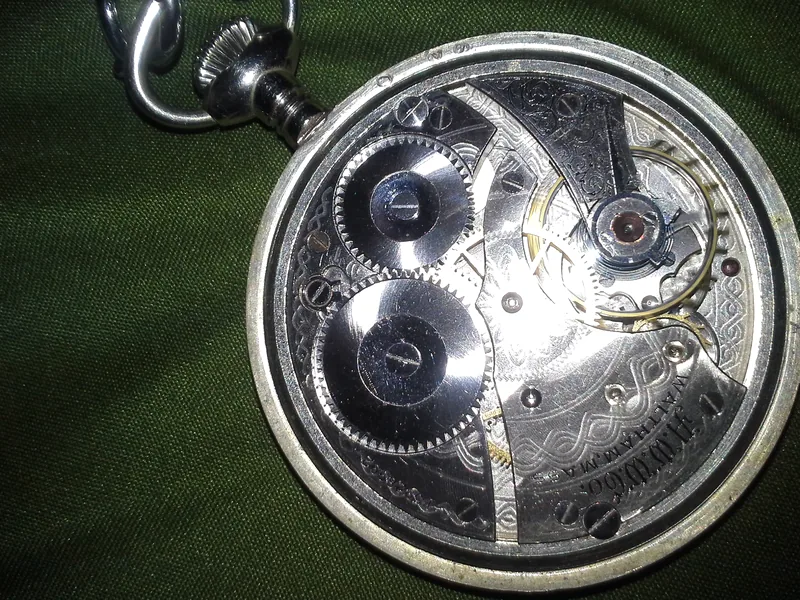
To successfully execute a project to convert waltham 18s pocket watch into wristwatch configurations, a watchmaker must thoroughly understand the internal architecture of these movements. At 44.87 mm in diameter, the movement chassis provides ample space for heavy-duty components. The mainplate and bridges are typically cut from brass, finished with intricate nickel plating, and adorned with decorative damaskeening (such as wild rose, sunburst, or parallel stripes). Lower-grade movements utilize 7 to 15 jewels, whereas railroad-grade 18s movements feature 17 to 23 fine ruby or sapphire jewels, often set in solid gold screwed chatons to secure the wheel train arbors.
The escapement assembly in a Waltham 18s is built around a heavy, large-diameter balance wheel. Railroad grades feature cut bimetallic compensation balance wheels with gold or platinum timing screws, paired with a Breguet overcoil hairspring to minimize isochronal errors. The balance operates at a traditional frequency of 18,000 vibrations per hour (vph) or 2.5 Hz, delivering a deliberate, resonant beat that is visually and acoustically distinct from modern high-frequency wristwatches. Furthermore, high-tier 18s movements incorporate patent micro-metric regulators—such as Reed’s spring regulator or Star wheel regulators—allowing micro-adjustments to the active length of the balance spring.
Power transmission flows from a substantial mainspring housed inside a brass mainspring barrel. Most high-grade Waltham 18s movements feature a safety pinion or safety barrel design. This crucial feature ensures that if the mainspring snaps, the destructive recoil force is decoupled from the delicate center wheel and teeth of the wheel train, preventing catastrophic gear strip-out. Understanding these architectural nuances is imperative when servicing, cleaning, and preparing the movement for its transition to a wrist-borne housing.
3. Challenges of Converting Waltham 18s to Wristwatch
While the prospect of wearing a 130-year-old railroad movement on the wrist is captivating, adapting an 18s mechanism presents substantial engineering obstacles. The foremost physical challenge is sheer scale. A bare movement diameter of 44.87 mm means that once a protective steel case wall, movement holder ring, and bezel threadings are factored in, the resulting wristwatch diameter easily spans 48 mm to 52 mm, with a total thickness often exceeding 14 mm to 16 mm. This results in a massive wrist presence that demands careful physical and aesthetic accommodation.
The second major technical hurdle involves shock protection—or the total lack thereof. Pocket watches were designed to reside vertically in a vest pocket, subject to minimal sudden impact. The balance staff pivots on a Waltham 18s are extraordinarily fine, measuring a fraction of a millimeter in diameter, and are seated directly against fixed jewel caps without shock-absorbing springs like Incabloc or KIF systems. Wearing an un-shock-protected 18s movement on a wrist—an extremity subject to door-frame impacts, rapid gestures, and everyday vibrations—exposes the delicate balance staff to severe risk of shearing.
Finally, movement layout dictates winding stem position and sub-seconds orientation. Pocket watch movements are configured either as Open Face (Lépine) or Hunting Case (Savonnette):
- Open Face (Lépine): The winding stem is positioned at 12 o'clock, directly aligned with the sub-seconds dial at 6 o'clock. If cased in a standard wristwatch orientation with the crown at 3 o'clock, the main dial rotates 90 degrees, moving the sub-seconds register to 9 o'clock.
- Hunting Case (Savonnette): The winding stem is at 3 o'clock, while the sub-seconds register sits at 6 o'clock relative to the stem. This layout aligns naturally with modern wristwatch ergonomics but requires sourcing a scarcer hunting-style movement or dial.
4. Lug Welding and Case Selection
Selecting or fabricating an appropriate housing is the foundation of any 18s build. Sourcing a purpose-built waltham 18s pocket watch to wrist conversion case is the preferred route for modern customizers. Modern conversion cases are CNC-machined from 316L stainless steel or bronze, specifically engineered to accommodate the 44.87 mm plate diameter with internal retaining grooves, screw-down display casebacks, and synthetic sapphire crystals. These cases provide rigid structural support, integrated rubber gaskets for basic dust and moisture defense, and pre-fitted lugs engineered at ergonomic downward angles to pull the wide case flush against the wrist.
Alternatively, traditionalists sometimes attempt to modify an original pocket watch case (nickel, sterling silver, or gold-filled) by hard-soldering or micro-welding custom lugs directly to the case band. This process requires advanced metallurgical knowledge and extreme caution:
- Thermal Management: Heat from TIG welding or silver brazing will instantly warp thin case rims, ruin crystal snap-fits, and melt original solder joints on the case hinges. The case must be entirely stripped of all steel springs, bezels, and glass, and packed with heat-sink paste.
- Material Compatibility: Silver-filled or gold-filled cases cannot be easily welded without burning through the thin precious metal cladding, exposing the underlying brass base metal. Solid sterling silver (.925) or coin silver (.900) cases require silver solder with precise flow temperatures to achieve structural integrity.
- Lug Geometry: Due to the wide 48mm+ case footprint, straight wire lugs make the watch unwearable by pushing the total lug-to-lug distance beyond 60 mm. Lugs must be contoured downward aggressively, wrapping around the wrist arc to reduce cantilevered load and prevent snagging.
5. Crown and Stem Solutions
Interfacing a custom wrist case crown with a 19th-century Waltham 18s winding system is one of the most complex mechanical aspects of the conversion process. Unlike modern wristwatches, where pulling the crown engages the hand-setting mechanism inside the movement keyless works, American pocket watches used two distinct external setting paradigms: Pendant-Set (Sleeve-Set) and Lever-Set mechanisms.
In a standard pendant-set Waltham, a split steel sleeve located inside the original pocket watch case pendant holds the stem in place and mechanically toggles between the winding and setting positions. When removing the movement from its original case, that keyless setting sleeve stays in the pocket watch pendant. Consequently, placing the movement into a modern wrist case requires installing a specialized conversion stem or fitting an internal stem sleeve into the new case neck. The stem length must be calculated down to tenths of a millimeter using a micrometer, turned down on a watchmaker’s lathe if necessary, and threaded to receive a modern wide-gauge crown.
Lever-set movements (common on railroad-grade Walthams like the Model 1892) present a different operational requirement. To set the time on a lever-set movement, a small steel setting lever located under the bezel at 1 o'clock or 5 o'clock must be physically pulled outward. This mechanical slide shifts the setting wheels into engagement with the dial train. In a wristwatch conversion, the case must either feature an accessible side slot or an easily removable threaded bezel so the wearer can manually pull the setting lever when adjusting the time. The custom stem in a lever-set conversion remains permanently in the winding position.
6. Dial and Hand Considerations
The visual identity of a converted Waltham 18s relies heavily on its dial and hands. Original Waltham dials from this era are vitreous enamel (fired porcelain) fused onto a copper plate base. While stunningly vibrant and resistant to fading, porcelain dials are extraordinarily brittle. Decades of micro-vibrations, temperature swings, or improper handling cause hairline cracks, edge chipping, or full structural fractures. Modern wrist casing subjects these delicate enamel structures to new shock forces, demanding absolute mechanical isolation.
Securing the dial to the movement mainplate requires careful attention to the dial feet. Waltham 18s movements utilize side-locking dial screws or rotating cams to grip the copper dial feet. If an original dial is damaged beyond repair, or if a custom dial layout is required to correct sub-seconds alignment, the builder must either solder new brass dial feet onto a custom metal dial plate using a low-temperature solder jig or utilize specialized adhesive dial dots—though true watchmaking standards dictate solid mechanical mounting via copper feet. Screwing or clamping down a porcelain dial too tightly into a new conversion case will cause instant tension fractures across the enamel surface.
Fitting hands to an 18s movement requires custom sizing or precise adjustment of original blued-steel hands:
- Hour Hand Hole Diameter: Typically ranges around 2.10 mm to 2.30 mm depending on the exact model and wheel caliber.
- Minute Hand Hole Diameter: Requires precise fitting onto a square or rounded friction-fit cannon pinion arbor, measuring approximately 1.10 mm to 1.25 mm.
- Sub-Seconds Hand: Sits on the extended pivot of the fourth wheel, which typically measures a minuscule 0.20 mm to 0.28 mm in diameter. Modern replacement hands almost never fit these vintage American dimensions without micro-bushing or staking on a watchmaker’s staking tool.
7. Why 18s is Less Common for Conversion
When horological enthusiasts evaluate candidates for pocket watch wrist conversions, 16-size (16s) and 12-size (12s) movements are chosen far more frequently than 18s movements. The primary deterrent is ergonomic viability. A 16s movement measures 43.18 mm (1.7 inches), allowing for a finished wristwatch case diameter of roughly 44 mm to 46 mm—a size that aligns with modern oversized sports watch aesthetics. The 18s movement, by contrast, pushes case sizes into the 48 mm to 52 mm realm, yielding a lug-to-lug length that often exceeds the width of an average human wrist.
Beyond spatial dimensions, mass and wearable comfort play significant roles. The solid brass plates, thick center wheels, heavy brass balance bridges, and massive steel components of an 18s movement make the finished watch exceptionally heavy. On the wrist, this creates a high center of gravity, causing the watch to rotate or sag on the strap unless secured uncomfortably tight. The sheer inertia of the heavy balance wheel also creates noticeable gyroscopic feedback when the wearer moves their arm rapidly.
Finally, there is an ethical and historical preservation debate within the horological community regarding high-grade 18s pieces. Masterpieces like the Waltham Model 1892 Vanguard or 21-jewel Crescent St. represent peak achievements of 19th-century American industrial craftsmanship. Destroying complete, matching original pocket watch cases or modifying pristine movements to fit modern wrist housings permanently destroys horological provenance. Consequently, ethical watchmakers strictly restrict conversions to "orphan" movements—mechanisms whose original precious metal cases were irrevocably lost or scrapped decades ago.
8. Final Thoughts on Waltham 18s Conversions
Deciding to convert waltham 18s pocket watch into wristwatch form is a project that bridges historical preservation with bespoke mechanical crafting. When executed properly using an uncased, orphaned movement, an 18s conversion breathes dynamic new life into a historic machine that would otherwise sit forgotten in a watchmaker's drawer. The visual spectacle of a massive, hand-finished, damaskeened Waltham movement operating behind a sapphire display caseback offers a tactile connection to America's industrial golden age that no modern factory-produced watch can replicate.
However, success requires respecting the mechanical limitations inherent to 19th-century horology. The lack of shock protection, the massive physical proportions, the delicacy of porcelain dials, and the intricate stem-setting geometry mean that an 18s wristwatch conversion cannot be treated as a rugged daily wear timekeeper. It is a specialized, heroic statement piece that requires careful handling, regular servicing with period-correct lubricants, and a deep appreciation for the craft.
For the watchmaker or collector willing to navigate the technical complexities of custom casing, stem adaptation, and dial protection, a converted Waltham 18s stands as a wearable monument. It celebrates the brilliant engineers of Waltham who, over a century ago, conquered time precision through industrial innovation—bringing history out of the vest pocket and onto the wrist.