Historical Background of Waltham 8s Movements
The American Waltham Watch Company, established in Waltham, Massachusetts, stands as one of the most significant pillars in the history of industrial horology. Operating from the mid-19th century through the mid-20th century, Waltham pioneered the American System of Watch Manufacturing, introducing interchangeable parts, extreme precision machining, and scalable assembly lines to an industry previously dominated by European hand-craftsmanship. Among the wide variety of sizing scales developed by the company, the 8-size (commonly abbreviated as 8s) movement held a uniquely versatile position within their production lineup from the late 1870s through the early 1920s.
The 8s sizing metric belongs to the traditional American Watch Gauge system, positioning it squarely between the massive 18-size and 16-size railroad-grade pocket watches and the tiny 0-size or 3/0-size pendant watches meant for women's lapel wear. Models such as the Waltham Model 1873, Model 1884, and Model 1891 in 8-size were historically cased as refined gent’s dress pocket watches or high-grade mid-sized pocket timepieces. These movements showcased the finest of late-19th-century American design, featuring intricate nickel damaskeening, gold-plated movement plates, screwed gold jewel chatons, and hand-engraved balance bridges.
Over the decades, changing economic conditions—most notably the gold and silver scrap metal surges of the Great Depression and the late 20th century—led to tens of thousands of solid gold and sterling silver pocket watch cases being melted down for bullion. This historical reality left behind a vast surplus of high-grade, fully functional "orphaned" movements devoid of their original housings. Today, master watchmakers and vintage horological enthusiasts routinely seek to convert waltham 8s pocket watch into wristwatch configurations, granting these engineering marvels a second life on the modern wrist rather than letting them languish in material scrap bins.
Technical Specifications and Movement Architecture
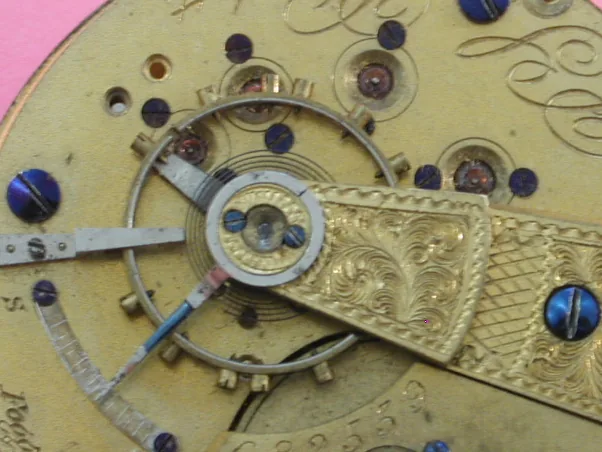
To evaluate a Waltham 8s movement for modern re-casing, a watchmaker must first analyze its core architecture and mechanical dimensions. Under the American sizing standard, an 8s movement features a mainplate diameter of approximately 1.367 inches, or roughly 34.72 millimeters. This diameter presents an exceptionally advantageous footprint for wrist conversion, as it allows the complete movement to fit comfortably within modern case proportions without requiring extreme oversized case geometry.
Architecturally, Waltham 8s movements were manufactured across a variety of plate configurations, including full-plate designs, three-quarter plate structures, and split-bridge layouts. These calibres typically feature traditional lever escapements, precision cut bimetallic compensation balance wheels with gold timing screws, and hand-formed Breguet overcoil balance springs. Operating at a steady frequency of 18,000 vibrations per hour (2.5 Hz), these movements deliver a classic, deliberate sweeping motion of the seconds hand. Power delivery is managed via a manual-wind mainspring housed inside a standard barrel, typically providing a operational power reserve ranging between 30 and 36 hours when fully wound.
Setting and winding systems on 8s movements vary depending on the production era and grade. Earlier iterations utilized key-wind and key-set mechanics, whereas later high-grade variants incorporated stem-wind pendant-set or stem-wind lever-set mechanisms. Jewel counts on these calibres span from utility 7-jewel variants up to high-grade 15, 17, and 21-jewel movements equipped with ruby and sapphire cap jewels for the balance arbors, escape wheels, and pallet arbors. Understanding these exact mechanical nuances is vital when designing structural support components and custom winding stems for modern conversion housings.
Challenges of Converting Waltham 8s to Wristwatch
A common question posed by collectors and clients is: can you convert waltham 8s pocket watch movements into daily-wear wristwatches without destroying their historical or mechanical integrity? The answer is unequivocally yes, but the process presents severe technical obstacles that require advanced bench watchmaking skill, custom machining capabilities, and a fundamental understanding of materials engineering. Modern wristwatches operate in a harsh environment compared to pocket watches, subjecting internal mechanics to sharp shocks, rotational kinetic energy, magnetic fields, and direct exposure to moisture and dust.
The primary technical vulnerability of any 19th- or early 20th-century pocket watch movement is the complete absence of modern shock-absorption systems (such as Incabloc, KIF, or Novodiac). The delicate, hardened-steel pivots of the balance staff sit directly inside rigid jewel bushings or un-cushioned endstones. Wearing an uncushioned 8s conversion during high-impact activities can instantly snap a balance staff pivot. Therefore, conversion designs must incorporate external movement cushion rings or dampening gaskets, and the end user must accept that the converted timepiece is a delicate mechanical artifact best suited for careful, dress-wear scenarios.
Another monumental obstacle stems from movement layout orientation—specifically the distinction between open-face (Lepine) and hunter-case (Savonnette) movements. In an open-face 8s movement, the winding stem sits at the 12 o'clock position directly opposite the running small-seconds subdial at 6 o'clock. Converting an open-face movement into a standard wristwatch configuration (with the crown at 3 o'clock) rotates the small-seconds subdial to the 9 o'clock position. Conversely, a hunter movement features the winding stem at 3 o'clock with the subdial at 6 o'clock. Aligning these mechanical realities with aesthetically pleasing dial geometry requires careful planning prior to selecting or machining a custom case.
Lug Welding and Case Selection
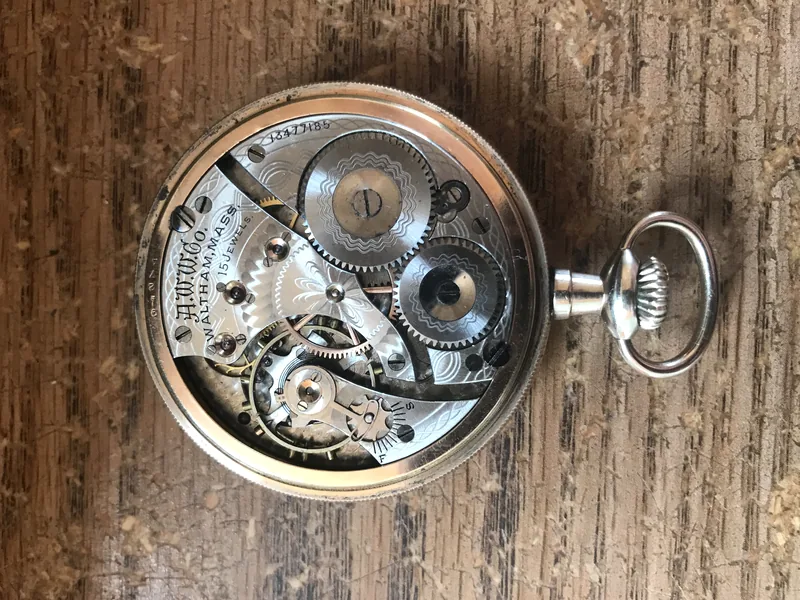
When selecting a housing for an 8s project, finding or manufacturing an appropriate waltham 8s pocket watch to wrist conversion case is the single most critical aesthetic and structural decision. Modern off-the-shelf watch cases designed for ETA or Seiko movements will not accommodate the unique thickness, stem height, or plate diameter of a vintage Waltham movement. Watchmakers typically choose between two paths: precision CNC-machining a dedicated 316L stainless steel or bronze case from scratch, or modifying an original vintage silver/nickel pocket watch case by retrofitting wire lugs.
If retrofitting an original vintage pocket watch case to accept modern wrist straps, the watchmaker must employ specialized micro-welding or hard-soldering techniques. Wire lugs (often styled after early 20th-century trench watches) are shaped from solid stainless steel, sterling silver, or brass rod stock. These lugs must be welded onto the case band at precise 180-degree opposing positions. High-grade TIG (Tungsten Inert Gas) welding or micro-laser welding is strongly preferred over soft soldering, as soft solder lacks the tensile strength required to secure heavy cases against accidental wrist drops. Heat management during welding is paramount; the movement, crystal, and gaskets must be entirely stripped from the case band, and localized heat sinks must be applied to avoid warping the case frame or destroying delicate hinge geometry.
When working with bespoke CNC-machined modern conversion cases, internal dimensions are engineered specifically for the 34.72mm Waltham 8s mainplate. These modern cases often feature see-through display casebacks equipped with sapphire crystals, allowing full view of the hand-finished nickel or damaskeened plates. The inner perimeter of the conversion case uses a custom-machined movement spacer ring made of brass or aluminum. This ring centers the movement, compensates for varying stem heights, and absorbs minor lateral shock forces, ensuring the movement remains perfectly rigid relative to the winding stem tube.
Crown and Stem Solutions
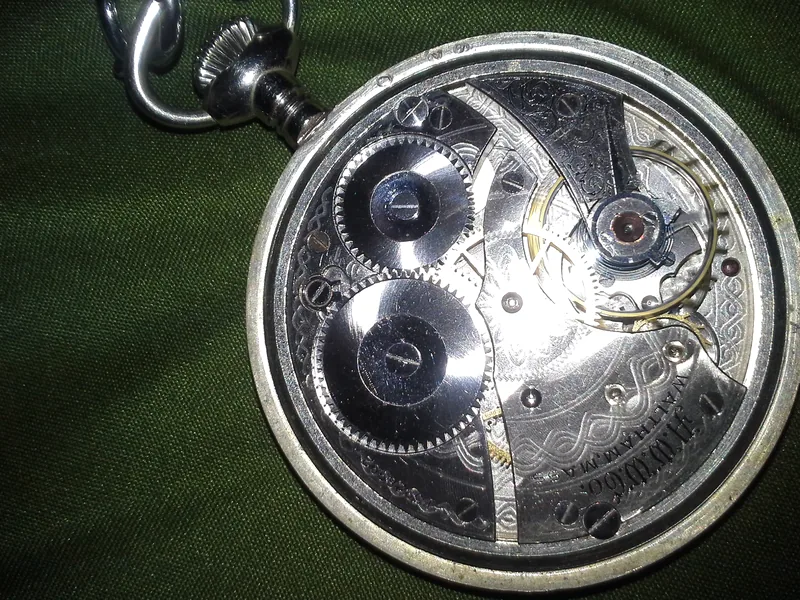
Interfacing a 19th-century Waltham winding mechanism with a modern wristwatch case requires solving complex stem geometry issues. Pocket watch stems during the Waltham 8s era were rarely standardized across different case manufacturers. Many Waltham calibres utilized a square-arbor winding interface or a split-stem mechanism where part of the stem mechanism was permanently mounted inside the pocket watch case pendant, rather than staying entirely attached to the movement movement mainplate.
To establish reliable winding and setting capability in a conversion case, the watchmaker must often turn a custom winding stem on a precision watchmaker's lathe (such as a Levin or Lorch lathe). The inner end of the stem must be ground and filed to fit the exact square socket of the Waltham winding pinion, while the outer section is threaded to standard modern crown tap sizes (typically Tap 9 or Tap 10). If the original movement utilizes a stem-wind lever-set (SW-LS) architecture, the case construction must include a dedicated bezel slot or sliding lever mechanism that allows the user to pull out the setting lever located near the edge of the dial to adjust the hands, preventing reliance on stem-tension pull-setting.
Crown selection must strike a technical balance between period-correct aesthetics and practical functionality. Large onion crowns, pumpkin crowns, or flat trench-style crowns are traditionally selected to match the era of the Waltham 8s movement. The crown stem tube must be fitted with internal nitrile rubber O-ring gaskets to offer a baseline defense against dust and atmospheric moisture. While a converted Waltham pocket watch can never be rendered truly waterproof due to the lack of mainplate seals, modern gasketed crowns eliminate basic humidity intrusion that could otherwise cause rust on the steel winding arbors and hairspring.
Dial and Hand Considerations
The dial and hands of a vintage Waltham 8s movement represent its artistic heart, requiring delicate preservation during the conversion process. Waltham 8s pocket watches predominantly featured original vitreous enamel dials (fired enamel over copper plates) or metal painted dials. Vitreous enamel dials are virtually impervious to fading or atmospheric corrosion, but they are exceptionally brittle and prone to micro-cracking, hairlines, or chipping if subject to flexure or improper handling during movement casing.
When attempting to convert waltham 8s pocket watch into wristwatch specifications, the dial feet positioning must be respected. Modifying or soldering new dial feet onto a original enamel dial is virtually impossible without destroying the delicate enamel glass surface due to thermal shock. Therefore, the conversion housing or movement spacer ring must be engineered around the movement's native dial feet locations. Furthermore, if an open-face movement is turned 90 degrees to position the crown at 3 o'clock, the user must accept having the running small-seconds subdial at 9 o'clock. Alternatively, custom bespoke metal dials can be manufactured with foot placements that allow full 12 o'clock crown orientations or centered sweep-seconds conversion modifications.
Hand clearance represents another critical mechanical threshold. Pocket watch cases offered generous vertical clearance beneath thick glass crystals. Modern wristwatch cases—especially those designed with low-profile sapphire crystals—present significantly tighter vertical tolerances. The watchmaker must precisely check the cannon pinion height, hour wheel pipe, and fourth wheel sub-seconds arbor length. Hands must be carefully set with hand-press tools to ensure absolute parallelism with the dial surface. Blued steel hands should be inspected for surface oxidation and, if necessary, re-blued using traditional thermal bluing pans over heat to restore their deep iridescent cobalt finish.
Why 8s is more common for conversion
In the vintage watch conversion community, a clear structural preference exists for the Waltham 8s calibre over other popular American sizes. To understand this preference, one must analyze the physical dimensions of competing sizes, such as the 18s, 16s, 12s, and 0s/3s calibres. An 18s movement measures roughly 44.86mm in diameter; when housed inside a protective wristwatch conversion case with adequate wall thickness, the resulting watch measures between 48mm and 52mm wide—a size that proves uncomfortably massive and heavy for the vast majority of human wrists.
While 16-size (43.18mm) and 12-size (39.78mm) movements are frequently converted, the 8-size movement occupies the ideal mathematical sweet spot. With a mainplate diameter of 34.72mm, an 8s movement can be cased inside a finished wristwatch housing measuring approximately 38mm to 41mm in outer diameter. This exact case dimension matches contemporary luxury wristwatch sizing preferences perfectly, delivering substantial presence without exceeding the anatomical dimensions of the wristband lugs relative to the wearer's wrist width.
Additionally, 8s movements are far more structurally robust than smaller 0-size, 3/0-size, or 6/0-size ladies' pendant movements. Smaller sizes feature paper-thin balance staff pivots, fragile gear trains, and miniature mainsprings that are extraordinarily difficult to service and prone to structural failure under wrist torque. The Waltham 8s strikes an ideal balance: it possesses heavy-duty industrial gearing and large, easily tunable balance wheels while remaining small enough to be worn in total modern comfort. Consequently, high-grade 8s movements remain the premier candidate for custom conversion commissions worldwide.
Final Thoughts on Waltham 8s Conversions
Converting a historical Waltham 8s movement into a high-grade wristwatch is far more than a simple re-casing procedure; it is an exercise in horological preservation, micro-engineering, and artistic revitalization. When executed by an experienced watchmaker who respects original tolerances and refrains from permanently altering irreplaceable movement components, a conversion rescues an orphaned movement from historical obscurity and returns it to functional life.
Prospective owners of converted Waltham 8s wristwatches must maintain realistic expectations regarding their care and performance. These internal mechanisms were hand-assembled over a century ago in an era before synthetic lubricants, shock-absorbing jewels, and stainless steel water seals. A converted timepiece must be kept far away from water, removed during athletic or high-impact activities, demagnetized periodically, and serviced every three to five years using high-grade synthetic watch oils (such as Moebius 9010 and HP-1300) to minimize mechanical friction on un-jeweled arbors.
Ultimately, a successfully executed Waltham 8s conversion stands as a wearable masterpiece of American industrial history. Ticking gently at 18,000 beats per hour on the wrist, the mechanical movement offers a direct tactile connection to the peak era of American manufacturing excellence. By fusing 19th-century micro-mechanics with 21st-century case design, watchmakers preserve the legacy of the Waltham Watch Company for generations to come.