What is the Austrian Ducat Hallmark?
In high-grade vintage horology, few precious metal markings carry the prestige, historic weight, and purity of the pocket watch hallmark austrian ducat 986 gold. While the vast majority of antique solid gold pocket watch cases were crafted from standard 18-karat (750/1000) or 14-karat (585/1000) gold alloys to balance durability with brilliance, select imperial, presentation, and ultra-high-grade pocket watches utilized Ducat gold. Stamped at an extraordinary fineness of 986 parts per thousand—equivalent to 23.66 karats—this rare marking signifies a case forged almost entirely from pure gold, adhering strictly to the stringent monetary standards of the Austro-Hungarian Empire and the subsequent Austrian Republic.
The Austrian Ducat hallmark is not merely a modern stamp of precious metal content; it is an official state guarantee applied by authorized assay offices (Hauptpunzierungsämter). Unlike typical gold alloys that incorporate significant amounts of copper, silver, or zinc to increase mechanical hardness, 986 Ducat gold preserves the rich, deep buttery hue and intense luster characteristic of near-pure bullion. When stamped into the inner cuvette, case back, or rim of a vintage pocket watch, this hallmark serves as absolute proof that the case maker crafted the housing from official mint-standard Ducat gold stock, often refined directly at the Imperial Mint in Vienna (Münze Österreich).
Identifying an authentic pocket watch hallmark austrian ducat 986 gold requires an understanding of both official punch symbols and the unique physical properties of hyper-pure gold alloys. Because 986 gold is notably softer than lower-karat alternatives, case makers who worked with this metal were exceptional artisans, executing precise engine-turning, hand-engraving, and tight tension closures despite the metal's malleability. For collectors, horological historians, and auction house specialists, encountering an authentic 986 Ducat hallmark transforms an ordinary vintage pocket watch into a extraordinary artifact of Central European metallurgy.
 rolex-database-hallmarks-austrian-ducat-1-3dcaac0a.webp" alt="pocket watch — Clockwork of the Holy Cross Church in Dülmen, North Rhine-Westphalia, GermanyThe" style="max-width:100%; height:auto; display:block; margin:15px auto;">
Historical Origins and Assay Office
To fully grasp the significance of the Austrian Ducat hallmark on vintage horological cases, one must examine the monetary history of the Habsburg Monarchy. The Ducat (Dukat) was first minted in Austria in the early 16th century under Emperor Ferdinand I, modeled after the legendary Venetian gold ducat. By the 18th and 19th centuries, particularly under the reign of Empress Maria Theresa and later Emperor Franz Joseph I, the Austrian Ducat became the gold standard across Central and Eastern Europe. The state strictly standardized its composition at 986.11 parts fine gold per thousand, with the remainder consisting of a minute silver-copper balancing fraction designed solely to facilitate minimal structural cohesion during coining.
During the 19th and early 20th centuries, the Austro-Hungarian Empire established one of the most sophisticated and tightly controlled hallmark inspection systems in the world. Enacted officially under the Precious Metals Marking Acts of 1866 and expanded in 1872, all gold and silver articles sold or manufactured within the realm were required by law to undergo physical testing at an official state Assay Office (Punzierungsamt). While standardized case marks were created for 18K, 14K, and 10K items, special provisions were maintained for ultra-high-purity commissions utilizing melted or freshly rolled Ducat bullion plate.
The primary center for assaying and stamping these exceptional watch cases was the Hauptpunzierungsamt in Vienna, identified by the hallmark letter code "A". Other regional imperial assay offices—such as Prague ("C"), Brünn/Brno ("B"), Budapest ("E"), or Trieste ("K")—were also authorized to inspect and apply punches, though the overwhelming majority of 986 gold pocket watch cases originated from high-end Viennese case makers (Gehäusemacher) operating in close proximity to the court horologists. These masters cased elite Swiss movements from raw suppliers like Vacheron Constantin, Patek Philippe, and Audemars Piguet, as well as native Austro-Hungarian chronometers produced by masters such as Carl Suchy & Söhne or Ludwig Oechslin.
Following the collapse of the Austro-Hungarian Empire in 1918, the First Austrian Republic overhauled its hallmark legislation in 1925. The new system introduced modernized punch outlines, incorporating iconic symbols such as the profile of the Austrian Maiden, the double-headed or single-headed state eagle, and numeric fineness indicators. Throughout these legislative transformations, the 986 Ducat gold standard was explicitly retained in law as an official national gold fineness, ensuring that pocket watches produced up through the mid-20th century preserved this historical link to imperial coinage metallurgy.

Metal Purity and Standards
The technical profile of 986 gold distinguishes it sharply from virtually all other precious metal alloys encountered in antique pocket watch construction. In the standard horological hierarchy, gold fineness is divided into distinct operational tiers. 18K gold (750/1000 fine) contains 75% pure gold mixed with 25% base metals, yielding optimal hardness, tensile strength, and scratch resistance necessary for daily pocket wear. 14K gold (585/1000 fine) offers even higher rigidity and durability at the expense of rich coloration. In contrast, 986 Ducat gold is comprised of 98.6% pure gold, leaving only a microscopic 1.4% alloy buffer—typically a precise 3:1 ratio of copper to silver.
This extreme purity alters both the visual aesthetics and mechanical behavior of the pocket watch case. From a visual standpoint, 986 gold exhibits an intense, warm golden-orange brilliance, often referred to in historical texts as *Dukatengold-Farbe*. Unlike 18K yellow gold, which often carries a paler lemon-yellow tone due to silver content, or 18K rose gold, which contains heavy copper additions, 986 gold possesses a deep, radiant luminosity that does not tarnish, oxidize, or develop heavy surface patination over centuries of storage.
From a metallurgical perspective, crafting a durable pocket watch housing out of 986 gold posed immense engineering challenges. Pure gold has a Mohs hardness of approximately 2.5, whereas annealed 18K gold sits between 3.5 and 4.0. To overcome this inherent softness, Austro-Hungarian case makers employed specialized cold-hammering, strain-hardening, and work-hardening techniques during the rolling of the gold sheets. By repeatedly compressing the molecular matrix of the 986 plate before machining, smiths achieved sufficient structural rigidity to support key-wind rims, snap-fit bezels, and complex spring-hinge mechanisms on hunting-case (savonnette) pocket watches.
| Gold Standard / Alloy | Millimal Fineness | Karat Equivalent | Typical Composition | Horological Application |
|---|---|---|---|---|
| Austrian Ducat (Dukaten) | 986 / 1000 | 23.66K | 98.6% Au, ~1.0% Cu, ~0.4% Ag | Imperial Presentation Cases, High-Grade Pocket Watches |
| Standard High-Grade | 750 / 1000 | 18.00K | 75.0% Au, 12.5% Ag, 12.5% Cu | Premium Swiss & Austro-Hungarian Pocket Watches |
| Commercial Grade | 585 / 1000 | 14.00K | 58.5% Au, 20.0% Ag, 21.5% Cu | Standard Everyday Pocket Watches (US & European) |
How to Identify on Vintage Watch Cases
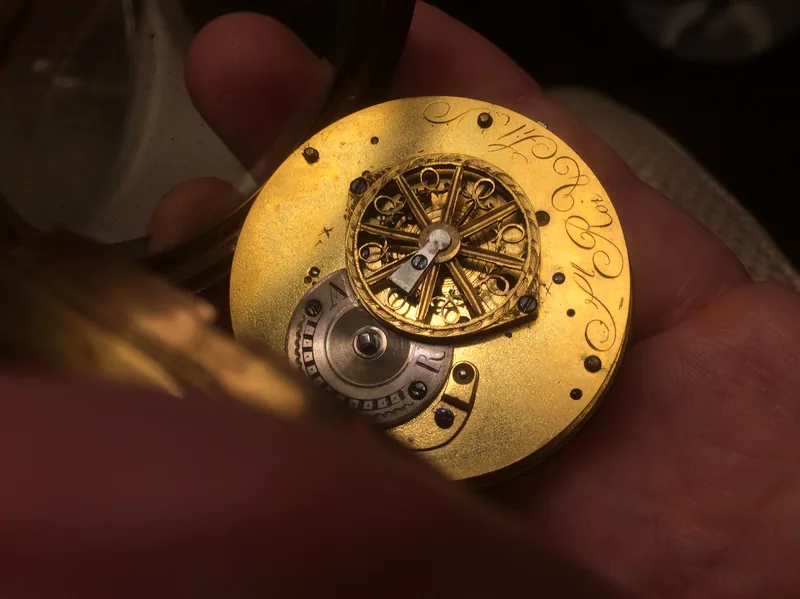
Locating and correctly interpreting the **pocket watch hallmark austrian ducat 986 gold** requires a systematic examination under high magnification (minimum 10x horological loupe). Hallmark applications on vintage cases were strictly regulated in terms of placement. The official punches were routinely struck into three primary zones: the inner surface of the exterior case back (outer lid), the inner surface of the cuvette (the inner dust cover protecting the movement), and occasionally on the internal rim or outer pendant bow of the case.
The geometry and iconography of the hallmark vary depending on the era in which the watch case was inspected and stamped:
- 1867–1922 (Austro-Hungarian Imperial Era): During this period, the assay mark for 986 gold typically features a uniquely shaped frame containing specific heraldic or symbolic elements. High-purity gold was designated by specific animal head icons or imperial devices. For Ducat gold specifically, look for a small chamfered shield containing a numeric designation or the head of a fox/hound or chamois flanked by the assay office letter (e.g., "A" for Vienna) on one side and a numeric standard code on the other. In many high-purity pieces, the explicit decimal number "986" or "0.986" was struck directly alongside the primary city assay mark.
- 1925–1988 (Austrian Republic Era): The modern post-imperial mark is highly distinctive. The primary stamp features a stylized profile outline—most commonly the Head of the Austrian Maiden or a stylized state eagle symbol—surrounded by a specific geometric border shape reserved exclusively for gold fineness above 900. Adjacent to this pictorial punch, the numerical fineness stamp **986** is deeply impressed, usually in a crisp rectangular or pill-shaped cartouche.
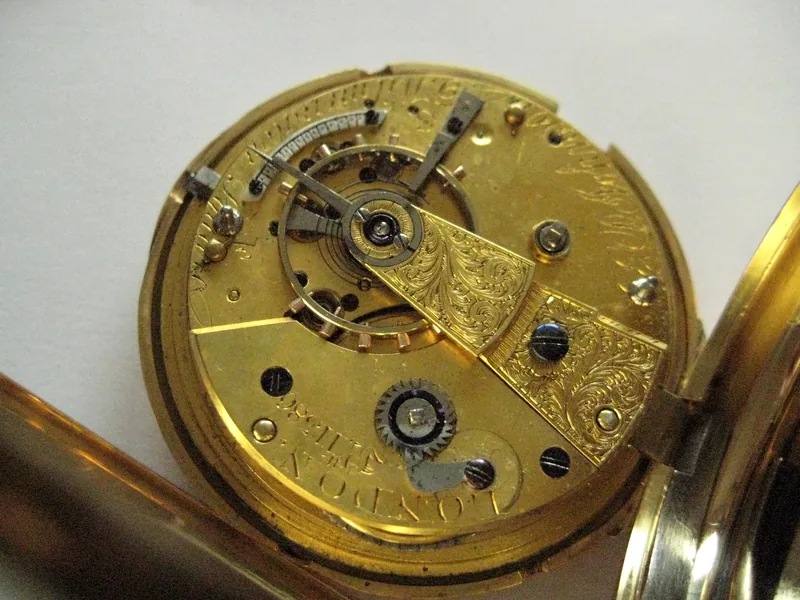
In addition to the official state assay punches, an authentic 986 gold pocket watch case will feature secondary markings. These include the registered sponsor or maker's mark (Meisterzeichen)—consisting of the initials of the goldsmith enclosed in a geometric shape—and matching case serial numbers stamped across all case components (bezel, back lid, cuvette, and rim) to confirm that no elements have been swapped.
Collectors must be vigilant regarding potential misidentifications. Standard 18K cases from Austria-Hungary bear a chamois head inside a hexagon with the number "3" (indicating 3rd standard gold), while 14K cases bear a hound's head with the number "4". A true 986 Ducat case will never bear these lower-standard numerical indicators; instead, it will clearly display the elevated standard code or explicit "986" fraction punch.
Dating and Authentication Value
Because Austrian assay laws were systematically amended over time, the physical morphology of the hallmark provides an incredibly accurate tool for dating a vintage pocket watch case. By cross-referencing the shape of the hallmark frame, the assay office city letter, and the internal movement serial numbers, specialists can narrow the production date of a timepiece down to a precise multi-year window.
For authentication, non-destructive scientific testing is essential when dealing with 986 gold horological pieces. Traditional acid testing (touchstone method) should be approached with extreme caution, as severe chemical solutions can deface the soft surface of a high-purity case. Instead, expert appraisers utilize advanced spectroscopic techniques:
X-Ray Fluorescence (XRF) Analysis: XRF analyzers shoot primary X-rays into the metal surface and measure the secondary fluorescent X-rays emitted by the elements present. An authentic 986 case will generate an elemental readout showing precisely 98.5% to 98.7% gold mass concentration, with trace levels of copper and silver, instantly distinguishing it from 18K alloys or modern gold plating.
Density & Specific Gravity Testing: Pure gold has a specific gravity of 19.32 g/cm³, while 18K yellow gold sits significantly lower at roughly 15.2 to 15.8 g/cm³. A 986 Ducat case possesses a specific gravity of approximately 19.0 to 19.1 g/cm³. Measuring the precise displacement of the bare, unencumbered case (with movement, crystal, and steel springs removed) provides absolute confirmation of the alloy's true physical density.
Counterfeits and re-struck hallmarks are occasionally encountered in the vintage market. Fraudsters sometimes take standard 18K cases and attempt to apply false "986" punches to inflate value. However, spectroscopic analysis easily catches these forged marks, as the underlying 18K alloy matrix cannot hide from XRF radiation. Authentic 986 cases also display unique micro-wear: because the metal is soft, original engine-turned *guilloché* patterns on the outer covers typically show gentle, soft-focus smoothing along high-contact edges, rather than sharp, brittle flaking seen on plated or lower-grade metal surfaces.
Collector Significance
In the hierarchy of horological collecting, finding a authentic **pocket watch hallmark austrian ducat 986 gold** represents an extraordinary acquisition. Due to the inherent material costs and the technical difficulties associated with manufacturing structurally sound watch cases from soft 23.66K gold, 986 cases were produced in exceedingly limited quantities. They were virtually never used for mass-market commercial timepieces. Instead, these hyper-pure cases were commissioned for special purposes: imperial presentation gifts from the House of Habsburg-Lorraine, high-precision observatory marine chronometers, bespoke commissions for European high nobility, or grand complications showcased at Universal World Expositions (such as the Vienna World Exhibition of 1873).
From a valuation perspective, a 986 Ducat gold case acts as a significant value multiplier over equivalent 18K models. At premier international auction houses such as Christie's, Sotheby's, and Antiquorum, pocket watches verified with Austrian 986 hallmarks routinely command premiums of 50% to over 200% compared to identical movements housed in standard 18K gold cases. The value lies not merely in the intrinsic bullion weight—though 986 gold obviously carries higher spot value—but in the supreme rarity, historical exclusivity, and superior craftsmanship required to produce high-purity horological armor.
To preserve the value and structural integrity of a 986 gold pocket watch, collectors must observe strict handling guidelines. Due to the softness of 23.66K gold, these cases should never be subjected to harsh mechanical buffing or aggressive polishing wheels, which can rapidly erase delicate hallmark punches and hand-engraved motifs. Cases should be handled with clean cotton gloves, stored in climate-controlled environments away from friction with harder metals, and opened using specialized brass or bone case-opening tools to prevent gouging the soft snap-lip joints.
Ultimately, the Austrian Ducat hallmark is a masterpiece of metallurgical and legal history. It stands as a bridge connecting the monetary legacy of the Habsburg Empire with the golden age of mechanical horology. For the discerning collector, identifying the small, historic punch of "986" inside an antique pocket watch case is the ultimate confirmation of owning a rare piece of horological royalty.