What is the Chester Acorn & Sheaves Hallmark?
In horological taxonomy and metallurgical history, few markings carry as much regional character and precise legal history as the assay marks applied by the Chester Assay Office. When examining an antique or vintage silver watch case, encountering the distinct iconography associated with Chester—specifically the transition between the domestic coat of arms (featuring three garbs or wheat sheaves surrounding a sword) and the dedicated foreign import mark (an acorn flanked by oak leaves)—provides an immediate window into the case's provenance, age, and purity.
The phrase pocket watch silver hallmark chester acorn & sheaves .925 / .935 import encapsulates a specific intersection of British hallmarking legislation and international watchmaking trade from the late Victorian period through the mid-20th century. Prior to the early 20th century, watch movements manufactured in Swiss horological hubs such as La Chaux-de-Fonds, Le Locle, and Geneva were frequently exported as cased or uncased units into the United Kingdom. To comply with strict British assay laws designed to protect domestic consumers from debased bullion, these cases were submitted to British assay offices, among which Chester was uniquely prominent.
To distinguish native British craft from foreign manufacture, British hallmarking law underwent pivotal revisions between 1904 and 1907. For silver, Chester's traditional domestic town mark—the city arms displaying three wheat sheaves and a sword—was strictly reserved for items melted and wrought within the United Kingdom. Imported silver cases, conversely, were stamped with a dedicated import town mark: a single acorn with two oak leaves. Collectors and horological researchers frequently conflate or group these symbols under the collector term "Acorn & Sheaves" when describing Chester-assayed foreign silver watch cases of .925 or .935 purity grades.
Understanding these punch marks requires analyzing the distinct components present within the hallmark cluster. A standard Chester import hallmark sequence on a silver pocket watch or early wristlet case consists of four distinct strikes: the sponsor's mark (representing the importer or casemaker), the decimal fineness mark (.925 or .935), the Chester import town mark (the acorn), and the annual date letter. Together, these marks form an indelible physical record of the watch's journey through British customs and assay controls.
 rolex-database-hallmarks-chester-acorn-&-sheaves-1-3dcaac0a.webp" alt="pocket watch — Clockwork of the Holy Cross Church in Dülmen, North Rhine-Westphalia, GermanyThe" style="max-width:100%; height:auto; display:block; margin:15px auto;">
Historical Origins and Assay Office
The Chester Assay Office possessed a rich history dating back to the Middle Ages, receiving formal statutory authorization under an Act of Parliament in 1700 during the reign of King William III. Located in the historic walled city of Chester in Cheshire, the office operated continuously until its eventual closure in August 1962. While larger industrial centers like Birmingham and London handled the vast majority of domestic silver hollowware and flatware, Chester carved out a highly specialized niche in the late 19th and early 20th centuries by processing a massive volume of watch cases.
The influx of continental watch movements into Great Britain during the late Industrial Era created severe legal and economic friction. British casemakers argued that foreign manufacturers were flooding the market with sub-standard alloys housed in cases that masqueraded as native sterling silver. In response, the British Parliament enacted the Revenue Act of 1883, followed by the groundbreaking Foreign Plate Act of 1904 and the Hallmarking of Imported Watch Cases Act of 1907. These statutes mandated that all foreign-made gold and silver watch cases imported into the United Kingdom must be tested for purity at a recognized British assay office before being offered for sale.
Between 1887 and 1906, imported silver cases were briefly marked with an elongated letter 'F' in an oval shield alongside traditional British hallmarks. However, this system proved confusing to consumers and was quickly replaced under the 1906 Order in Council, which took full effect on June 1, 1907. Under this landmark legislation, each of the active British assay offices was assigned a completely distinct set of import town marks, explicitly separate from their historical domestic symbols:
- London: The Sign of Cancer (constellation symbol) for imports, replacing the Leopard's Head.
- Birmingham: An Equilateral Triangle for imports, replacing the Anchor.
- Chester: An Acorn with two oak leaves for silver imports (and a Phoenician Galley/Caravel for gold imports), replacing the City Arms (Garbs/Sheaves and Sword).
- Edinburgh: A St. Andrew's Cross for imports, replacing the Castle.
- Glasgow: A Bishop's Mitre for imports, replacing the Tree, Fish, Ring, and Bell.
The Chester Assay Office, known for its swift turnarounds and willingness to accommodate specialized trade submitters, became a favored destination for major importers of Swiss timepieces. Prominent firms such as Stockwell & Co. (George Stockwell), Dimier Frères, Arthur George Rendell, and Sylvain Dreyfuss routed hundreds of thousands of Swiss pocket watch and early trench watch cases through Chester. Consequently, the Chester acorn became synonymous with high-grade Swiss movements cased for the lucrative British and Commonwealth markets.
Metal Purity and Standards
When inspecting an imported pocket watch silver case processed through Chester, the purity markings typically diverge from traditional British domestic silver. Native British sterling silver has historically been defined as 92.5% pure silver alloyed with 7.5% copper (or other base metals), signified on domestic items by the iconic Lion Passant punch. For imported silver watch cases, however, the Lion Passant was explicitly prohibited to prevent consumer confusion regarding the item's origin.
Instead, assay offices applied numerical decimal fineness marks directly onto the metal. In the context of foreign pocket watch cases, two numerical standards dominate the historical record: .925 and .935.
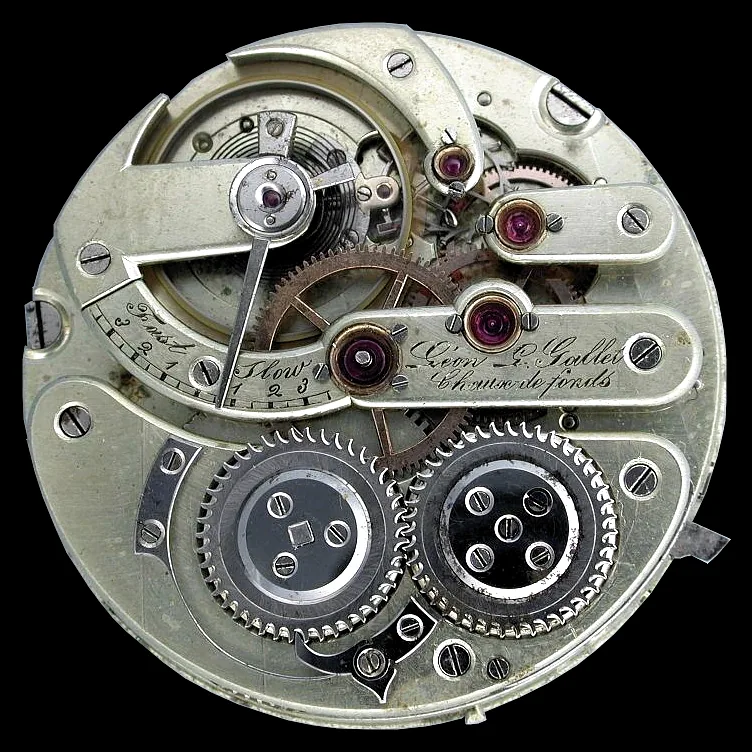
The existence of the .935 grade is particularly significant in Swiss-British horological history. Under the Swiss Stamping Act of 1880, Switzerland established official national silver hallmarks, including the Three Bears system for silver grades of .800, .875, and .935. Continental casemakers frequently manufactured export-grade cases at .935 fineness—slightly exceeding the British sterling standard of .925 (925/1000)—to ensure that even with minor metallurgical variances during the melting and alloying process, every case submitted to foreign assay offices would comfortably pass fire assay testing without risk of rejection and destruction.
When these .935 Swiss cases arrived at the Chester Assay Office after 1907, they underwent rigorous chemical testing. The assaying procedure involved scraping a minute sample of silver from the interior of the case wall or bezel rim. This scrap was subjected to cupellation—a thermal assay process that separates precious metals from base impurities. If the metal met or exceeded the official British sterling requirement (92.5%), the office stamped it with the appropriate numerical decimal mark:
| Marking | Purity Percentage | Historical Context & Application |
|---|---|---|
| .925 | 92.5% Silver | Standard British Sterling equivalent. Stamped on imported cases meeting the precise statutory minimum for UK sterling classification post-1907. |
| .935 | 93.5% Silver | Higher continental export standard. Commonly found on Swiss cases (e.g., Borgel, Tavannes, Longines, Omega) imported into the UK between 1888 and the 1920s. Assayed at Chester as exceeding .925. |
It is important for collectors to note that the decimal mark was struck inside an oval or rectangular cartouche alongside the Chester Acorn import mark. Unlike domestic silver, which used the Lion Passant to guarantee purity, the presence of the decimal figures ".925" or ".935" directly stamped adjacent to the acorn served as the legal certification of precious metal content under the Foreign Plate Acts.
How to Identify on Vintage Watch Cases
Proper identification of a **pocket watch silver hallmark chester acorn & sheaves .925 / .935 import** mark requires a systematic approach using appropriate optical magnification—ideally a 10x or 15x achromatic jeweler's loupe under directional LED illumination. Hallmarks on vintage pocket watch cases are small, often measuring less than 1.5 millimeters in height, and may exhibit surface wear or pocket friction from decades of handling.
To conduct a complete diagnostic identification, open the pocket watch back cover (and dust cover/cuvette, if present) and examine the inner leaf of the case back. A complete, legally compliant Chester import hallmark set from the 1907–1962 era consists of four distinct punch marks arranged in a horizontal line or clustered pattern:
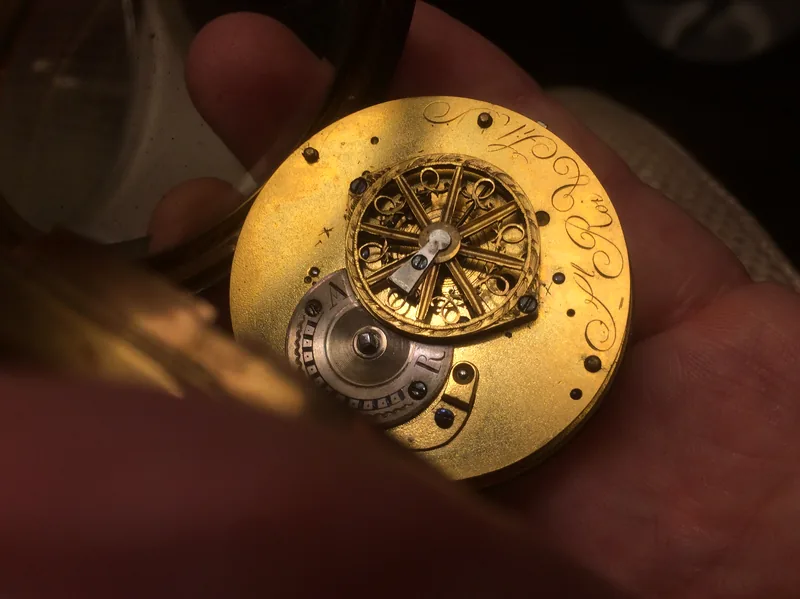
- The Sponsor's Mark: Comprising two or three initials enclosed within a geometric shield (e.g., "GS" for George Stockwell / Stockwell & Co., "AGR" for Arthur George Rendell, "DF" for Dimier Frères). This mark identifies the legally registered agent or importer responsible for submitting the case to the Chester Assay Office.
- The Decimal Fineness Mark: Explicit numerical figures stating either "925", ".925", or ".935", indicating the precise millesimal fineness of the silver alloy.
- The Chester Import Town Mark: The hallmark symbol depicting a stylized acorn attached to a small stem with two oak leaves. On heavily worn cases, this mark can sometimes be mistaken for a leaf cluster, a shield, or an altered heraldic emblem, but closer inspection under magnification reveals the central rounded nut of the acorn topped by its cap and flanked by leaves.
- The Date Letter: A single alphabetical character enclosed in a specific shield outline. The typeface (Gothic, Roman, Italic, or Block), case (uppercase or lowercase), and shield geometry uniquely identify the exact assay year.
In addition to the main inner case back, secondary components of the pocket watch case—such as the inner bezel rim, the neck of the pendant, the bow, and the cuvette—were often struck with secondary or partial marks. The Chester Acorn and decimal purity marks were frequently stamped on these smaller components to prevent the unauthorized substitution of non-precious silver-plated parts into a certified solid silver case assembly.
When distinguishing between genuine hand-punched hallmarks and forged or cast marks, inspect the perimeter of the impression. Authentic Chester hallmarks show clean, sharp displacement of metal around the margins of the punch (known as a displacement crown or halo), caused by the mechanical impact of the steel punch striking the cold silver. Cast reproductions, by contrast, exhibit soft, rounded edges, loss of fine detail within the acorn leaves, and micro-porosity visible under magnification.
Dating and Authentication Value
The inclusion of the Chester Assay Office date letter system allows collectors and horological historians to pinpoint the exact year a watch case was assayed with remarkable precision. Chester utilized distinct 26-year alphabetical cycles, altering the font style, letter case, and shield outline with each cycle. For imported silver pocket watches, the vast majority of relevant marks fall within three primary Chester date letter cycles:
- Cycle 1901–1925: Utilized lowercase script/italic letters from 'a' through 'z' inside a distinct shield with a flat top and pointed base. For example, lowercase 'g' represents 1906/1907, while lowercase 'r' corresponds to 1917 (the height of First World War trench and pocket watch production).
- Cycle 1926–1951: Utilized uppercase block/Roman letters from 'A' through 'Z'.
- Cycle 1952–1962: Utilized lowercase block letters from 'a' through 'k' until the abrupt closure of the office in August 1962.
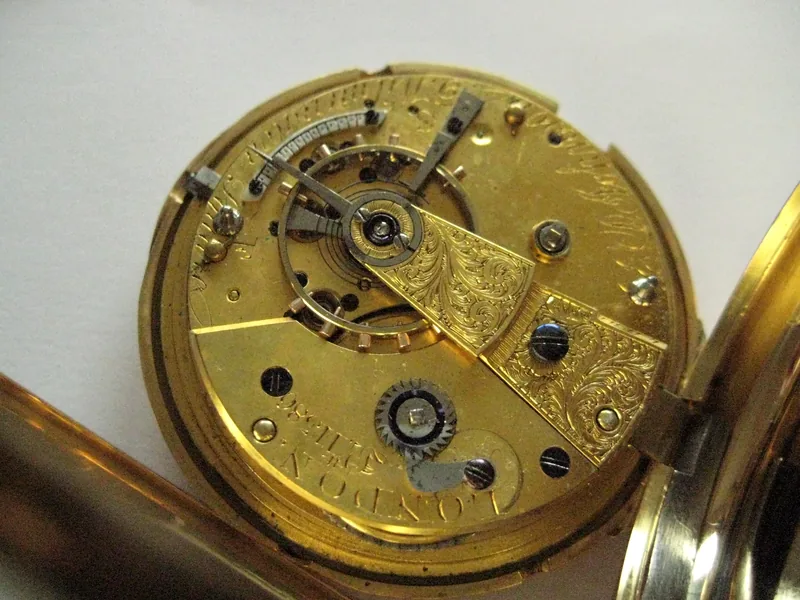
Dating the case via the Chester hallmark provides an invaluable baseline for authenticating the entire timepiece. Because watch movements and watch cases were manufactured separately and joined during final assembly or importation, the assay date code represents the exact time frame during which the watch was prepared for retail distribution in the British market.
Horological scholars routinely cross-reference the Chester case date letter with the serial number stamped on the mechanical movement (for manufacturers with established production ledgers, such as Longines, Omega, IWC, Tavannes, or Waltham). A movement serial number corresponding to 1915 housed inside a Chester acorn-marked case dated 'u' (1920) indicates that the movement remained un-cased in factory inventory for five years before being cased, exported, and assayed—a common occurrence during and immediately following the First World War.
Conversely, a severe chronological discrepancy—such as a 19th-century key-wind movement housed inside a Chester acorn-marked case dated 'K' (1935)—strongly suggests a later re-casing or a married assembly. Thus, the presence of an authentic Chester import hallmark serves as a critical forensic tool for detecting altered, assembled, or non-original watches.
Collector Significance
Among vintage watch enthusiasts, military horology collectors, and silver scholars, pocket watch cases bearing the Chester Acorn import hallmark hold exceptional historical and commercial significance. The period during which Chester processed imported watch cases at scale (1907–1930s) coincided directly with dramatic shifts in timekeeping technology, most notably the transition from traditional pocket watches to wristwatches during the First World War.
During the Great War (1914–1918), British military officers routinely purchased silver pocket watches and early wrist-watches (trench watches) private-treaty from high-end jewelers in London, Manchester, and Edinburgh. A vast percentage of these wartime military-grade timepieces—featuring robust Swiss lever movements, radium-lumed porcelain dials, and dust-proof cases such as those patented by François Borgel—were routed through Chester for assaying. The Chester Acorn, accompanied by the **.925 or .935** decimal stamp and wartime date letters ('r' for 1917, 's' for 1918), offers direct tangible evidence of timepieces active during this pivotal historical era.
Furthermore, the Chester Assay Office's permanent closure in 1962 introduced an absolute historical boundary on its hallmarks. Unlike the London or Birmingham assay offices, which continue to operate today, Chester's hallmark record is complete, finite, and unrepeatable. This relative scarcity enhances the desirability of Chester-marked cases compared to their more common Birmingham or London counterparts.
In terms of valuation, a pocket watch housed in a solid silver case bearing the Chester acorn import mark commands a premium over unmarked, nickel-silver, or silver-plated equivalents. It assures the buyer of two critical factors: uncompromised precious metal purity verified by an independent authority, and a legally documented chronological origin. Whether evaluating a heavy hunter-case pocket watch or a delicate open-face dress watch, mastering the identification of the Chester Acorn and its associated fineness marks remains an essential skill for the discerning horological collector.