What is the Wilsdorf & Davis Hallmark?
Before the iconic coronet and the name "Rolex" became universally recognized hallmarks of luxury horology, the enterprise operated under the moniker of its founders: Hans Wilsdorf and Alfred Davis. Established in London in 1905, Wilsdorf & Davis was not initially a integrated manufacture, but rather a specialized importing and casing firm. Understanding the wilsdorf and davis hallmarks rolex collectors encounter today requires looking at the regulatory and legal framework governing precious metal objects in early twentieth-century Great Britain and Switzerland.
A hallmark stamped inside a vintage watch case from this era is not merely a brand signature; it is a legally binding guarantee of precious metal purity verified by an independent assay office. The primary sponsor's mark registered by the firm was the letters "W&D", housed within a distinct oval or rectangular shield with clipped corners. When a watch case bears this stamp, it indicates that Wilsdorf & Davis acted as the legal entity responsible for presenting the precious metal case to a British Assay Office—such as London or Glasgow—for testing and stamping before retail distribution.
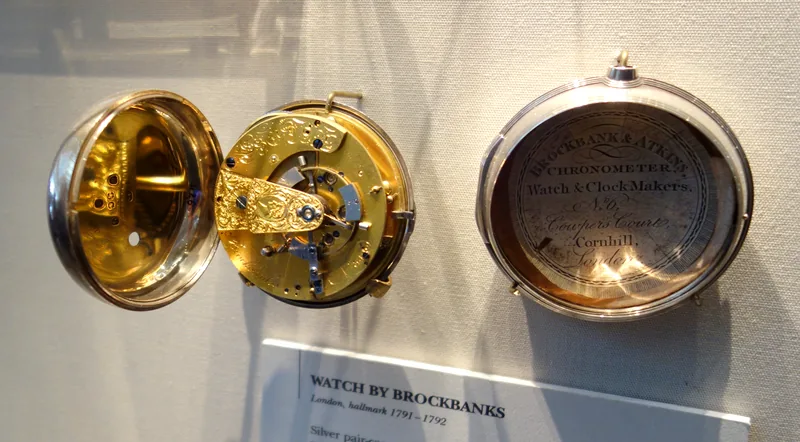
These early stamps provide a clear paper trail of Rolex’s embryonic years. Stamped on the inner casebacks of silver and gold wristlets, early pocket watch conversions, and pristine original WW1 trench watches, the W&D mark represents the crucial bridge between early Swiss ebauche manufacturing in Bienne and the British luxury market that fueled Hans Wilsdorf's initial success.
Historical Origins and Assay Office
To fully comprehend the migration of Wilsdorf & Davis marks across historical archives, one must analyze the legislative shifts in British metallurgical law between 1900 and 1920. In the early 1900s, Wilsdorf partnered with Jean Aegler of Bienne (Biel), Switzerland, to source high-grade lever escapement movements small enough to be worn on the wrist. These movements were paired with precious metal cases produced either in Switzerland or by specialized English casers such as the Dennison Watch Case Company.
Prior to 1906, foreign-made precious metal watch cases imported into the United Kingdom often received standard British domestic hallmarks, which created confusion regarding the true origin of the casing. To rectify this, the British Parliament enacted statutory revisions under the Customs Act 1842 and the Finance Act 1907, mandating distinct import hallmarks for foreign-manufactured gold and silver plate tested at British assay offices.
The London Assay Office (Goldsmiths' Hall)
In London, where Wilsdorf & Davis maintained their primary office at 83 Hatton Garden, cases submitted for assaying after June 1907 no longer received the traditional domestic Leopard’s Head. Instead, the London Assay Office applied the newly instituted Import Mark: the astrological sign of Capricorn (♑) for silver and gold, accompanied by the decimal representation of purity, the official year-letter, and the sponsor's W&D punch mark. Finding a Capricorn import mark alongside the W&D stamp definitively dates the casing process to the post-1907 London operational period.
The Glasgow Assay Office
A significant volume of Wilsdorf & Davis cases passed through the Glasgow Assay Office in Scotland. Glasgow became a favored location for Wilsdorf due to its efficient processing times and competitive assaying fees. The Glasgow import mark for foreign silver and gold differed dramatically from London, utilizing a double-pointed arrow / crossed compass-like symbol (often described as two opposed equilateral triangles or an 'F' mark for foreign plate depending on the specific year). Cases marked in Glasgow showcase the distinct Scottish town mark alongside the W&D sponsor punch, offering absolute proof of importation route through northern distribution nodes.
Bienne (Biel) Swiss Records and Official Poinçons
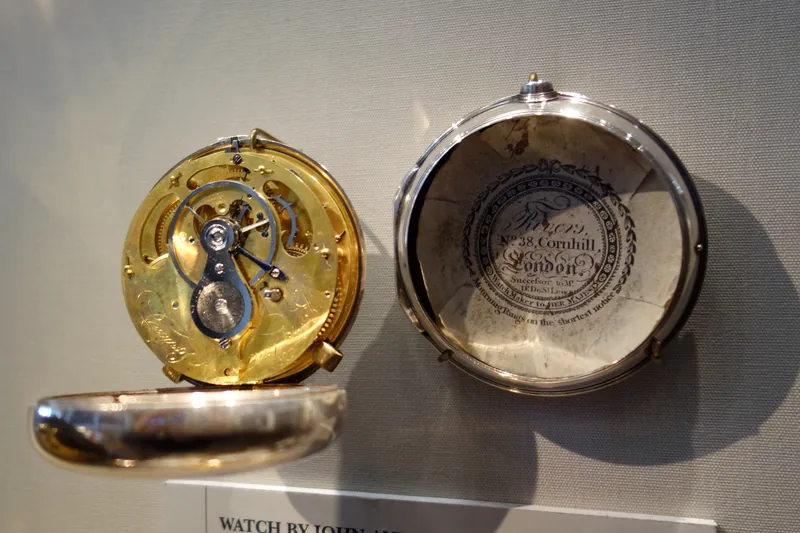
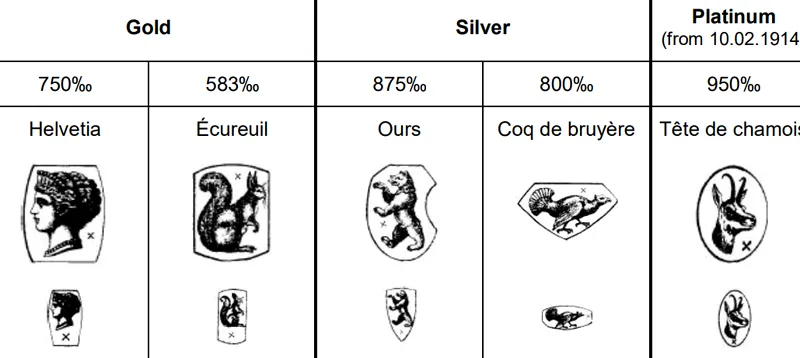
While the cases were stamped in Great Britain for retail, the movements and many raw cases originated in Bienne, Switzerland. Under the Swiss Federal Act on the Control and Guarantee of the Trade in Gold and Silver Articles of 1880, Swiss workshops placed official federal punches (poinçons) on export cases prior to shipment:
- Bear (*Ours*) Punch: Indicating 0.875 or 0.935 fine silver.
- Grouse (*Coq de Bruyère*) Punch: Indicating 0.375 (9-carat) gold.
- Squirrel Punch: Indicating 0.585 (14-carat) gold.
- Helvetia Bust Punch: Indicating 0.750 (18-carat) gold.
Consequently, high-grade museum-quality specimens frequently display dual-hallmarking: native Swiss federal poinçons struck at Bienne alongside British import hallmarks applied upon arrival at London or Glasgow.
Metal Purity and Standards
Wilsdorf & Davis maintained exacting metallurgical standards to establish a reputation for quality. During the Edwardian era, sterling silver and high-karat gold were the preferred metals for luxury timepieces. However, subtle variations in silver fineness were employed to meet technical and regional requirements.
In silver manufacturing, while the British standard for Sterling Silver was fixed at 0.925 (92.5% pure silver), Wilsdorf heavily favored 0.935 Fine Silver for Swiss-cased imports. This slightly higher purity offered superior tarnish resistance and malleable workability when crafting hinged casebacks, dust covers (cuvettes), and wire lugs. For gold timepieces, Wilsdorf & Davis supplied 9ct (0.375), 14ct (0.585), and 18ct (0.750) cases to accommodate varying economic segments of the British Empire.
The following technical archival specifications detail the official standards found on authenticated Wilsdorf & Davis watch cases between 1905 and 1920:
| Feature / Specification | Historical Archival Standard | Collector Verification Note |
|---|---|---|
| Sponsor's Mark | "W&D" in oval or clipped rectangular frame | Must be crisp; identifies Wilsdorf & Davis as legal importer. |
| London Import Mark (Post-1907) | Sign of Capricorn (♑) | Replaced Leopard's Head for foreign imports at Goldsmiths' Hall. |
| Glasgow Import Mark (Post-1907) | Double-headed arrow / criss-crossed mark | Used extensively on imported silver trench watch cases. |
| Silver Fineness Standard | 0.925 (Sterling) or 0.935 (Fine Silver) | 0.935 is strongly associated with early Aegler/Bienne exports. |
| Gold Karat Standards | 9ct (.375), 14ct (.585), 18ct (.750) | Stamped with decimal fractions and corresponding Swiss/UK marks. |
| Date Lettering System | Cyclical font characters in specific shield shapes | Allows exact single-year dating via London or Glasgow tables. |
How to Identify on Vintage Watch Cases
Inspecting a potential vintage timepiece for authentic wilsdorf and davis hallmarks rolex marks requires systematically analyzing the inner caseback and inner cuvette. Because early wristwatches featured double-hinged or snap-back construction, internal marks were protected from environmental wear and wrist friction, leaving them sharp and legible under a 10x horological loupe.
To perform a thorough horological inspection, examine the inner caseback structure for the following elements:
- The Sponsor Punch: Locate the "W&D" initials. The typography typically features serifed capital letters with an ampersand. Beware of modern laser-engraved signatures or punches that lack the slight perimeter metal displacement characteristic of historical mechanical strike punches.
- Purity Numerals: Search for explicit decimal stamps such as ".935", ".925", or "18K / .750". On English-made cases commissioned by W&D (such as those by Dennison), standard British imperial crown stamps may accompany the purity values.
- Assay Town Symbol: Identify whether the case was cleared in London (Capricorn) or Glasgow (Import Arrow/F mark). The presence of a pre-1906 domestic mark (like the London Leopard's Head or Birmingham Anchor) on a foreign-made case indicates an early import prior to strict enforcement of the Finance Act of 1907.
- The Date Letter: Observe the specific alphabetical letter. Each Assay Office used a distinct font family (Gothic, Roman, Italic) enclosed inside a unique shield silhouette that changed annually.
- Serial Matching: Cross-reference case serial numbers stamped below the hallmarks with known production ranges from Bienne archives. The serial digits should display consistent depth and spacing.
Many pieces from this transition period display early brand references. You may encounter a case stamped "W&D" while the dial or movement bridges are signed "ROLEX" or feature the early Rebberg movement markings. Peruse our vintage Rolex wristwatch collection to see structural examples of these historic transitional references.
Dating and Authentication Value
For the archival scholar and vintage watch buyer, hallmarks serve as an immutable chronological anchor. Unlike dials, which can be restored, or hands, which are frequently replaced during routine service, the struck metal inside a solid silver or gold caseback retains its physical integrity for over a century.
Because British assay offices updated their date letter codes annually on a specific day of the year (typically May or June when new wardens were elected), a clear hallmark allows an archivist to pinpoint the precise year a case was assayed. For instance, a London import mark featuring the italicized lower-case letter "a" inside a specific rounded shield corresponds to the 1916–1917 assay year. This level of accuracy is invaluable when verifying whether an early Aegler Rebberg caliber corresponds directly with its housing.
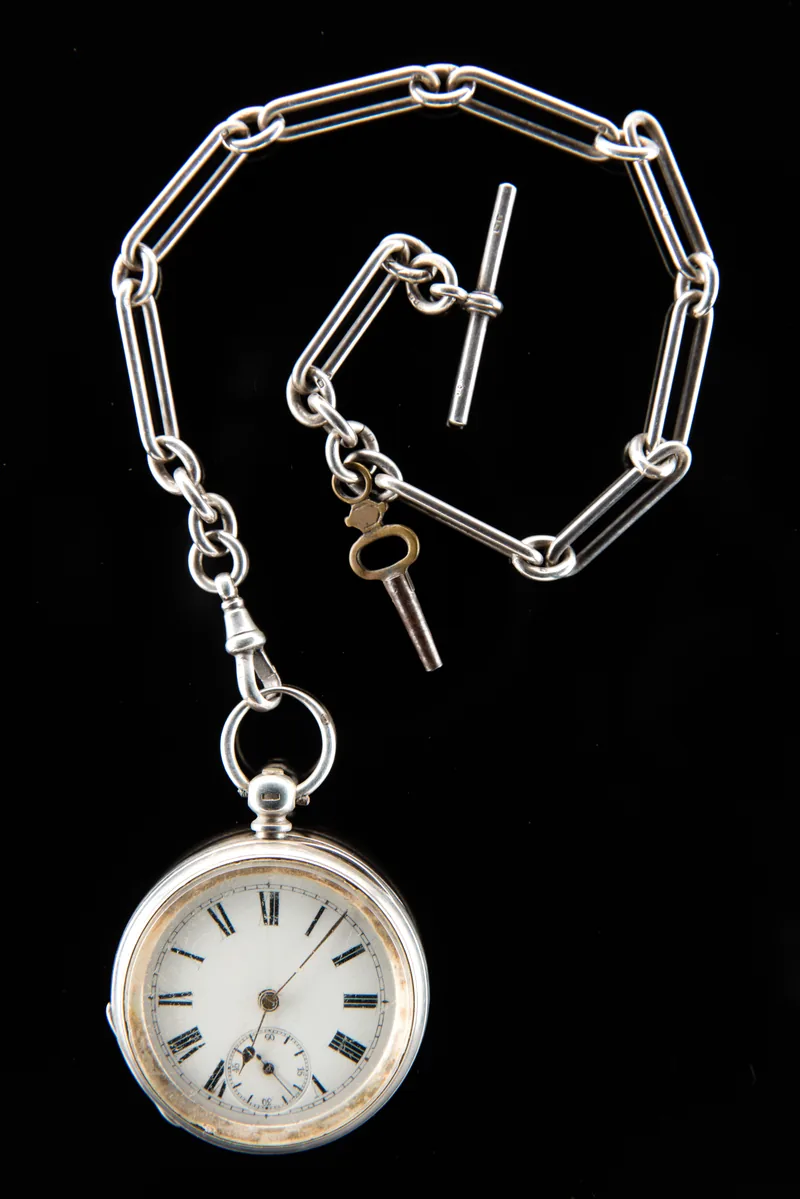
When authenticating historical pieces, horologists often guard against "marriage watches"—cases paired with non-original movements—or outright forgeries. Key verification rules include:
- Movement-Case Cohesion: A W&D case stamped with a 1912 date letter must house a movement featuring early Aegler/Rebberg architecture appropriate for 1912, rather than a later 1920s Hunter caliber.
- Punch Depth and Wear Uniformity: Natural micro-patination should be consistent across all stamped elements. If the W&D punch appears crisp while surrounding metal exhibits heavy pitting, the mark may have been added post-hoc.
- Cuvette Alignment: On officer and trench watch cases, serial numbers stamped on the outer edge of the inner dust lid should match the primary caseback serial digits precisely.
Collector Significance
The collector significance of Wilsdorf & Davis hallmarked timepieces stems from their rarity and foundational historical importance. In 1908, Hans Wilsdorf registered the trademark name "ROLEX" in La Chaux-de-Fonds, Switzerland, opening an official office there before consolidating operations in Geneva in 1919. However, the firm continued using the trusted "W&D" sponsor stamp on imported British cases alongside the Rolex name well into the late 1910s and early 1920s.
Consequently, timepieces bearing the W&D mark represent the genesis of the brand—a period when Hans Wilsdorf was proving the viability of the wristwatch to a skeptical global market dominated by pocket watches. These artifacts demonstrate the entrepreneurial ingenuity of Wilsdorf & Davis in navigating international trade laws, British hallmarking mandates, and Swiss manufacturing standards.
Today, museum curators and serious collectors view W&D hallmarked wristwatches not merely as antique timekeepers, but as crucial historical primary sources. They mark the birth of modern wrist-worn horology and command substantial premiums at international auctions when preserved in original, unrestored condition. Explore our selection of carefully preserved and restored vintage timepieces and conversions to appreciate the craftsmanship of this historic era.
Frequently Asked Questions
What does W&D mean on a vintage watch case?
The "W&D" stamp stands for Wilsdorf & Davis, the founding company established by Hans Wilsdorf and Alfred Davis in London in 1905, which later evolved into Rolex. It serves as the official British sponsor's mark indicating that Wilsdorf & Davis imported and presented the precious metal case to a British assay office for purity testing.
How can I date a Wilsdorf & Davis watch using its hallmarks?
You can date a W&D watch to a single year by analyzing the assay office date letter stamped inside the caseback. Cross-reference the specific letter shape, font style, and enclosing shield outline with official hallmark tables from the London (Goldsmiths' Hall) or Glasgow Assay Offices for the period between 1905 and 1920.
Why do some W&D cases have both Swiss and British hallmarks?
Dual hallmarking occurred because watch cases manufactured in Bienne, Switzerland were legally required to pass Swiss federal purity testing (receiving marks like the Bear for silver or Grouse for 9ct gold) before export. Upon importation into Great Britain, British law required the cases to be tested again and struck with official British import hallmarks (such as the Capricorn for London or Arrow for Glasgow) before retail sale.